
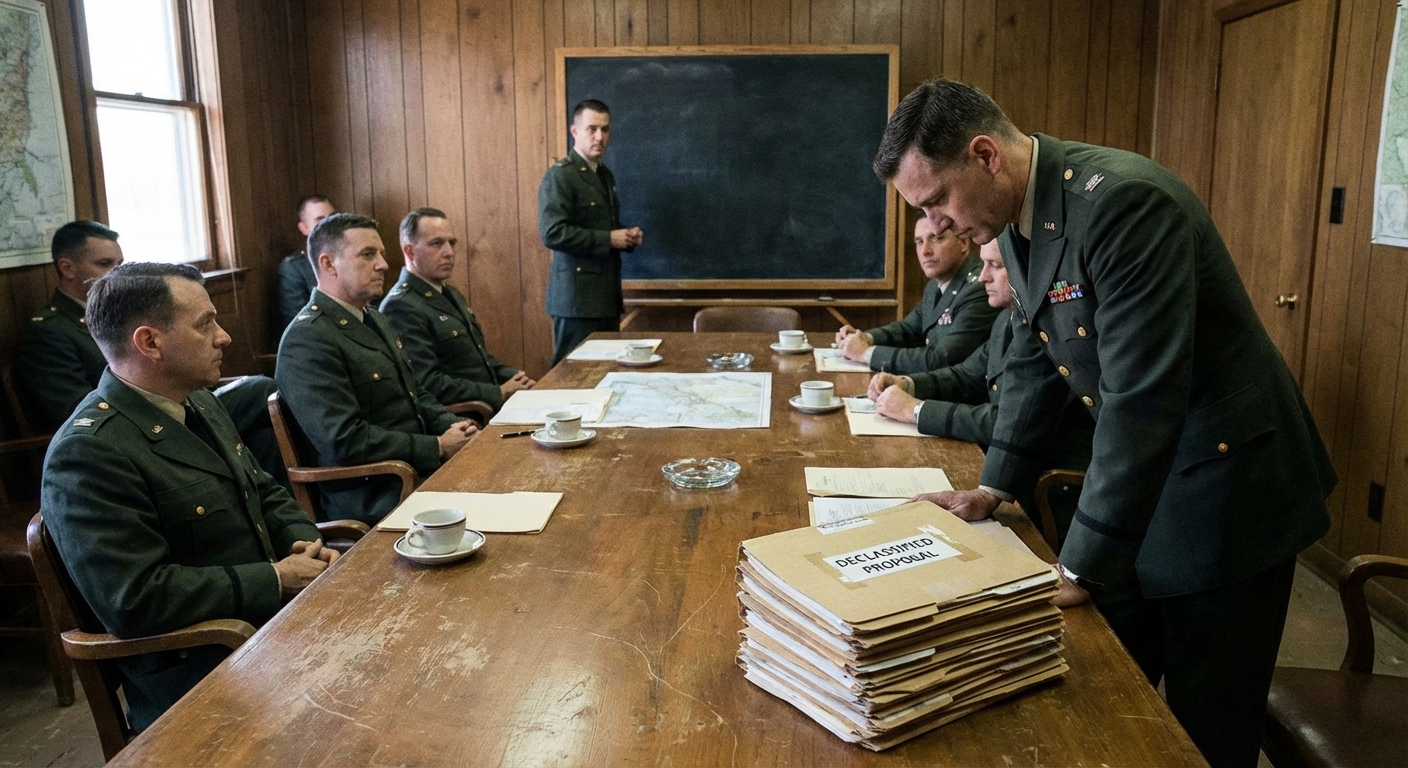
This verdict examines the claim known as Operation Northwoods (Declassified Proposal): that senior U.S. military planners drafted and approved plans to stage or fabricate hostile incidents against U.S. targets and attribute them to Cuba as pretexts for invasion. The article treats the subject as a claim and focuses on what the declassified documents show, where the record is strong, and where evidence is missing or disputed.
Operation Northwoods (Declassified Proposal): scope of the claim
In summary, the claim says that in early 1962 the Joint Chiefs of Staff prepared a top‑secret set of draft memoranda — collectively known in public as “Operation Northwoods” — that listed contemplated deceptive or staged incidents (including fabricated attacks and incidents presented as Cuban actions) intended to generate public and international support for U.S. military intervention in Cuba. These memoranda were transmitted to civilian defense leadership and later became public after declassification. The primary source materials are preserved in government archives and curated by projects such as the National Security Archive and other document repositories.
Verdict: what we know, what we can’t prove
What is strongly documented
– A top‑secret memorandum and supporting papers created by the Office of the Joint Chiefs of Staff in early 1962 exist and have been published in declassified form. The primary document commonly cited is titled “Justification for U.S. Military Intervention in Cuba” (March 13, 1962) and is available in public archives.
– The memoranda include a menu of proposed pretexts and covert measures. The text contains explicit discussion of staged or fabricated incidents — described as possible pretexts — intended to create public support for intervention. The documents themselves use language like “pretexts” and provide concrete scenario descriptions. These elements are visible in the declassified record.
– The Joint Chiefs of Staff, and specifically Chairman Lyman Lemnitzer, are credited in the record as the authors/presenters of the proposal, and the memorandum was transmitted within the Department of Defense chain of command to Secretary of Defense Robert McNamara. That procedural history is documented in the released files.
What is plausible but unproven
– That the Joint Chiefs authorized the draft memorandum internally and that it represented items the military believed could serve as pretexts is supported by the document text; however, whether the JCS intended immediate operational execution on a specific schedule (versus presenting options for contingency planning) is less clear from the record. The papers read like a menu of possible pretexts rather than an operational execution order; the doc’s intent and operational status requires interpretation.
– Some later accounts and commentators assert that elements of the plan were discussed at high White House levels; while internal memos indicate the plan was presented to civilian leadership, the archival record does not show any signed presidential authorization to implement the proposals. The evidence supports presentation but not presidential approval.
What is contradicted or unsupported
– There is no declassified primary‑source evidence that Operation Northwoods was executed, and multiple archival summaries state the proposals were not implemented. Contemporary and retrospective documentary records do not show actions carried out under these plans. Assertions that Northwoods was put into effect are not supported by the publicly available documents.
– Claims that Operation Northwoods was directly connected to the assassination of President John F. Kennedy are not supported by the declassified Northwoods documents alone. While the documents reveal the Joint Chiefs considered extreme measures as pretexts for intervention in Cuba, researchers and archives indicate no credible, documented link in the released records tying Northwoods to the JFK assassination. Where researchers have claimed connections, those claims rely on inference rather than direct documentary proof.
Evidence score (and what it means)
- Evidence score: 85/100
- Drivers supporting a high documentation score: existence of contemporaneous, original Joint Chiefs of Staff memoranda (primary documents), multiple archived copies and public releases, and curated PDF transcriptions from trustworthy archives (National Security Archive, National Archives, and other document libraries).
- Limits on a perfect score: some passages remain redacted in related JFK collections, situational context (intent vs. contingency planning) requires interpretation, and there is limited corroborating paper trail showing follow‑up action beyond the memorandum.
- Conflicting or second‑hand claims: later narratives and popular accounts sometimes overstate approval, execution, or links to other events; those claims extend beyond the primary documents.
- Archival provenance: material was located, cataloged, and released via the Assassination Records process and independent archival projects, giving scholars access to original pages and transcriptions.
Evidence score is not probability:
The score reflects how strong the documentation is, not how likely the claim is to be true.
This article is for informational and analytical purposes and does not constitute legal, medical, investment, or purchasing advice.
Practical takeaway: how to read future claims
– Read primary documents first. The inclusion of specific, contemporaneous JCS memos in public archives is what makes the Northwoods claim documentable. Where writers cite the plan, check that they reference the memorandum or a credible archival transcription rather than a secondary summary.
– Distinguish proposal from execution. The evidentiary difference between a draft or menu of options and an approved operational order matters: the record documents proposals, not implementation. Many conspiratorial leaps collapse that distinction; treat it as the central evidentiary test.
– Watch for selective quoting and context loss. Excerpts that remove framing language (for example, removing the words that label ideas as “options” or “pretexts”) can make proposals look like operational orders. When possible, consult the full PDF or scanned pages.
FAQ
Was Operation Northwoods (Declassified Proposal) ever carried out?
No. Declassified records show the Joint Chiefs produced the draft memorandum, but the proposals were not implemented; there is no primary‑source documentation in the released files showing that the plans were executed.
Who wrote the document and to whom was it sent?
The memo originated with the Joint Chiefs of Staff and is attributed to Chairman Lyman Lemnitzer’s office; it was forwarded to Defense Secretary Robert McNamara as part of planning documents related to U.S. policy toward Cuba in 1962. The archival record documents that transmission.
Is Operation Northwoods proof the U.S. government carried out false‑flag attacks?
Operation Northwoods documents demonstrate that certain military planners proposed false‑flag scenarios as potential pretexts. However, the documents do not by themselves prove that false‑flag attacks were carried out. The archival record shows proposal, not execution.
Are parts of the Northwoods record still classified or redacted?
Some related material held in JFK collections and other records has been subject to redactions or delayed release; researchers have noted a small number of passages connected to Cuba‑policy records that remained partially withheld during earlier releases. That affects how much contextual detail is publicly available.
Why do some sources link Operation Northwoods to the JFK assassination?
Because the Northwoods documents were found among records produced during the same Cold War-era programs that intersect with other contentious episodes of the early 1960s, some writers infer links. However, inference is not the same as direct documentary evidence; the released Northwoods papers themselves do not document a tie to the assassination. Where claims attempt to connect the two, they rely on circumstantial argument rather than a documented chain of events in the declassified files.

History-focused writer: declassified documents, real scandals, and what counts as evidence.