
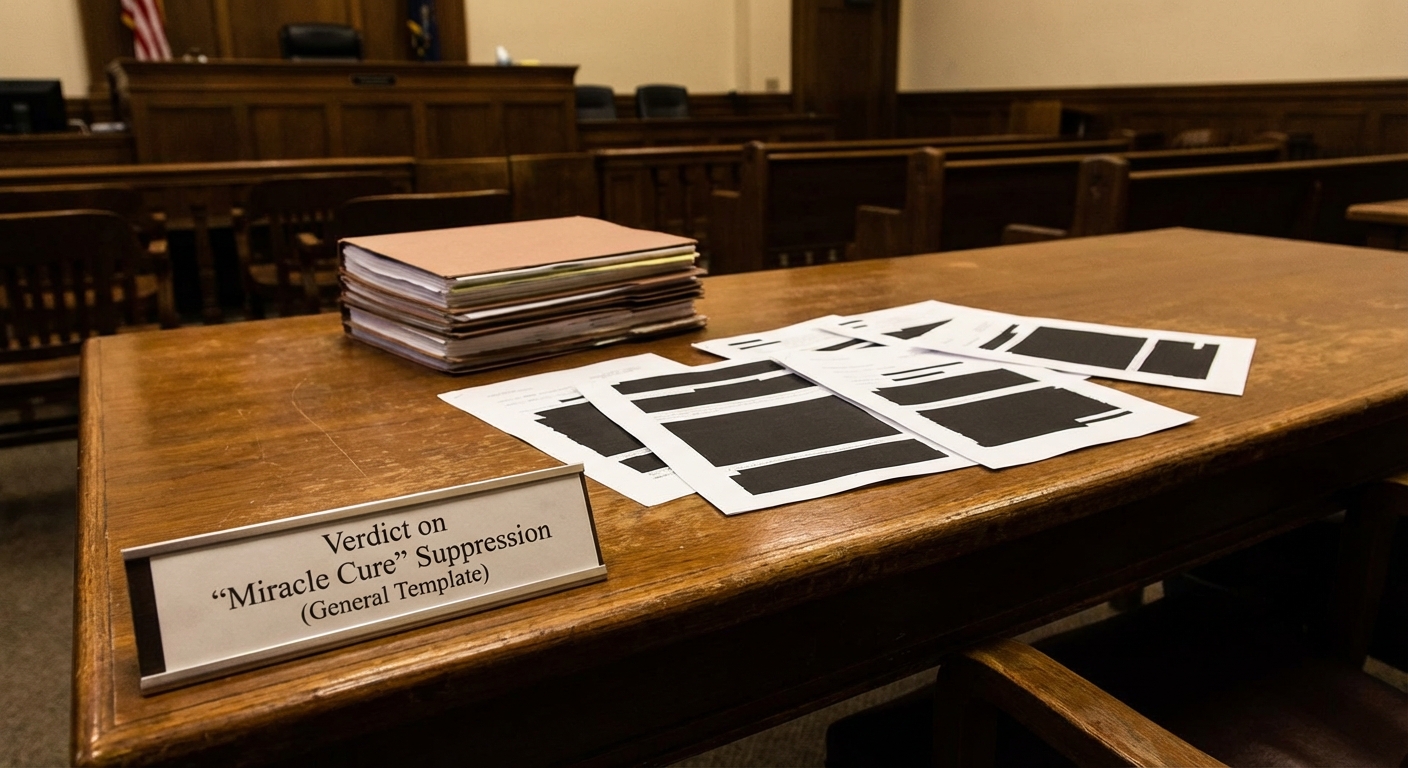
This verdict examines the claim that a so-called “miracle cure” has been suppressed. We treat the subject as a claim and review documented cases, mechanisms that can look like suppression, and the documents and studies that either support or contradict those assertions. The analysis uses official reports, peer‑reviewed reanalyses, regulatory statements, and legal records rather than rumor or speculation. Miracle Cure suppression is the phrase used through this article to refer to allegations that an effective medical treatment was deliberately hidden, blocked, or prevented from reaching patients.
Verdict: what we know, what we can’t prove
What is strongly documented
1) Selective reporting and non-publication of clinical trial data are real and well‑documented problems. Multiple large studies and government reviews have shown that many trials fail to report summary results in registries or peer‑reviewed journals, and regulators have acknowledged and begun enforcement actions to close reporting gaps.
2) There are verified legal cases where sellers marketed fraudulent “miracle” cures and were prosecuted. For example, U.S. authorities prosecuted and obtained convictions against promoters of “Miracle Mineral Solution” (a toxic industrial bleach promoted as a cure), documenting deception and harm to consumers. These prosecutions demonstrate that some purported cures are fraudulent and that law enforcement acts when evidence of harm and fraud exists.
3) Industry and publication misconduct have occurred in specific, well‑documented instances. Independent reanalysis of GlaxoSmithKline’s Study 329 (paroxetine in adolescents) concluded that the originally published paper overstated efficacy and downplayed harms; that reanalysis and associated documents are public and widely cited as an example of problematic reporting.
4) There are documented cases in which companies withheld or delayed disclosure of safety signals (for example, internal documents and litigation surrounding the COX‑2 inhibitor Vioxx), showing that concealment of data can happen and has serious consequences. The Vioxx litigation and published reporting on the VIGOR and APPROVe trials are part of the public record.
What is plausible but unproven
1) That a single, safe, effective “universal” cure for a major disease (for example, “a cure for cancer”) has been discovered and deliberately suppressed by governments or the pharmaceutical industry: this remains an unproven claim. The biological complexity of many diseases—cancer, in particular, is a group of related diseases—makes a single universal cure biologically unlikely, and there is no public, verifiable evidence that such a cure exists and is being hidden.
2) That withheld or unpublished trial results always represent a deliberate conspiracy to protect profits: non‑reporting can and does result from many factors—regulatory complexity, poor trial design, negative or inconclusive results, resource limits, or strategic business decisions (e.g., stopping development after failures). While some non‑disclosure may be morally or legally culpable, the presence of unpublished or unfavorable data does not by itself prove intentional suppression of a true cure. Research on drug development shows many late‑stage failures are explained by safety or efficacy deficiencies, not concealment.
What is contradicted or unsupported
1) Claims that regulators, academic journals, and the entire scientific community are uniformly complicit in hiding an existing cure for financial gain are contradicted by documented corrective and enforcement actions: regulators (FDA, NIH) and journals have undertaken transparency initiatives, reanalyses have been published in major journals, and law enforcement has prosecuted fraudulent sellers. These public corrective steps contradict blanket claims of universal, successful suppression.
2) Specific sensational allegations that rest only on anecdote or anonymous “insider” claims without documents or verifiable records cannot be treated as proven. Where independent documentation (trial protocols, court filings, regulatory correspondence) exists it must be cited; where it does not, the claim remains unproven. In short: absence of public evidence is not proof of a hidden cure.
Evidence score (and what it means)
- Evidence score: 42 / 100.
- The score reflects mixed documentation: clear proof exists that fraud, selective reporting, and deliberate deception have occurred in particular cases (raising legitimate concern), but there is no verified, general proof that an authentic, safe, effective “miracle cure” has been discovered and universally suppressed.
- Drivers that increase the score: documented prosecutions of fraudulent cures (DOJ/FDA cases), published reanalyses showing misreporting (Study 329), and litigation documents from unsafe drug cases that prove concealment can and has happened.
- Drivers that reduce the score: lack of verifiable primary‑source evidence that a legitimate cure exists and is being actively hidden for profit; strong alternative explanations (trial failure, biological complexity, regulatory rejection).
- Transparency progress lowers the likelihood of long‑term, large‑scale concealment but does not eliminate isolated misconduct. Regulatory initiatives and mandatory trial registries provide public records that can be checked.
Evidence score is not probability:
The score reflects how strong the documentation is, not how likely the claim is to be true.
This article is for informational and analytical purposes and does not constitute legal, medical, investment, or purchasing advice.
Practical takeaway: how to read future claims
When you encounter a claim that a “miracle cure” is being suppressed, ask for and evaluate these concrete items and corroborating signals before treating the claim as plausible:
- Primary documents: trial protocols, regulatory submissions, court filings, or internal company memos. Allegations based only on anonymous testimony or hearsay are weak without documents.
- Data availability: is the trial registered on ClinicalTrials.gov or another official registry, and are results posted? Non‑registration or missing results may indicate selective reporting, but it does not by itself prove a deliberate scheme to hide a proven cure.
- Independent reanalysis: has independent academic or regulatory reanalysis been published in a reputable journal? Reanalyses (for example, Study 329’s RIAT reanalysis in The BMJ) are high‑value evidence for assessing earlier claims.
- Regulatory actions: have health agencies warned, sanctioned, or prosecuted actors? Official enforcement or corrective labeling is strong evidence of misconduct or risk.
- Biological plausibility and replication: does the underlying science show consistent reproducible effects across independent labs and trials? If results cannot be replicated or fail in larger trials, the explanation may be scientific failure rather than suppression.
FAQ
Q: Is there a proven example of a safe, effective cure being hidden from the public?
A: No fully substantiated, general example exists showing a verified, safe, and effective “miracle cure” deliberately hidden from the global public and medical regulators. There are, however, documented instances of fraud, selective reporting, and data concealment in specific drug cases (e.g., reporting problems documented in Study 329 and litigation around Vioxx), and law enforcement has prosecuted fraudulent cure sellers. Those examples show misconduct but do not prove a broad, successful suppression of a legitimate cure.
Q: If a treatment works, wouldn’t someone profit by releasing it?
A: Often yes—an effective treatment typically has high commercial value. But there are countervailing factors: scientific uncertainty, high costs of scale‑up and regulatory approval, safety concerns discovered in later trials, and legitimate competitive or strategic business reasons to halt development. Many promising candidates fail in late‑stage trials because they lack clear efficacy or show safety problems. These documented failure modes explain many non‑adoptions without requiring a conspiratorial suppression.
Q: What role does non‑publication of trials play in suppression claims?
A: Non‑publication and selective reporting are real problems that can distort the public record and medical decision‑making. Failure to publish results or to register trials can make it harder to evaluate evidence and fuels suspicion. Governments and regulators have recognized these gaps and are taking steps to improve enforcement and transparency. But non‑publication alone is not direct proof that a true cure has been intentionally suppressed; actual suppression claims require additional documentary evidence.
Q: How should journalists and researchers verify a suppression allegation?
A: Look for primary sources (trial registrations, regulatory filings, internal documents, court records) and independent reanalysis. Contact regulatory agencies and trial sponsors for documentation of status or reasons for non‑publication. Seek corroboration from credible independent experts and prefer peer‑reviewed reanalyses where available. If sources conflict, report the conflict and avoid definitive conclusions beyond the documented facts.
Q: Could a company hide evidence and profit indefinitely?
A: Historical cases show companies or actors sometimes delayed or misrepresented data, but indefinite, large‑scale concealment is difficult to sustain because of whistleblowers, regulatory oversight, litigation discovery, independent researchers, and public registries. That said, isolated misconduct can still cause real harm, and vigilance, transparency, and stronger enforcement are necessary to reduce those risks. Examples such as Study 329 reanalysis and Vioxx litigation show both the problem and the mechanisms by which it comes to light.

Beginner-guide writer who builds the site’s toolkit: how to fact-check, spot scams, and read sources.