
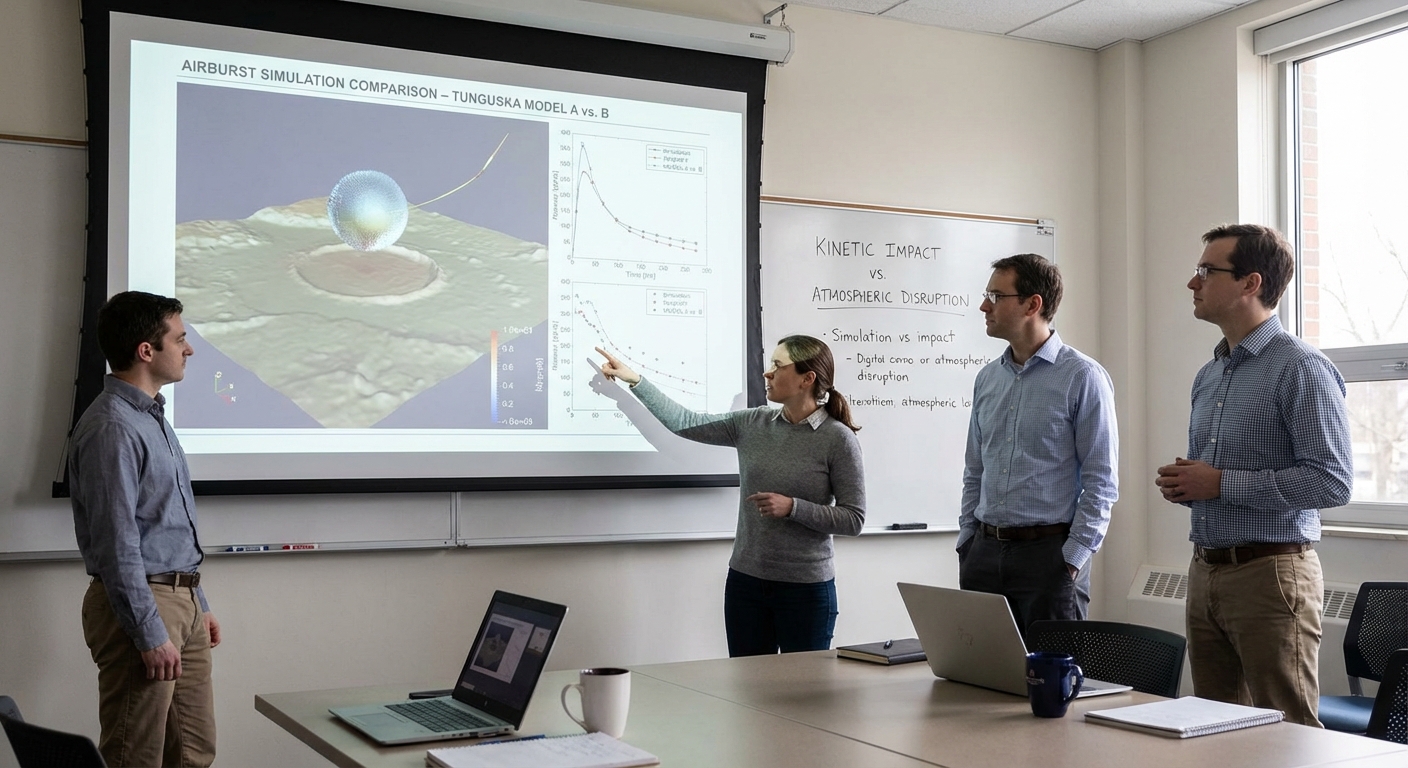
The phrase “Tunguska Event unusual explanation claims” refers to a set of theories that go beyond the mainstream scientific explanation for the June 30, 1908 explosion over central Siberia. This verdict examines the available documentation, highlights where sources agree or conflict, and separates what is strongly supported by evidence from what remains speculative or contradicted. The article treats these unusual explanations strictly as claims to be evaluated, not as established facts.
Verdict: what we know, what we can’t prove
What is strongly documented
1) A very large explosive airburst occurred above the Tunguska River basin on 30 June 1908 that flattened trees across a wide area and produced atmospheric shock waves detected far from the site. Multiple contemporary observations, later scientific surveys, and modern modeling all support a high-energy atmospheric explosion as the core event.
2) The leading scientific interpretations model the event as an atmospheric breakup of a cosmic body — commonly described as a small asteroid or a fragile cometary fragment — with estimated energies often placed in the single-digit to tens-of-megatons TNT equivalent range. Contemporary atmospheric modeling and comparisons to more recent airbursts (for example Chelyabinsk, 2013) underpin this consensus.
3) Several peer-reviewed and technical studies document physical traces in and near the epicentral region consistent with a cosmic-origin airburst: unusual peat and soil spherules, charred trees with radial fall patterns, and shocked-tree patterns recorded by early expeditions. These data do not, by themselves, uniquely identify the fragment’s exact composition but support a high-altitude energetic disruption.
What is plausible but unproven
1) Small surviving fragments: Some papers and searches propose that fragments of the Tunguska cosmic body survived to reach the ground or rivers (candidate finds in riverbeds and a debated small lake called Lake Cheko). These interpretations rely on geophysical surveys, sediment cores, or putative stone finds; they are plausible but remain disputed and inconclusive.
2) Detailed energy and composition estimates: While the airburst explanation is robust, precise values for the object’s mass, speed, material strength, and therefore exact yield remain model-dependent. Different fragmentation and atmospheric interaction models produce different energy and altitude ranges. These uncertainties are recognized across recent modeling studies.
What is contradicted or unsupported
1) Exotic-physics or non-natural-origin claims (for example, alien spacecraft crash, secret nuclear devices, mini black holes, or antimatter reactions) lack verifiable, reproducible evidence. These hypotheses are not supported by primary field data, peer-reviewed analyses, or credible physical traces that would be expected for such mechanisms. They are primarily speculative narratives or originated as cultural/historical myth-making rather than evidence-led science. Historical and cultural reviews show how such stories appeared and spread in the decades after 1908.
2) Strong claims of a found crater or a single clear impact site remain unproven. The so-called Lake Cheko impact hypothesis has been tested in multiple studies with conflicting interpretations; no broadly accepted impact crater consistent with an intact large fragment has been confirmed. The lake hypothesis and similar single-crater claims remain contested in the literature.
Evidence score (and what it means)
Evidence score is not probability:
The score reflects how strong the documentation is, not how likely the claim is to be true.
- Evidence score (0–100): 20
- Score drivers: the central event (an energetic atmospheric explosion) is strongly documented by field reports and modern modeling; that documentation does not support most unusual-origin claims.
- Many unusual explanations rely on anecdotal or secondary sources, retrospective storytelling, or interpretations of ambiguous samples (e.g., putative meteorite fragments or lake morphology) rather than reproducible, peer-reviewed data.
- Where physical-sample claims exist (microspherules, anomalous peat chemistry), the results are contested, method-limited, or insufficient to support extraordinary causal claims without additional, independently replicated evidence.
- The literature includes high-quality models of airburst physics that explain the main observations without invoking exotic mechanisms; this reduces the evidentiary need for extraordinary explanations but does not by itself disprove every alternative.
Evidence score is not probability:
The score reflects how strong the documentation is, not how likely the claim is to be true.
Practical takeaway: how to read future claims
1) Ask for primary data: credible claims about the Tunguska Event should point to reproducible primary data — peer-reviewed field surveys, geochemical analyses with methods and replication, or archival contemporary documents — not only hearsay or popular summaries.
2) Check model-dependence: estimates of energy, altitude, and surviving fragments come from models with explicit assumptions about composition and fragmentation. If a claim hinges on a single modeling approach, it needs independent confirmation.
3) Distinguish cultural/historical narratives from scientific evidence: some unusual explanations grew from post-event storytelling or cultural motifs (for instance, mid-20th-century science fiction and Cold War-era speculation). Those narratives can be interesting historically but are not substitutes for physical evidence.
This article is for informational and analytical purposes and does not constitute legal, medical, investment, or purchasing advice.
FAQ
What is the most evidence-supported explanation for the Tunguska Event?
Scientific evidence most strongly supports an atmospheric breakup of a cosmic body—either a fragile cometary fragment or a small asteroid—producing a high-energy explosion that flattened a radial pattern of trees and produced far-field atmospheric effects. This interpretation is supported by field surveys, modern airburst modeling, and analogies to later observed airbursts such as Chelyabinsk in 2013.
Do the “Tunguska Event unusual explanation claims” have any credible scientific backing?
Most unusual-origin claims (e.g., alien craft, secret nuclear devices, exotic physics) lack convincing, independently verified evidence in peer-reviewed literature or primary field data. Some physical anomalies have been reported locally (microspherules, contested rock finds, or lake morphology), but these findings have not produced consensus support for extraordinary explanations and remain disputed or unreplicated.
Could Lake Cheko be an impact crater from Tunguska?
Lake Cheko has been proposed as a candidate impact site for a surviving fragment, but studies and surveys reach conflicting conclusions: some geophysical surveys and sediment analyses were interpreted as consistent with an impact origin, while other analyses argue the lake’s features are otherwise explained and do not require an impact origin. The claim remains unresolved and contested in the scientific literature.
Why do unusual explanations for Tunguska keep circulating?
Factors include the event’s dramatic nature, gaps and ambiguities in early documentation, cultural storytelling, and the human tendency to prefer novel or agency-driven explanations. Some unusual hypotheses also gained traction through secondary sources, popular books, and re-interpretations of ambiguous samples without full methodological transparency. These factors help explain ongoing interest despite the absence of robust evidence for most unusual claims.
What new evidence would change the verdict?
Independently replicated, well-documented, peer-reviewed physical evidence that uniquely supports a non-natural mechanism would alter the assessment. Examples include an authenticated engineered artifact with traceable provenance, incontrovertible radiochemical signatures of a nuclear device in dated 1908 sediments, or reproducible geophysical data proving an impact crater with a consistent fragment. Until such evidence appears and is vetted, extraordinary explanations remain unsupported by strong documentation.

Science explainer who tackles space, engineering, and ‘physics says no’ claims calmly.