
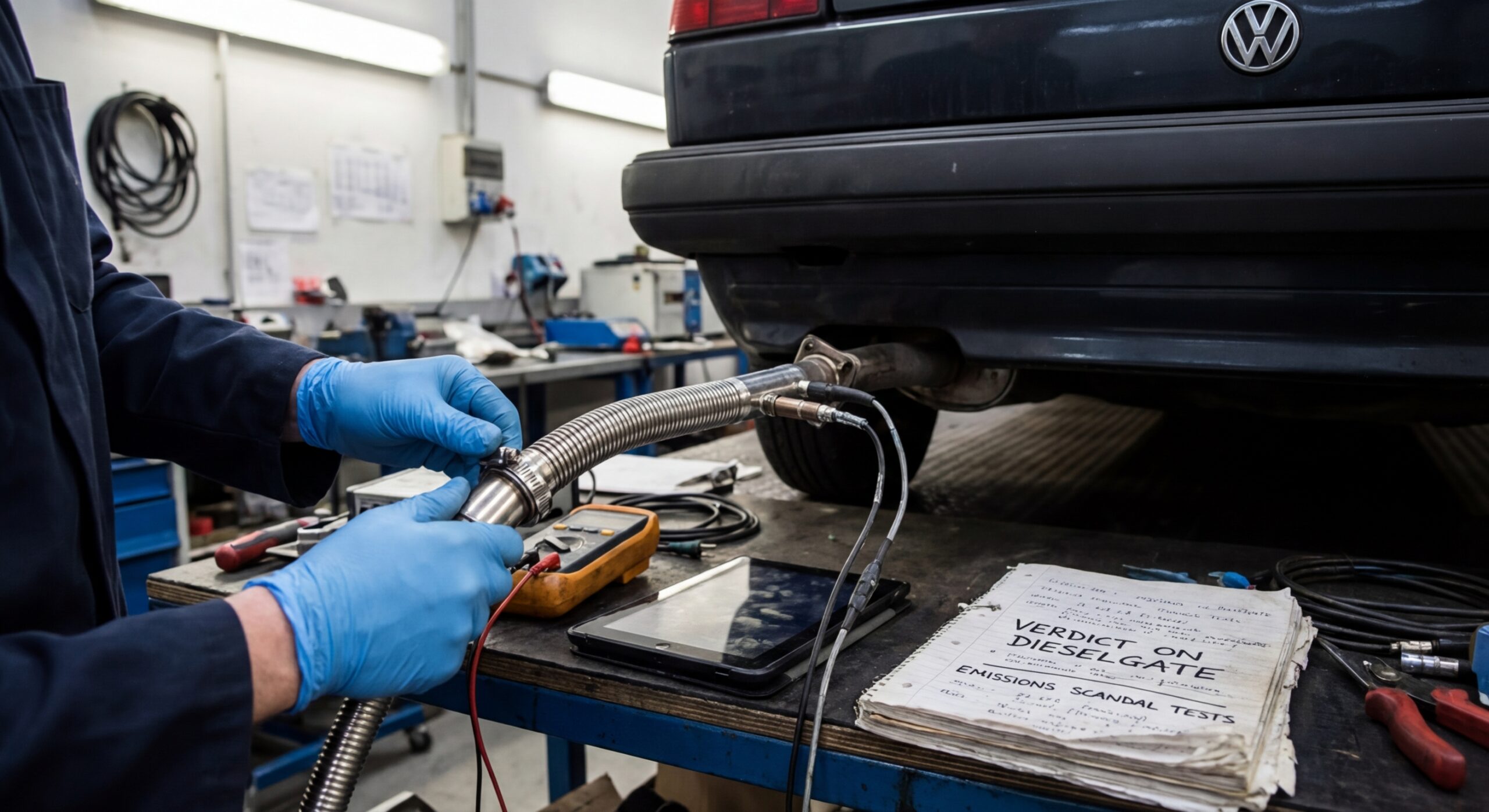
This article examines the claim commonly referred to as the Dieselgate Volkswagen emissions scandal: that Volkswagen Group installed software in certain diesel vehicles to alter emissions performance during regulatory tests. We review primary public documents, regulator statements, criminal and civil case outcomes, and independent research to distinguish what is documented, what remains inferential, and what cannot be proven from available records. This analysis treats the claim as a subject of inquiry rather than as an accepted fact and uses the term “Dieselgate Volkswagen emissions scandal” where relevant.
Verdict: what we know, what we can’t prove
What is strongly documented
Multiple official actions and court documents provide strong documentation that regulators identified discrepancies between certified laboratory emissions and real-world emissions, that Volkswagen admitted certain software was present, and that the company and some executives faced criminal and civil penalties.
Key documented items include:
- The U.S. Environmental Protection Agency issued a Notice of Violation on September 18, 2015, alleging that Volkswagen, Audi and related U.S. entities had installed software that circumvented U.S. emissions testing requirements for model year 2009–2015 2.0‑liter diesel vehicles.
- Volkswagen publicly acknowledged in September 2015 that the irregularities affected about 11 million vehicles worldwide using the EA189 engine family, a company statement that is recorded in Volkswagen’s 2015 reporting.
- The Department of Justice and U.S. prosecutors reached criminal resolutions: Volkswagen AG pleaded guilty in U.S. federal court to three felony counts (conspiracy to defraud the United States and violate the Clean Air Act, obstruction of justice, and importation of merchandise by false statement) and agreed to pay substantial penalties as part of the U.S. resolution.
- U.S. civil settlements and enforcement actions (including partial 2.0‑liter settlements and mitigation funds) were approved by courts and regulators; the EPA and related U.S. agencies documented multi‑billion‑dollar agreements addressing consumer remedy, environmental mitigation and civil penalties.
- Independent, peer‑review‑style testing commissioned by the International Council on Clean Transportation and performed by university laboratories flagged large differences between lab certification tests and on‑road NOx emissions; those results triggered further regulatory testing.
What is plausible but unproven
Certain interpretations and inferences are consistent with the documented record but are not fully proven in public documents. These include intentions of senior managers, the degree of knowledge among different corporate levels at specific dates, and the extent to which non‑U.S. vehicles used identical software features that had the same functional effect.
- Internal awareness timeline: court filings and press reports show some executives and engineers were aware of discrepancies by 2014 and that communications with legal counsel and regulators occurred in 2014–2015, but exact knowledge by particular senior executives at specific earlier dates is contested in some filings and not fully established in public evidence.
- Scope of features across engine families and geographical variants: Volkswagen admitted EA189‑family irregularities for many vehicles, but technical differences across engine models (2.0 vs 3.0 liter, regional calibrations) mean the precise behavior and environmental impact differ; therefore extrapolating a single technical motive or identical mechanism across all affected models remains partly inferential.
- Health impact magnitudes: independent studies have estimated premature deaths or public‑health impacts linked to excess NOx emissions from affected vehicles; these estimates depend on modeling choices (exposure, geographic distribution), so while plausible and potentially large, precise attribution remains model‑dependent.
What is contradicted or unsupported by available evidence
Some claims circulating in public discussion exceed what is supported by court records or regulator findings and should be treated skeptically unless new evidence appears.
- Claims that every single Volkswagen diesel vehicle worldwide contained identical defeat‑device code with identical effects are not supported by public filings; regulators and company reports identify specific engine families and model years rather than a single universal program.
- Allegations that no internal documents or employee testimony support deliberate deception are contradicted by plea agreements and internal correspondence introduced in litigation; however, the degree of centralized direction versus local engineering decisions is disputed across legal filings.
- Unfounded numerical claims (for example, precise global death tolls attributed solely to Volkswagen vehicles without modeling context) are unsupported by authoritative public health consensus and rest on extrapolation beyond available peer‑reviewed studies.
Evidence score (and what it means)
Evidence score: 82 / 100
- Strong official documentation: EPA Notices of Violation, company admissions, DOJ criminal plea and approved civil settlements provide high‑quality, primary‑source evidence for core assertions about test‑vs‑real‑world discrepancies and regulatory violations.
- Independent verification: third‑party testing commissioned via ICCT and academic labs corroborated regulator concerns and prompted regulatory follow‑up.
- Legal resolutions: guilty plea by Volkswagen AG in U.S. court and multi‑billion dollar settlements document regulatory and legal acknowledgment of serious violations.
- Gaps remain on internal intent and exact contemporaneous knowledge across corporate levels; some questions are subject to ongoing litigation or non‑public records.
- Technical complexity: different engine software behaviors across models and regions complicate universal technical claims; public disclosures focus on identified engine families rather than exhaustive technical code publication.
Evidence score is not probability:
The score reflects how strong the documentation is, not how likely the claim is to be true.
Practical takeaway: how to read future claims
When encountering new or amplified claims about the Dieselgate Volkswagen emissions scandal, treat the claim as a composite of (a) what regulators and courts have documented, (b) technical inferences from independent testing, and (c) unsupported or speculative extensions. Prioritize primary sources (agency notices, court pleadings, company statements) and high‑quality technical reports over single‑source commentary. The combined record supports that regulatory violations occurred in identified vehicle families and that the company reached criminal and civil resolutions in multiple jurisdictions; however, precise motivations, company‑wide uniformity, and global health attributions require careful, sourced analysis rather than repeated assertion.
This article is for informational and analytical purposes and does not constitute legal, medical, investment, or purchasing advice.
FAQ
Q: What evidence shows the Dieselgate Volkswagen emissions scandal occurred?
A: Primary evidence includes the EPA’s Notice of Violation issued on September 18, 2015, Volkswagen’s public acknowledgment (September 22, 2015) that irregularities affected about 11 million vehicles worldwide, independent on‑road testing commissioned by the ICCT and performed by university labs, and a U.S. Department of Justice guilty plea and associated penalties. These are documented in regulator press releases, company reports and DOJ filings.
Q: Does the evidence prove senior executives ordered illegal software?
A: Public records (plea agreements, indictments and regulatory filings) document internal communications and admissions that employees developed and installed software features that altered emissions behavior; however, establishing the precise chain of command and intent for specific senior executives at precise dates remains partly contested in legal proceedings and is not fully resolved in a single unambiguous public document. Readers should rely on court records and prosecutorial filings for the most concrete evidence on individuals.
Q: How many vehicles were affected and what sources support that number?
A: Volkswagen announced in September 2015 that around 11 million vehicles worldwide with EA189 engines were affected; U.S. regulator filings have also specified populations for particular engine sizes and model years (e.g., approximately 482,000 2.0‑liter vehicles in the U.S. for model years 2009–2015). These figures come from company statements and EPA/CARB notices.
Q: Were there criminal penalties or only civil settlements?
A: Both. Volkswagen AG pleaded guilty to felony charges in U.S. federal court and agreed to pay criminal fines as part of its resolution; civil settlements with U.S. federal and state authorities, plus consumer remedy programs and environmental mitigation funds, were also approved. The DOJ and EPA provide official summaries of those outcomes.
Q: What remains unproven and where do I look for updates?
A: Unproven items include detailed internal intent timelines for all senior managers, the complete technical content of all software variants across regions and models, and uniformly precise public health attributions. For updates, consult primary sources: agency sites (EPA, CARB), official court dockets and justice department press releases, and published technical analyses from independent research organizations such as the ICCT.

History-focused writer: declassified documents, real scandals, and what counts as evidence.