
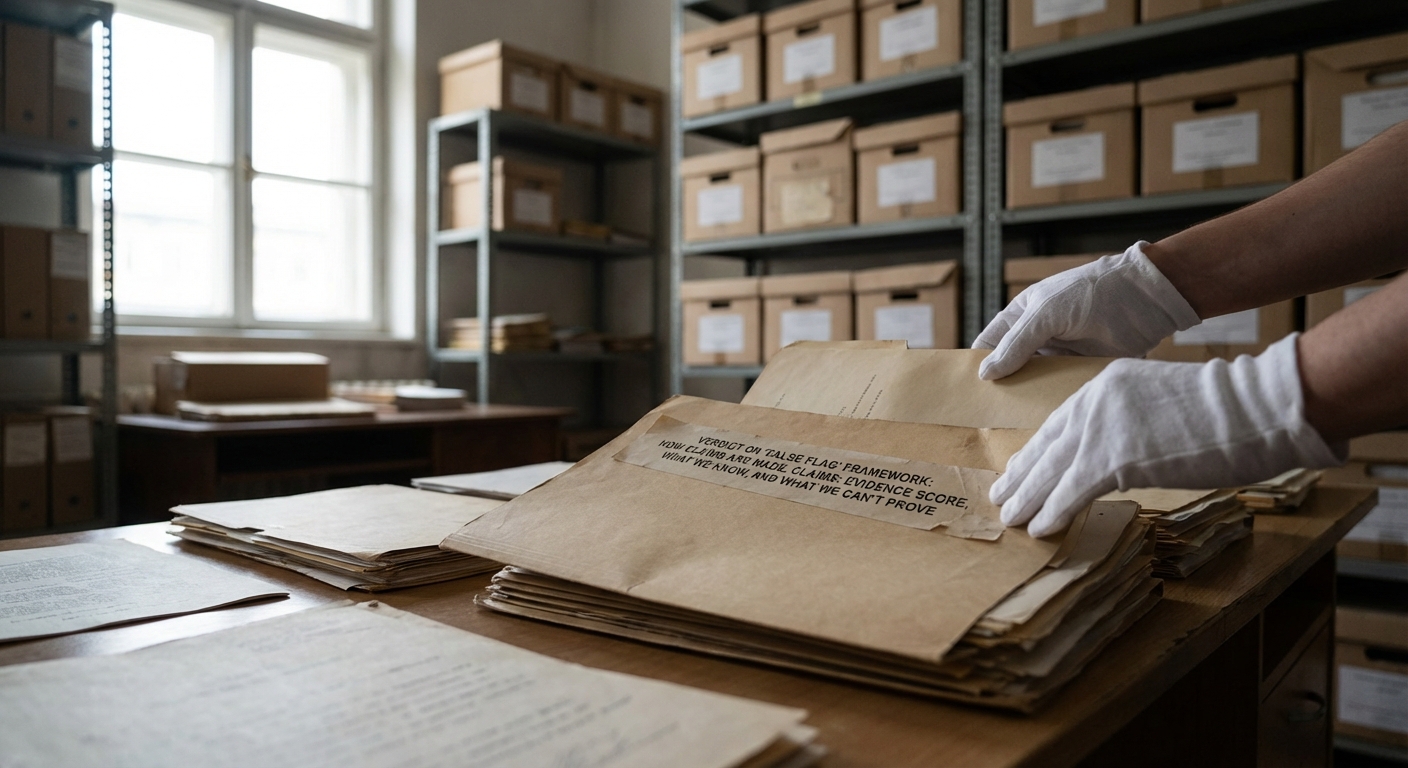
This verdict evaluates claims about a so-called “False Flag Framework” — the assertion that particular events are deliberately staged or misattributed by actors to shift blame or justify actions. We treat these as claims, not established facts, and we assess what is documented, what is plausible but unproven, and what is contradicted or unsupported by available public evidence. This article uses the term “false flag framework claims” throughout for clarity.
This article is for informational and analytical purposes and does not constitute legal, medical, investment, or purchasing advice.
Verdict: what we know, what we can’t prove
What is strongly documented
There are historically documented cases where governments or state actors planned or carried out operations designed to be blamed on other parties; these are the canonical examples that give the phrase “false flag” empirical grounding. Well-documented historical examples include the Nazi-era Operation Himmler (the Gleiwitz incident) used as a pretext for the 1939 invasion of Poland and declassified U.S. planning documents such as Operation Northwoods (a proposed, not executed, plan from 1962), which demonstrates that senior planners at times discussed staged provocations in strategic planning. These incidents are supported by declassified records and longstanding academic treatments of mid-20th-century statecraft.
Independent open-source investigative methods and international reporting standards for documenting atrocities and covert operations have matured: organizations such as Bellingcat and international legal units now publish method guidance for verifying imagery, metadata and timelines, and courts increasingly require documented chain-of-custody for digital evidence to be admissible. These standards matter when assessing present-day “false flag” claims because they determine what counts as verifiable documentation.
What is plausible but unproven
It is plausible that some modern incidents could involve staged elements or disinformation used to amplify a chosen narrative. Scholars of information operations and recent reporting show that actors — state-aligned media, influencer networks, and proxies — sometimes coordinate to promote narratives (including accusations of false flags) rapidly across social media. However, plausibility from patterns of coordinated messaging is not the same as proof that an event was actively staged by a particular actor; proving orchestration requires primary evidence (internal documents, authenticated communications, reliable admissions, verifiable forensic traces). Research on information networks demonstrates the speed and mechanisms by which false flag claims can be amplified, which makes the claim plausible as a communicative strategy even when direct operational proof is lacking.
What is contradicted or unsupported
Many contemporary assertions that high-profile events were “false flags” rest on inference, selective use of ambiguous footage, or mismatched timelines rather than primary sourcing. Independent fact-checks and law-enforcement documentation have often contradicted specific false flag allegations — for example, claims that the January 6, 2021 U.S. Capitol breach was an “FBI false flag” have been refuted by investigative reporting and court filings; available evidence identifies participants, organizers, and communications that do not support the false-flag narrative in that case. When official documents, charging papers, or open-source forensic evidence identify responsible parties and show no credible link to staging by a third actor, the false flag claim is unsupported.
Evidence score (and what it means)
Evidence score is not probability:
The score reflects how strong the documentation is, not how likely the claim is to be true.
- Evidence score (0–100): 34 — The documentation for the general idea that false flags have occurred historically is strong, but documentation tying a specific contemporary event to a staged false flag framework is typically weak or circumstantial.
- Score drivers: presence of declassified historical records (raises baseline), existence of robust fact-checks and court records contradicting some modern claims (lowers support for broad assertions), frequent reliance on social amplification and unverifiable media (reduces score), and improvements in OSINT verification standards (increases ability to test claims).
- Many modern allegations cite correlational patterns (timing, mutual amplification) rather than primary operational evidence (internal communications, authenticated orders, verified chain-of-custody), which keeps most contemporary claims in the unproven column.
- Where primary admissions or declassified orders exist (historical cases), documentation is robust and the score would be higher; absence of such records for many modern claims keeps the overall score low-to-moderate.
Practical takeaway: how to read future claims
Assessing a “false flag” claim requires tracing evidence back to primary sources and evaluating the chain of custody for digital material. Key questions to ask: who provided the original material, can timestamps and metadata be independently verified, do independent witnesses corroborate the asserted sequence of events, and are there internal documents or credible admissions that demonstrate orchestration? Rapid social-media proliferation and coordinated messaging can create the appearance of a concealed operation without proving one; distinguish between (a) coordinated narrative amplification and (b) actual operational staging backed by primary documents.
When official investigations or independent open-source research produce verifiable chain-of-custody and corroborated documentary evidence, claims move from “plausible” to “documented.” Absent that, treat broad claims about a “False Flag Framework” as hypotheses that require targeted evidence to validate.
FAQ
What is meant by “false flag framework claims” and how should they be interpreted?
“False flag framework claims” assert that an incident is not what it appears to be — that actors staged or misattributed it to achieve political or operational goals. Interpret them as hypotheses that require primary evidence (documents, admissions, authenticated forensic traces) rather than inferences from timing, motive, or social-media patterns.
What kinds of evidence would convincingly support a false flag claim?
Convincing evidence would include authenticated internal orders or communications directing staging, verifiable financial or logistical trails linking an actor to operational elements, reliable chain-of-custody for forensic materials (photos, video, device logs), and independent corroboration from multiple high-quality sources (e.g., court filings, declassified documents, credible whistleblower testimony with supporting records). Guidance from OSINT practitioners and legal units explains how such evidence must be preserved and presented.
How do we distinguish coordinated disinformation from an actual staged operation?
Coordinated disinformation typically leaves a pattern of repeated messaging across networks, recycled or manipulated media, and reliance on unverified or misattributed material. A staged operation leaves operational traces—logistics, orders, payment, or direct admissions—that map to the event itself. Both can co-occur, but only the latter pushes a claim into the documented category. Researchers recommend verifying original media sources, checking metadata and timestamps, and seeking independent on-the-ground reporting.
Can historical examples prove modern claims?
No. Historical cases (for example, the Gleiwitz incident in 1939 and declassified U.S. planning papers in the 1960s) show that states have planned or executed staged provocations in the past. However, history demonstrates possibility, not proof of a connection to any contemporary event; each modern claim requires its own, contemporaneous evidence.
Why do false flag claims spread so quickly online?
False flag claims tap into existing mistrust, simplify complex events into conspiratorial narratives, and are amplified by networked social platforms where speed and engagement often outpace verification. Studies and journalistic investigations document how influencers, state-aligned media, and platform features can accelerate such narratives. That amplification explains widespread belief in some claims even when supporting documentation is weak.
Evidence score is not probability:
The score reflects how strong the documentation is, not how likely the claim is to be true.
FAQ (short form and verification tips)
How can I quickly check whether a “false flag” claim has credible evidence?
Look for primary-source links (official documents, court filings, declassified records), independent forensic verification (metadata, satellite imagery, or authenticated device logs), and corroboration by reliable investigative organizations. Absent these, treat the claim as unproven.
Where can I find reliable debunks or confirmations?
Use established fact-checkers and high-trust outlets that provide sourcing (for example, Snopes, AP, Reuters) and consult open-source investigation groups that document their methods and evidence. When those sources publish detailed refutations or confirmations with primary-source links, they are the best starting point.
Are there legal or ethical risks in labeling something a “false flag”?
Yes. Accusing identifiable individuals or organizations without strong evidence can be defamatory or harmful. Ethically, spreading unverified claims can endanger people and distort public debate. Always require and cite primary, verifiable evidence before repeating such allegations.
Summary: The historical record confirms that false flag operations have occurred; modern communications networks enable rapid spread of false flag claims, but most contemporary assertions lack the primary-source documentation required to move from allegation to verified fact. Where declassified documents or credible forensic evidence exist, claims can be documented; otherwise, treat them as unproven hypotheses and apply rigorous verification standards.

Beginner-guide writer who builds the site’s toolkit: how to fact-check, spot scams, and read sources.