
Scope and purpose: This timeline compiles documented records, media reports, and key turning points related to the claim often styled as “Bohemian Grove: ‘Secret Ritual Control’”. The aim is to lay out dates, source types, and where interpretations diverge, not to endorse the claim. The phrase Bohemian Grove ‘Secret Ritual Control’ claims is used here to anchor the set of allegations under review.
Timeline: key dates and turning points
- 1872 — Founding of the Bohemian Club (document type: historical record). The Bohemian Club was established in San Francisco as a private club for artists, journalists, and patrons; it later developed the Bohemian Grove encampment tradition.
- 1878 — First Midsummer encampment (document type: club annals / historical account). Records show an early summer encampment that became the annual tradition.
- 1881 — First recorded ‘Cremation of Care’ ceremony (document type: club history / program texts). Club histories and archival sources identify the ceremony’s origins in the 1880s as a theatrical pageant intended to symbolize the banishing of worldly “care.”
- 1899 — Purchase of the current Bohemian Grove site (document type: property record / historical summary). The Club purchased the Monte Rio property that became the long-term Bohemian Grove site.
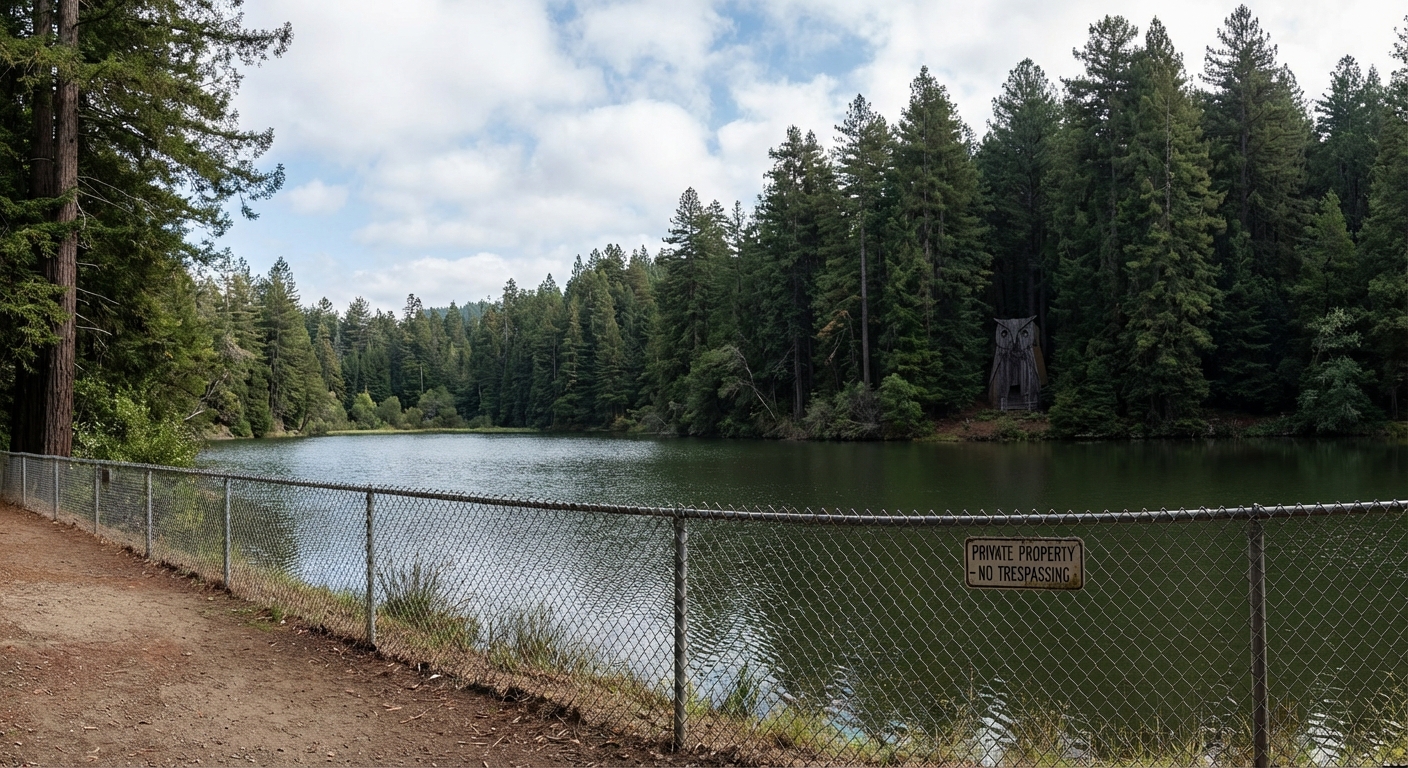
- 1929 — Construction of the Owl Shrine (document type: visual record / club sources). The large concrete owl statue that serves as the backdrop for the Cremation of Care was erected in the late 1920s and has been central to descriptions of the ceremony.
- 1978–1981 — Legal dispute over women employees (document type: administrative and court records reported by press). The club faced state employment actions in the late 1970s; in October 1981 the state commission ordered the club to hire women employees, triggering further legal proceedings. Case reporting and summaries are available in legal and press sources.
- 1989 — Spy magazine infiltration and reporting (document type: long-form journalism). Writer Philip Weiss reported on extended undercover observation inside the Grove, producing a high-profile magazine piece that gave the public a detailed descriptive account of rituals and culture at the encampment.
- July 15, 2000 — Alex Jones and cameraman enter the Grove and film the Cremation of Care (document type: clandestine video footage; later broadcast excerpts). Alex Jones’ covert footage showing the opening-night ceremony was widely circulated by Jones and appeared in documentary coverage; Jones characterized the ritual in explicitly sinister terms, which later became a focal point for conspiracy narratives. Mainstream documentary filmmakers (Jon Ronson) and reporting subsequently covered the footage and its presentation.
- 2001 — Jon Ronson’s Channel 4 documentary and reporting (document type: broadcast documentary). Jon Ronson documented Alex Jones’ infiltration in a Channel 4 episode and wrote about his impressions, offering both the footage and interviews that dispute sensational interpretations of the ceremony.
- 2011 and earlier — Reporting about private conversations and influence (document type: investigative journalism / historical reporting). Various mainstream outlets have documented high-profile guests and described the Grove as a private retreat where influential people gather; reporting has noted protests and speculation about the group’s influence while the club maintains it is primarily recreational.
- April 2023 — ProPublica reporting on Justice Clarence Thomas’ undisclosed trips to gatherings including Bohemian Grove (document type: investigative journalism; disclosure filings). ProPublica reported on multiple luxury trips and weekend visits tied to powerful donors; reporting included specific references to repeated travel that involved the Bohemian Grove, leading to amended disclosures and renewed public scrutiny.
Where the timeline gets disputed
Three kinds of disputes commonly appear around this timeline:
- Interpretation of theatrical rituals: The Cremation of Care’s staging, costumes, and the owl iconography are well documented; scholars and investigative journalists generally describe it as theatrical symbolism rather than evidence of criminal ritual practice. The claim that the ceremony represents or includes actual human sacrifice is a serious allegation that lacks corroboration in primary-source reporting and scholarship.
- Significance of attendee lists: It is documented that many prominent business, media, and political figures have attended the Grove in various roles; disagreement arises over whether private conversation at the Grove constitutes coordinated policymaking or routine socializing. Scholarly work that mapped membership and attendance treats the Grove as a site of elite social cohesion, but does not provide conclusive proof of conspiratorial governance.
- Reliability of clandestine footage and anonymous claims: The 2000 Alex Jones footage is authentic as far as it shows portions of the ceremony, but Jones’ interpretive claims (e.g., labeling the owl as an ancient deity named Moloch or asserting that footage shows real human sacrifice) are assertions beyond what the filmed material proves. Independent observers such as Jon Ronson and scholars like Peter Phillips have criticized Jones’ interpretive leaps.
Evidence score (and what it means)
- Evidence score: 35 / 100.
- Score drivers:
- • Well-documented facts (existence of the Club and Grove, the Owl Shrine, the Cremation of Care ceremony, and selective attendee reporting) provide a solid documentary base.
- • Primary-source artifacts (club annals, program texts, journalistic accounts, and covert footage) document ceremonies and membership patterns but are often descriptive rather than explanatory.
- • High-salience allegations (human sacrifice, occult control, systemic clandestine policymaking) rely largely on interpretive claims, selective readings of theatrical elements, or sources with credibility and verification problems. These claims lack corroborating primary evidence from credible independent investigators.
- • Scholarly studies (e.g., membership/network analyses) document elite social ties but do not substantiate criminal ritual practices; investigative journalism has exposed ethically problematic connections (e.g., undisclosed trips), which increases scrutiny but does not validate ritual-control claims.
Evidence score is not probability:
The score reflects how strong the documentation is, not how likely the claim is to be true.
What this score means in practice: the foundational, verifiable elements of the timeline (club existence, ceremonies, high-profile attendees, covert footage) are well documented. However, the leap from documented symbolic ritual and private gatherings to claims of organized criminal ritual control (for example, actual human sacrifice or a secret global governance cabal) is not supported by independently verifiable primary evidence at this time.
“This article is for informational and analytical purposes and does not constitute legal, medical, investment, or purchasing advice.”
FAQ
Q: What exactly are the Bohemian Grove ‘Secret Ritual Control’ claims?
A: The label collects a range of allegations: that the Grove’s theatrical “Cremation of Care” ceremony is a cover for occult or criminal rites; that attendees use the retreat to secretly control political and economic outcomes; and that the Grove is the site of illicit activities such as human sacrifice. Those are claim categories; as described above, the symbolic ceremony and private gatherings are documented, while the criminal and sacrificial assertions are not supported by independent primary evidence.
Q: Did Alex Jones prove the Grove practices human sacrifice?
A: No. Alex Jones’ 2000 covert footage documents elements of the ceremony but does not provide independent proof of human sacrifice. Mainstream documentary and scholarly observers have described the ceremony as theatrical symbolism; critics of Jones have said he interpreted the footage beyond what it supports. Claims of actual sacrifice are extraordinary and require correspondingly strong direct evidence, which has not been produced in credible, independently verified form.
Q: What documented evidence shows powerful people meet at Bohemian Grove?
A: Historical membership lists, journalistic reporting, and scholarly analyses show that senior political figures, business leaders, and media executives have attended the Grove across many decades; sociological work has used these data to study elite social networks. These attendance records and credible press accounts are part of the verified timeline.
Q: How does the 2000 footage and later reporting change the public record?
A: The footage increased public visibility of the ceremony and catalyzed both scholarly and activist attention. Later investigative reporting (for example, coverage of undisclosed trips by public officials reported by ProPublica) has renewed scrutiny about private hospitality and transparency—but those reporting threads are about disclosures, ethics, and influence, not about proving ritual crimes.
Q: Where can I find primary or high-quality sources to examine these claims myself?
A: Useful primary and high-quality secondary sources include: club archival material and published annals (for ceremony origins), scholarly work such as G. William Domhoff’s analyses of elite institutions, long-form journalism from outlets like Vanity Fair, The Washington Post, and investigative pieces from ProPublica. Documentary footage and Channel 4 reporting (Jon Ronson) are available as visual primary sources but require contextual interpretation. Always check original documents and filings where possible.

Geopolitics & security writer who keeps things neutral and emphasizes verified records over speculation.