
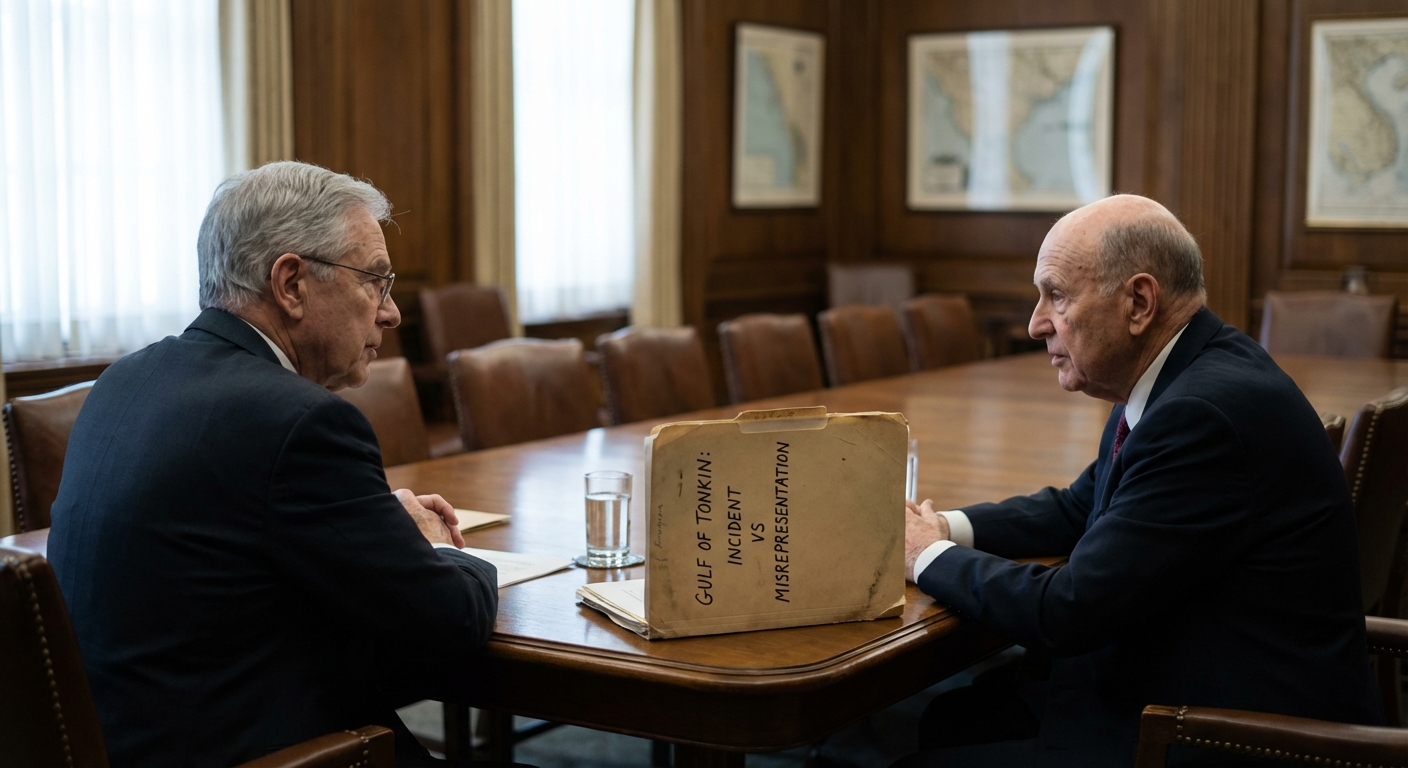
This article tests the claim framed as “Gulf of Tonkin: Incident vs Misrepresentation” against the strongest available counterevidence and expert explanations. It focuses on primary and near-primary sources (declassified intelligence studies, contemporaneous government records, naval reports) and on later statements by participants, and it keeps a neutral, evidence-first tone throughout. The goal is to show which parts of the claim are documented, which are contested, and which cannot be proven from available records.
The best counterevidence and expert explanations
-
Declassified NSA historical study (Robert J. Hanyok): detailed SIGINT review concluding the August 4 attack was not supported by the intercept record as originally presented. The NSA-hosted PDF of Hanyok’s Cryptologic Quarterly study shows analysts misdated and mistranslated intercepts and explains how analysts and communicators reconstructed events that made a second attack appear to have occurred. This document is a primary, contemporaneous analysis of NSA holdings and is central to the claim that the August 4 episode was a product of faulty SIGINT handling. Limit: the version released publicly is an internal study and the agency redacted or contextualized some materials before public release; some raw intercepts remain unavailable in full.
-
Contemporaneous State/Defense records and White House cables: contemporaneous Foreign Relations of the United States volumes and related memoranda record that senior officials debated the reliability of reports on August 4 and show that Washington received cables expressing doubt. FRUS documents demonstrate there was uncertainty among senior officials as the events unfolded, and that operational orders and political decisions sometimes preceded full verification. Limit: FRUS provides authoritative snapshots but is a curated collection and does not contain every raw signal or ship log.
-
Shipboard reports and later naval analyses: the August 2 clash in which USS Maddox engaged North Vietnamese torpedo boats is well-documented by naval logs and later navy histories; the supposed August 4 radar/sonar contacts reported by USS Maddox and USS Turner Joy have been shown in several official and scholarly reappraisals to be ambiguous and likely false positives (radar anomalies, weather, or crew misperception). These after-action reports and historical reviews document the difference between the two dates and why the second contact is disputed. Limit: sailors on the scene reported contacts in real time, and human perception under stress can be hard to reconstruct decades later.
-
Public statements by principal actors years later: Robert McNamara’s retrospective remarks — including his 1995 exchange with Vietnamese General Võ Nguyên Giáp and later interviews — acknowledged persistent uncertainty about what happened on August 4 and that there was reason to believe the second attack did not occur. General Giáp told McNamara that “absolutely nothing” happened on August 4, which McNamara reported and which has been widely cited in subsequent reappraisals. Limit: retrospective statements reflect later recollection and interpretation rather than contemporaneous verification, and participants’ memories may be influenced by later scholarship.
-
Investigative reporting and scholarly syntheses: major reporting (summarizing released studies and interviews) and specialist histories contend that analytic error — and in some accounts selective editing of SIGINT products — explains how Washington concluded a second attack took place. The New York Times reporting on Hanyok’s work and multiple secondary histories summarizing declassified materials have been influential in shaping the modern consensus that the August 4 attack is not well-supported. Limit: investigative articles summarize and interpret documents rather than replace them; interpretations vary across scholars and journalists.
Alternative explanations that fit the facts
-
Honest intelligence and sensor error: rough seas, radar anomalies and ambiguous sonar contacts on the night of August 4 could have produced false-positive contacts. Naval crewmembers reported echoes and sonar returns; under stress and with a recent August 2 clash in mind, those returns could plausibly be misread as hostile craft. Several historians point to environmental and technical factors as sufficient to explain the apparent contacts on August 4.
-
Contextual misinterpretation of intercepts: Hanyok’s analysis highlights timing errors, translation slips and contextual mistakes (for example, a phrase about earlier casualties rendered ambiguously). Some misread intercepts appear to have referred to the August 2 action but were interpreted as fresh August 4 reporting — a sequencing error that can turn an after-the-fact report into apparent evidence of a new engagement.
-
Operational provocation and linked operations: the Maddox was operating as part of DESOTO intelligence patrols near recent South Vietnamese raids; those raids and U.S. presence may have contributed to a situation in which local commanders (on either side) reacted in unpredictable ways, or in which U.S. forces expected and therefore perceived a new engagement. This does not prove intentional fabrication; it shows that provocative operational posture and simultaneous covert actions increased the likelihood of confusion.
-
Selective presentation versus deliberate falsification: Hanyok’s study and subsequent reporting assert that some mid-level analysts altered or emphasized language in SIGINT-derived reporting in ways that supported an attack narrative. Some secondary reporting suggests documents were edited to strengthen the case that an attack had occurred; other scholars caution that evidence for a coordinated, high-level conspiracy is inconclusive. The difference between mistaken emphasis and deliberate falsification remains one of the key disputed points.
What would change the assessment
-
Release of full raw SIGINT intercepts (unredacted originals) covering August 2–4, including original Vietnamese-language messages and time-stamps, would allow independent verification of translation and sequencing claims. Hanyok’s study points specifically to missing or redacted originals as a limiting factor.
-
Transparent, time-sequenced shipboard logs and real-time radar/sonar recordings from USS Maddox and USS Turner Joy (if extant) would materially strengthen or weaken claims about actual contacts on August 4. Many later reappraisals rely on summaries, not raw sensor tapes.
-
Conclusive documentary evidence of intentional alteration (e.g., internal messages admitting document edits intended to mislead policy-makers) would be decisive for claims of deliberate misrepresentation. Current public records show allegations and plausible reconstructions but not an unambiguous “smoking gun.” Hanyok’s reconstruction is suggestive but the public record remains incomplete.
-
Credible contemporaneous North Vietnamese operational records explicitly reporting a new August 4 engagement would undermine the position that no second attack occurred; conversely, a verified North Vietnamese record confirming no action on August 4 would further strengthen the counterevidence. Existing Vietnamese statements (e.g., Giáp’s later remark) are helpful but not a contemporaneous operational log.
Evidence score (and what it means)
- Evidence score: 78 / 100.
- Drivers: multiple declassified, near-primary documents (NSA internal study; FRUS records) that directly address SIGINT handling and contemporaneous decision-making.
- Drivers: corroborating public statements by principal participants (McNamara’s later acknowledgements and Giáp’s 1995 reply) that align with documentary reappraisals.
- Limits: key raw materials remain partially redacted or missing in public archives (original SIGINT transcripts, some raw ship sensor recordings), which prevents a fully conclusive accounting.
- Limits: some allegations (intentional alteration vs analytic error) remain interpretive and contested among credible scholars and journalists.
Evidence score is not probability:
The score reflects how strong the documentation is, not how likely the claim is to be true.
Rationale: a score of 78 reflects substantial, high-quality documentary material pointing to serious analytic errors and to at least selective shaping of signals-derived reporting. That material is strong enough to undermine a simple, literal reading of an August 4 attack as an established fact. The score is not a judgment of motive; while Hanyok and some journalists argue mid-level deception, available public documents do not uniformly prove a deliberate, centrally directed falsification beyond dispute.
“This article is for informational and analytical purposes and does not constitute legal, medical, investment, or purchasing advice.”
FAQ
Q: What does the phrase “Gulf of Tonkin incident vs misrepresentation” mean in this context?
A: The phrase frames a claim that the August 4, 1964 event (often cited as a second attack) was either a genuine hostile action or a misrepresentation/misinterpretation used to justify escalation. The evidence review above treats that framing as a claim and evaluates documentary support for the contention that the August 4 episode did not occur as an actual enemy attack. Key sources include the NSA historical study and contemporaneous U.S. government records.
Q: Did an attack definitely happen on August 2 and not on August 4?
A: The August 2 engagement in which USS Maddox exchanged fire with North Vietnamese torpedo boats is documented in naval reports and histories. The August 4 contacts, however, are poorly supported by surviving primary material and are the subject of later reappraisal; several declassified studies and participant statements suggest the August 4 attack likely did not occur as originally reported. The distinction between the two dates is central to contemporary re-evaluations.
Q: Did the NSA intentionally alter intelligence to mislead policymakers?
A: The NSA historian Robert Hanyok’s internal study concluded that mid-level errors and selective edits produced an appearance of an August 4 attack; investigative reporting based on that work reported allegations that some analysts altered or emphasized language. However, publicly available materials do not fully resolve whether actions amounted to intentional, coordinated falsification ordered from senior leadership. The available documents support claims of problematic handling and possible cover-up at some levels, but the degree of intent remains contested in the historical record.
Q: Why does this question still matter today?
A: The Gulf of Tonkin episode is repeatedly cited in discussions about how intelligence, uncertainty and political decision-making interact at moments of crisis. It is a case study in how ambiguous sensor data, translation issues, and institutional pressures can cascade into major policy decisions; it is therefore relevant to historians, intelligence professionals and anyone assessing how governments verify and present evidence in support of military action.
Q: Where can I read the primary documents cited here?
A: The NSA’s Hanyok study and related Cryptologic Quarterly material are publicly available on the NSA website in declassified form; contemporaneous U.S. government memoranda and FRUS volumes are available from the U.S. Office of the Historian; major press coverage and scholarly syntheses summarize and analyze those documents. Links cited in this article point to those sources.

Geopolitics & security writer who keeps things neutral and emphasizes verified records over speculation.