
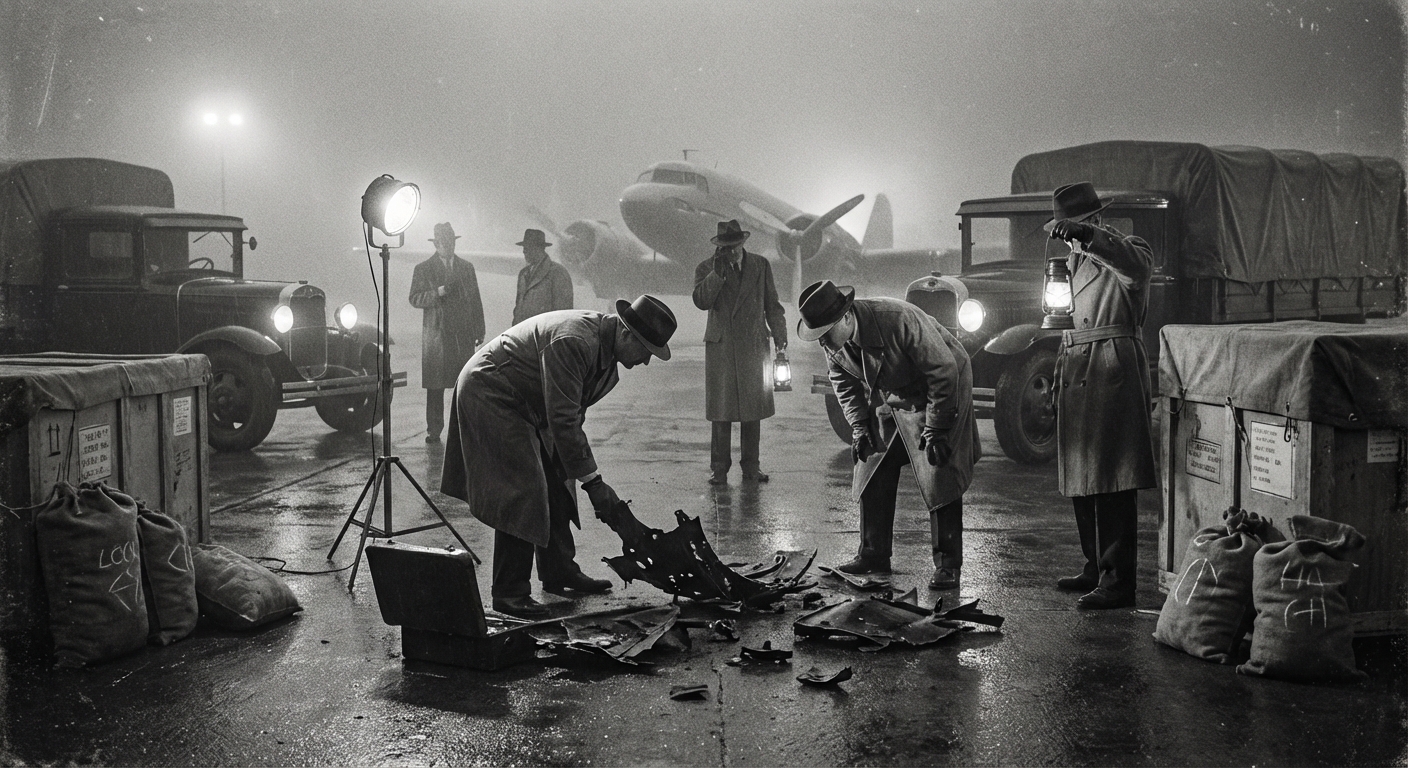
Below are the arguments people cite when claiming “Hindenburg sabotage” — presented as arguments supporters use, not as established facts. Each entry lists the claim, the primary source or source type, and a simple test a researcher could run to try to verify or refute it. Where available we cite primary reports and reputable secondary analyses.
The strongest arguments people cite
-
Claim: Physical residue consistent with a small incendiary (a dry-cell battery residue) was found in the wreckage near the reported origin of the fire.
Source type: Secondary reporting of investigative notes and later popular books (A. A. Hoehling; later retellings summarized in reference works).
How to test / verification: Inspect original investigation exhibits, chain-of-custody records, and laboratory reports from 1937 (NYPD, FBI, Commerce Department). Verify the exact location on the ship where the sample was collected and whether later analysts reclassified the residue (for example as extinguisher residue rather than battery material).
Notable documentation: the claim appears in mid-20th-century sabotage books and is summarized in modern reference entries; contemporaneous official reports are the primary records to consult for the physical evidence trace.
-
Claim: Eyewitness reports of a brief flash or bright reflection inside a specific gas cell (commonly cited as Gas Cell 4 or the upper stern) indicate an internal ignition consistent with a timed incendiary or bomb.
Source type: Witness statements collected during the 1937 public hearings and later survivor interviews; repeated in books arguing sabotage.
How to test / verification: Compare original witness testimony transcripts from the Department of Commerce hearings and Navy observers for consistency about location, timing, and whether observers saw a flash before flames. Cross-check whether those same witnesses later endorsed sabotage or accepted the official ignition hypothesis. The U.S. Department of Commerce record contains the hearing transcripts and summaries.
-
Claim: A crew member (commonly named in books as a rigger such as Erich/Erik Spehl) had motive or access and is a plausible saboteur because of personal contacts or ideological ties.
Source type: Post-event investigative books (Hoehling 1962; Michael Mooney’s later book and the 1975 film dramatization) based on interviews and selective archival material.
How to test / verification: Examine original personnel files, contemporaneous suspect interviews, FBI files, and any Gestapo or German police records cited. Confirm whether primary-source documents tie the individual to explosive materials or show credible motive, rather than inference from circumstantial details. Note that book authors cited inference and rumors tied to this claim.
-
Claim: Threatening letters or prior warnings (anti-Zeppelin or pro-/anti-Nazi harassment) made before the voyage provide a motive and opportunity for sabotage.
Source type: Contemporary press reports and statements by Zeppelin officials (initial reactions and speeches) recorded immediately after the accident.
How to test / verification: Locate original threatening communications or police reports listed in the Department of Commerce or German inquiry documents. Distinguish generic threats (which were not uncommon for high-profile targets) from credible operational plots with logistics and materials. The early public statements noted threats, but the official inquiries looked for corroborating material evidence and found none sufficient to prove sabotage.
-
Claim: The airship’s outer skin (doped fabric) was unusually flammable, so an incendiary placed on or under the skin could have started the fire quickly and made the damage look like a sudden explosion.
Source type: Technical hypothesis referenced in both sabotage arguments and in alternative non-sabotage explanations (discussions of the dope mixture and its properties appear in official reports and later technical studies).
How to test / verification: Consult the 1937 engineering notes and material specifications, later laboratory re-creations of the fabric/dope, and peer-reviewed analyses or controlled ignition tests. Researchers and official summaries discussed fabric properties and whether the doped surface could account for rapid flame spread, but the dominant official finding attributed ignition to hydrogen with the skin accelerating spread rather than being the initial cause.
-
Claim: Structural damage (a snapped bracing wire, torn cell, or mechanical failure) was staged or exploited by a saboteur who knew ship structure and could place an incendiary where a structural failure would concentrate hydrogen leakage.
Source type: Derived from the puncture/structural-failure hypotheses discussed in official inquiries; used in sabotage narratives to argue insiders could time an attack to structural vulnerabilities.
How to test / verification: Compare mechanical failure evidence in the U.S. and German investigative reports with the physical debris catalog. Check whether sabotage proponents identified distinct tool marks or foreign devices on structural parts — official reports recorded snapped bracing wires and examined them but did not find definitive explosive signatures.
-
Claim: Political motive — because the Hindenburg was a high-profile Nazi symbol, outside anti-Nazi actors or internal opponents of the regime had motive; thus sabotage as political terrorism is plausible.
Source type: Contextual argument appearing in both early press and later books; not a single piece of forensic evidence but an inference from political context.
How to test / verification: Seek primary-source intelligence, police, or diplomatic records showing hostile plotting against Zeppelin flights; check U.S. and German security files from 1937–1938. Most modern summaries note the symbolic value but emphasize lack of documentary proof tying external political operatives to an actionable plot.
How these arguments change when checked
When researchers move from secondary books and retrospective narratives to primary documents (the Department of Commerce hearings, the German investigation report, contemporaneous police notes, and surviving laboratory exhibits), several patterns appear:
-
Physical-trace claims tend to weaken: some residues were reported and discussed by investigators, but later testing and chain-of-custody questions mean the samples are not a clear, uncontested signature of an incendiary device — investigators at the time reported competing interpretations (battery residue, sulphur, or extinguisher residue). Researchers relying only on later books often omit those caveats.
-
Eyewitness testimony is mixed: multiple witnesses described fluttering fabric and brief glows that could be consistent with static discharge or St. Elmo’s Fire; others described sudden flames. Transcripts show disagreement about precise location and character of the early event, which weakens a single-suspect incendiary narrative. Official inquiries used these testimonies to support an electrostatic ignition scenario rather than sabotage.
-
Motive-based arguments are suggestive but not documentary: political motive alone does not survive as proof without operational evidence. The official inquiries searched for such evidence and reported none conclusive. Later books sometimes conflate motive with proof.
-
Secondary books and movies amplified circumstantial points: Hoehling and Mooney popularized the sabotage narrative and named suspects, which increased public attention; courts later noted that such reconstructions mixed fact and conjecture. Contemporary investigators and many later historians consider those reconstructions speculative.
This means that while several of the “strongest” sabotage arguments have concrete hooks (samples, witness flashes, late-night threats, insider access), each hook weakens under direct archival and forensic scrutiny or is compatible with non-sabotage explanations (static ignition, structural failure, rapid flame spread of doped fabric). Researchers should avoid treating motive or a single ambiguous sample as conclusive.
Evidence score (and what it means)
- Evidence score: 28 / 100
- Drivers of the score:
- Positive: There are contemporaneous investigative records (U.S. Department of Commerce hearings; German technical commission) and witness statements documenting where investigators looked and what they examined.
- Negative: No uncontested, independently verified forensic artifact (e.g., an identifiable explosive device component with clear provenance) has been published in the primary record. Many alleged traces are ambiguous or reinterpreted by investigators.
- Negative: Retrospective books and dramatizations amplified circumstantial material and rumor; their claims often rely on inference.
- Neutral: Alternative explanations (static spark, structural puncture, rapidly burning fabric) are documented and compatible with many observations, which lowers the explanatory exclusivity of sabotage.
Evidence score is not probability:
The score reflects how strong the documentation is, not how likely the claim is to be true.
This article is for informational and analytical purposes and does not constitute legal, medical, investment, or purchasing advice.
FAQ
Q: What primary records exist about the Hindenburg investigations?
A: The main primary records are the U.S. Department of Commerce public hearing transcripts and final report and the German Board of Inquiry report; those contain witness statements, technical exhibits, and the inquiries’ reasoning. Many later books and articles draw on or reinterpret these files.
Q: Is “Hindenburg sabotage” the accepted cause today?
A: No. The accepted archival record from the 1937 U.S. and German inquiries did not find clear proof of sabotage and favored electrostatic ignition of leaked hydrogen with rapid flame spread. However, because some traces and eyewitness reports remain ambiguous and several speculative books popularized sabotage narratives, the claim persists in public discussion. Modern summaries emphasize the lack of definitive forensic proof for sabotage.
Q: What happened to the physical evidence (residues, debris)?
A: Investigators collected debris and noted traces of materials in many locations; later assessments reinterpreted some residues (for example, material on a valve cap was reported as sulfur or yellow residue in some accounts but was later considered consistent with fire-extinguisher residue). Where samples are still archived varies by institution; independent re-analysis is limited in the public record.
Q: How should I treat books or films that say “the Hindenburg was sabotaged”?
A: Treat such works as secondary sources that may mix fact, inference, and dramatization. Cross-check their claims against the primary records (Commerce Department transcripts, German inquiry report, contemporaneous police and FBI notes) before accepting an attribution of sabotage. Many modern historians consider the strongest sabotage books to be speculative rather than documentary.
Q: Where can I read the original investigation reports?
A: The U.S. Department of Commerce report and the German Board of Inquiry report are reproduced in public archives and specialist sites that collect historical airship documents; library collections and online archives (including some museum and academic repositories) hold original or reproduced copies. The Air Commerce Bulletin reproduction is a standard starting point for primary transcripts.
Q: Does the phrase “Hindenburg sabotage” appear in credible contemporary records?
A: Early newspaper reports and initial statements from Zeppelin officials raised sabotage as a possibility; however, the term became more prominent in later books and popular accounts. Contemporary official inquiries focused on mechanical and electrostatic explanations and did not find conclusive sabotage proof. Researchers should distinguish early speculation from documented conclusion.
Q: How can a reader evaluate future claims about Hindenburg sabotage?
A: Prioritize direct primary evidence (contemporaneous lab reports, clear chain-of-custody for physical samples, original witness transcripts, official investigative conclusions). Treat secondary books, movies, and articles as hypotheses to be tested against primary records. If sources conflict, prefer documented primary records and be explicit about disagreements.

Science explainer who tackles space, engineering, and ‘physics says no’ claims calmly.