
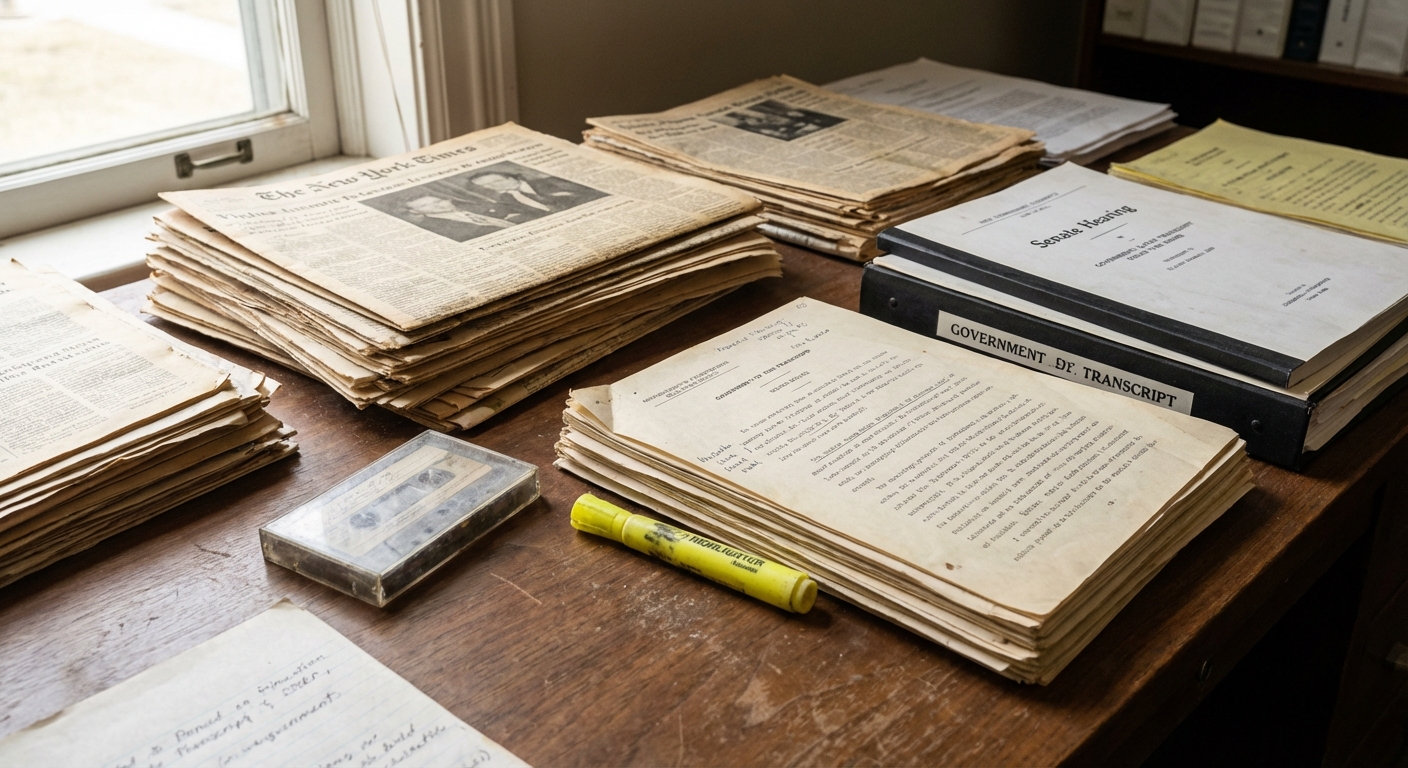
Scope and purpose: this timeline reviews the evidence and major milestones behind the claim commonly called the “Backmasking” panic. It focuses on when and where allegations were first reported, major institutional responses (media, courts, and congressional activity), and key research that tested whether backward-recorded speech can produce covert persuasion. This piece treats the subject as a claim that was asserted and contested; it does not assume the claim’s truth.
This article uses the phrase “Backmasking panic timeline” to describe the sequence of events by which alleged backward messages in recorded music became a public controversy and legal issue. The goal is to show what is documented, what is disputed, and where the evidence is thin or absent.
This article is for informational and analytical purposes and does not constitute legal, medical, investment, or purchasing advice.
Timeline: key dates and turning points
- 1968–1969 — Early curiosity and the “Paul is dead” rumor: Rumors that playing portions of Beatles recordings backwards produced phrases (notably an alleged “turn me on, dead man” on Revolution 9) spread after campus and local radio discussion in 1969; the episode helped popularize the idea that hidden backward messages might exist in records. (source type: contemporary press, later histories).
- 1970s — Sporadic artistic use and listener reports: Some artists experimented with intentionally inserted backward sounds (for creative or humorous effect), and listeners continued to report apparent backwards messages, often after suggestion. These reports remained largely anecdotal and localized in fan and radio communities. (source type: music histories and retrospective reporting).
- 1984–1985 — Growing public concern and the PMRC era: The Parents Music Resource Center formed in 1985 and pushed for greater attention to explicit lyrics and content; in the same cultural moment, concerns about hidden or “satanic” messages in rock music were widely discussed in U.S. media. The PMRC’s activity culminated in a widely publicized Senate hearing on September 19, 1985, where musicians including Dee Snider, Frank Zappa, and John Denver testified about labeling and artistic freedom. (source type: contemporary news coverage and hearing records).
- Mid‑1980s — Scientific testing of backward-message claims: Cognitive researchers, notably J. R. Vokey and J. D. Read, published controlled studies in the 1980s testing whether backward-recorded speech produced persuasive or measurable priming effects; these studies found that listeners typically could not recognize or be primed by backward messages unless suggestion or leading instructions were provided. (source type: peer-reviewed experimental psychology literature and summaries).
- 1985 (December 23) — Tragic event that triggered litigation: Two young men from Reno, Nevada (Ray Belknap and James Vance) attempted a suicide pact after an afternoon of alcohol, drugs, and listening to music; one died immediately and the other was gravely injured. The families later alleged that backmasked messages on Judas Priest’s Stained Class album contributed to the event. (source type: contemporaneous reporting and later case histories).
- 1986–1990 — Civil lawsuit against Judas Priest: Families of the Reno youths filed civil claims that Judas Priest and their label had embedded subliminal backward messages that induced suicide-related behavior; the case proceeded in Washoe County and drew national attention. The trial was held in summer 1990. (source type: newspaper reports, trial coverage).
- 1990 (July–August) — Expert testimony and legal rulings in the Judas Priest matter: The trial included testimony from audio analysts and computer experts who reported hearing or detecting backward syllables; defense experts and psychological research were also cited. The presiding judge ruled against holding the band liable; the case did not establish that backmasked messages were effective causal agents in the tragedy. (source type: trial reports / court reporting).
- 1990s onward — Scholarly and popular reassessment: After the high-profile cases and hearings, academic summaries of the literature and popular reporting commonly found that apparent backward messages are often the product of suggestion, pareidolia (hearing patterns in noise), or coincidental phonetic overlap—and that controlled experiments show weak or no priming effects from backward speech. However, debates about intent (artist insertion vs. listener construction) and the ethics of labeling continued in cultural commentary. (source type: peer-reviewed summaries, mainstream press).
Where the timeline gets disputed
Several points on this timeline are contested or ambiguous; those disputes fall into three categories:
- Did specific songs intentionally contain persuasive backward messages? Some artists did intentionally place reversed phrases for artistic reasons. In many other cited examples, researchers and audio experts found no reliable evidence that messages were intentionally encoded to influence behavior. Scholarly studies conclude that engineered, purposive backmasked persuasion is difficult to demonstrate from audio analysis alone.
- Do backward messages, if present, produce covert behavioral effects? Controlled psychology experiments (for example, work summarized from Vokey & Read and related follow-ups) generally found no robust priming or behavioral influence from reversed speech presented without prior suggestion. Where effects have been reported, they often depended on leading instructions or demand characteristics. That undermines claims that unconscious decoding of backward speech reliably changes behavior.
- Legal causation and liability: Lawsuits (notably the Judas Priest civil case) tested whether backmasked content could be a proximate cause of harm. Courts have considered such claims and in high-profile instances declined to hold artists liable; legal rulings often turned on evidentiary standards, constitutional questions, and the difficulty of proving causal influence from ambiguous audio phenomena. The legal record documents attempts to litigate harm, but does not produce a settled, general legal finding that backmasking causes behavior.
Evidence score (and what it means)
- Evidence score: 38 out of 100.
- Score drivers:
- Strong documentation that a cultural panic occurred: multiple well-documented public events (Beatles-era rumors, the 1985 PMRC moment, and the 1990 Judas Priest litigation) are verifiable in press and public records.
- Weak direct evidence that intentional, persuasive backmasked messages routinely exist in commercial recordings: experimental psychology finds little support that backward speech reliably conveys covert persuasive content.
- Mixed expert testimony in legal settings: audio analysts sometimes detect speech-like patterns when recordings are manipulated, but courts and scientific reviewers note the risk of pareidolia and suggestion.
- Legal outcomes did not establish a causal, generalizable mechanism linking backmasking to complex behaviors like suicide; rather, judges weighed circumstantial evidence and constitutional questions.
Evidence score is not probability:
The score reflects how strong the documentation is, not how likely the claim is to be true.
FAQ
Q: What is meant by the “Backmasking panic timeline” and why does it matter?
A: The phrase describes the documented sequence by which backward-recording allegations moved from anecdote to media phenomenon, public policy debate, courtroom litigation, and scientific testing. The timeline matters because it separates three things: (1) documented events (rumors, hearings, lawsuits), (2) laboratory evidence about perception and priming, and (3) disputed causal claims that backward messages persuaded specific listeners to act.
Q: Did the 1990 Judas Priest trial prove that backmasked messages caused suicides?
A: No. The Reno-area civil case drew intense attention and included expert testimony about alleged backward phrases, but the litigation did not produce a binding finding that backmasked messages caused the deaths. Courts examining such claims have noted the difficulty of proving causation from ambiguous audio phenomena. (See trial reporting and legal summaries.)
Q: What does laboratory research say about backward-recorded speech and influence?
A: Controlled psychology experiments (e.g., Vokey & Read and later studies) generally show listeners do not reliably extract intended meaning from backward speech or show priming effects unless they are led to expect particular phrases—meaning suggestion and pattern‑finding explain many reports. The experimental literature is the strongest direct evidence that simple backward recordings are not an effective subliminal persuasion channel.
Q: Are there documented cases where musicians intentionally used backmasked phrases?
A: Yes—some artists intentionally used reversed sounds for artistic or humorous effect (and sometimes acknowledged doing so). But intentional placement of a backward phrase for artistic effect is different from the claim that artists systematically embedded covert persuasive commands that would reliably alter behavior. Documentation exists for the former; the latter remains unsupported by robust evidence.
Q: If the evidence is mixed, how should readers interpret new claims about backmasked messages?
A: Treat new claims the same way historians and scientists treat earlier ones: ask for primary documentation (original audio, timestamps, master tapes), independent audio analysis, and evidence that the alleged influence is measurable (experimental or epidemiological). Claims that rely on subjective impressions, leading suggestions, or unverified transcripts should be treated as weak until independently corroborated.

Culture writer: pop-culture conspiracies, internet lore, and how communities form around claims.