
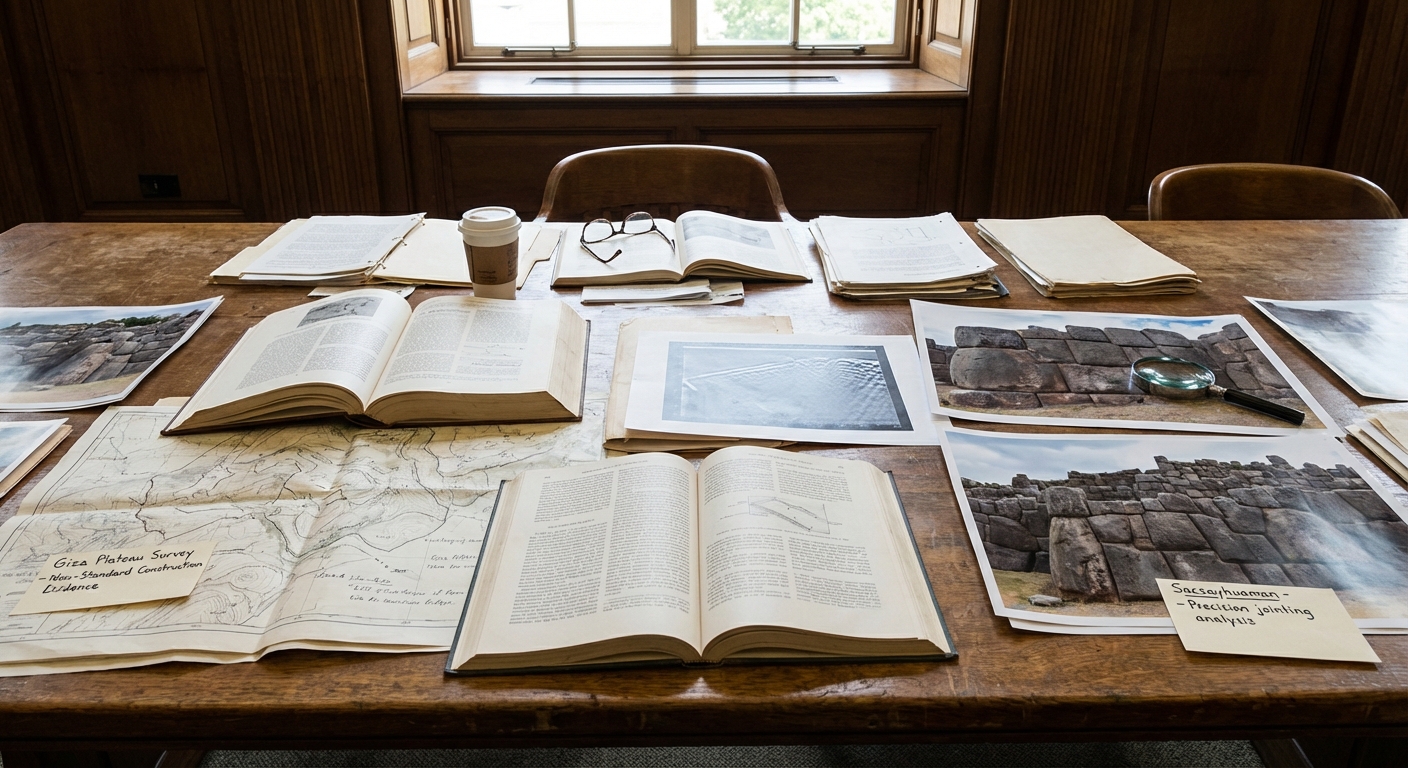
Intro: scope and purpose. This timeline analyzes the claim labeled “Ancient Megastructures ‘Impossible Tech’ Claims” by tracing key dates, documents, and turning points in the public and academic record. The goal is to separate primary documentation and peer-reviewed research from later inferences and sensational retellings so readers can assess the claim on evidence rather than rhetoric. The phrase ancient megastructures impossible tech claims appears throughout as the subject under review.
Timeline: key dates and turning points
- 1901 — Discovery of the Antikythera wreck and fragments of a complex geared mechanism (archaeological find, museum records). The wreck, recovered off Antikythera island, yielded corroded bronze fragments later identified as part of an advanced gears-and-dials mechanism; these fragments entered museum collections and became the basis for later scientific study.
- 2006 — Scientific decoding begins to change the narrative about ancient mechanical complexity (peer-reviewed journal publication). A multidisciplinary team published work reconstructing gearing and astronomical functions of the Antikythera mechanism; this peer-reviewed research established that highly sophisticated mechanical devices existed in the Hellenistic world and challenged earlier assumptions about when such gearing first appeared.
- 1977 (published/permanent record) — Scholarly proposal for moving Baalbek megablocks (specialist archaeological/architectural paper). Jean‑Pierre Adam published a technical study proposing physically plausible methods (capstans, ramps, cribbing) for quarrying and transporting the giant limestone blocks at Baalbek; this work remains a standard technical reference in the specialist literature for explaining how very large monoliths could be moved without invoking non-standard technology.
- 2015–2017 — Non-invasive imaging reveals previously unknown internal spaces in the Great Pyramid (international ScanPyramids project; peer-reviewed publication). Multiple teams using muon radiography reported a large void above the Grand Gallery of Khufu’s Pyramid; the result was published in Nature and confirmed independently by separate detector systems, prompting active scientific discussion about construction sequences and internal architecture.
- 2018 — Göbekli Tepe inscribed on UNESCO World Heritage list; continuing publication on early monumental planning (institutional report and peer-reviewed studies). The designation and ongoing Cambridge Archaeological Journal research highlighted that large, organized, and planned monumental constructions existed far earlier than previously believed, fueling renewed attention to how prehistoric communities achieved complex stone construction in the 10th–9th millennia BCE.
- Ongoing (2000s–2020s) — Advances in imaging, experimental archaeology, and materials analysis refine but also complicate interpretations (peer-reviewed and institutional reports). New imaging, replication experiments, and material studies continue to produce primary data (on quarry marks, tool traces, and engineering techniques), and teams publish models that test specific transport and erection hypotheses. Multiple recent studies propose different construction models for pyramids, megalithic walls, and polygonal masonry, demonstrating active debate rather than settled unanimity.
- 2019–2025 — Renewed reconstructions and computational models (preprints and peer-reviewed articles). Teams publish higher-resolution reconstructions of devices (e.g., Antikythera front-plate reconstructions) and new computational models for pyramid construction and megalith transport; some are peer-reviewed, and others are preprints or conference papers, so their status varies. These works often improve technical understanding but are sometimes adopted in popular accounts as proof of “impossible” ancient technology even when they only present plausible mechanical explanations.
Where the timeline gets disputed
Disputes arise at several junctions along this timeline. First, scholars agree that individual finds—like the Antikythera mechanism—are well documented and peer‑reviewed, but disagreement continues over how much such singular examples should change general narratives about technology diffusion and routine skill levels in premodern societies.
Second, sites with very large stones (for example, Baalbek’s Trilithon and related quarry monoliths) are documented in archaeological and architectural literature, and technical studies (e.g., Jean‑Pierre Adam’s work) propose mechanical solutions using manpower, ramps, capstans, and cribbing. However, these solutions require assumptions about labor organization, temporary works, and lost wooden/earth structures—features that often leave limited direct traces—so some popular accounts frame them as inexplicable or evidence of extraordinary technology. The specialist literature treats Adam’s proposals as plausible engineering solutions rather than proof that only ‘‘impossible’’ technologies could have worked.
Third, newly detected internal features (like the muon-imaged void in Khufu’s Pyramid) are unambiguous in terms of detection but ambiguous in interpretation. The ScanPyramids muon radiography result is a strong technical detection (multiple detector types and an article in Nature), but what the void represents—construction void, relieving chamber, or sequence artifact—remains debated and requires further targeted investigation. Public accounts sometimes treat the existence of unknown spaces as evidence for hidden advanced devices, but that inference is not supported by the available data.
Finally, prehistoric monumental sites such as Göbekli Tepe are well dated and formally recognized (UNESCO inscription), and research documents organizational complexity. The disputed step is whether such complexity implies routine access to technologies beyond the known toolkit of the period or whether sophisticated organization, planning, and large labor pools are sufficient to explain the physical results. In short: documentation of scale or complexity does not automatically document non-standard technology.
Evidence score (and what it means)
- Evidence score: 42/100
- Drivers for this score:
- Several well-documented primary finds (e.g., Antikythera mechanism) show surprising engineering complexity and are supported by peer-reviewed publications.
- Clear institutional documentation (UNESCO listing, published archaeological monographs) for sites such as Göbekli Tepe establishes antiquity and planned monumentality.
- Technical, peer-reviewed or specialist engineering studies provide plausible, replicable methods for moving and placing very large stones (e.g., Jean‑Pierre Adam’s transport proposals for Baalbek), reducing the need to posit non-standard technologies.
- High-quality detections (e.g., muon imaging of the Great Pyramid) demonstrate unknown elements exist but do not by themselves identify advanced or anachronistic technology.
- Widespread popular claims often conflate scale with impossibility; many popular sources lack primary documentation or rely on selective interpretation. The lower half of the score reflects the gap between documented data and extraordinary claims about ‘‘impossible tech.’’
Evidence score is not probability:
The score reflects how strong the documentation is, not how likely the claim is to be true.
This article is for informational and analytical purposes and does not constitute legal, medical, investment, or purchasing advice.
FAQ
Q: Do documented finds like the Antikythera mechanism prove the broader ancient megastructures impossible tech claims?
A: No. The Antikythera mechanism is a well-documented, peer-reviewed example of high mechanical sophistication in the Hellenistic period, but a single documented device does not by itself prove that large-scale monuments worldwide were built using the same specialized technologies or by a lost high-tech civilization. The mechanism’s documentation is strong and published in peer-reviewed outlets; inferences that generalize it to all ancient megalithic construction go beyond the evidence.
Q: What is the strongest documented evidence people cite for “impossible” ancient construction?
A: The strongest documented items are (1) well-published archaeological finds and analyses (for example, the Antikythera fragments and their technical reconstructions), (2) large-scale measurable features (mass/volume of Baalbek stones; internal muon-detected voids in pyramids), and (3) peer-reviewed engineering studies that reconstruct feasible methods. These are primary documents that should be distinguished from speculative popular narratives.
Q: How reliable are claims about Baalbek’s “unmovable” stones?
A: Measurements and field records show enormous monoliths in the Baalbek quarry and podium; the specialist literature (e.g., studies by Jean‑Pierre Adam and subsequent archaeological reports) offers mechanical explanations using known ancient techniques (capstans, ramps, cribbing). While logistics and temporary works may leave limited traces, expert analysis treats these stones as explicable by human engineering rather than as proof of non-standard technology.
Q: Are there comprehensive dates or documents I can check to evaluate ancient megastructures impossible tech claims myself?
A: Yes. Start with peer-reviewed and institutional records: (1) the 2006/2017 peer-reviewed work on the Antikythera mechanism and subsequent reconstructions; (2) Jean‑Pierre Adam’s technical paper on the Baalbek trilithon; (3) the ScanPyramids Nature report on muon imaging of Khufu’s Pyramid; and (4) archaeological summaries and UNESCO documentation for Göbekli Tepe. Those primary sources document measurements, methods, and uncertainties you can examine directly.
Q: How should a reader treat the phrase ancient megastructures impossible tech claims when they encounter it online?
A: Treat it as a claim that requires three checks: (1) is there primary, dated documentation (archaeological report, peer-reviewed article, or museum record)? (2) is the claimed inference supported within the primary source or introduced later by commentators? (3) where the interpretation is controversial, are alternative, peer-reviewed explanations available? If primary sources exist, read them; if not, treat dramatic conclusions skeptically.

Science explainer who tackles space, engineering, and ‘physics says no’ claims calmly.