
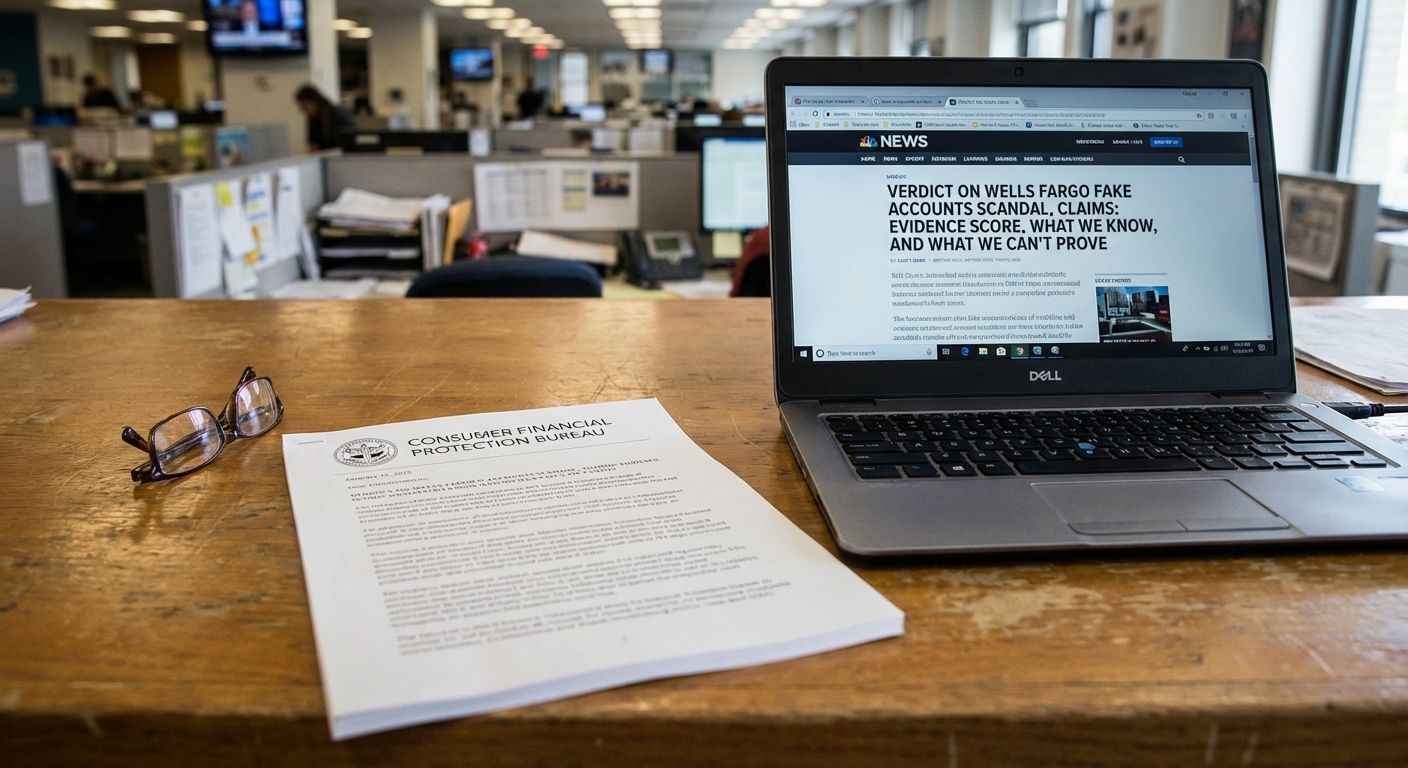
This article examines claims surrounding the Wells Fargo fake accounts scandal, framing the subject as a claim to be tested rather than an accepted fact. We review primary regulator documents, major investigative reporting, company statements, and subsequent enforcement actions to separate what is documented, what is plausible but unproven, and what is contradicted or unsupported. The phrase “Wells Fargo fake accounts scandal” appears throughout because it is the central claim under review.
This analysis relies on public agency orders and major reporting; when sources conflict we flag those conflicts rather than speculate. Key primary documents include the Consumer Financial Protection Bureau consent order and related filings, notices from the Office of the Comptroller of the Currency, and contemporaneous reporting from major outlets. Where possible, we cite those records directly.
This article is for informational and analytical purposes and does not constitute legal, medical, investment, or purchasing advice.
Verdict: what we know, what we can’t prove
What is strongly documented
Regulatory orders and company disclosures demonstrate a set of documented enforcement actions and remedial steps tied to account-opening practices at Wells Fargo.
- In September 2016 the CFPB issued a consent order against Wells Fargo related to unauthorized account openings and ordered penalties and remediation; that order is publicly available.
- Wells Fargo itself disclosed that an internal and external review identified millions of retail accounts opened or enrolled without clear customer authorization; the bank reported expanded totals in follow-ups through 2017. Reporting on the bank’s own expanded review indicated around 3.5 million potentially unauthorized accounts from 2009 through 2016.
- Congressional testimony and public hearings documented executive-level accountability and public scrutiny: senior executives (including then-CEO John Stumpf) testified before the Senate Banking Committee in September 2016. Reporting from multiple outlets and the hearing record capture those events.
- Federal regulators took formal supervisory and enforcement steps after the revelations, including civil money penalties and restrictions on Wells Fargo’s growth, reflecting documented supervisory findings. For example, the Federal Reserve in 2018 imposed growth restrictions and regulators later communicated changes to those constraints.
What is plausible but unproven
Certain claims tied to motive, the full scale beyond disclosed numbers, and precise individual criminal intent remain plausible given the documented incentives and internal sales practices but are not fully proven by the public record available to date.
- That an aggressive sales culture and quota-driven incentives materially encouraged employees to open accounts they should not have is supported by internal reviews and regulator commentary, but attributing specific decisions to explicit corporate directives versus local branch pressure is a contested inference. Reporting and regulator documents describe a problematic sales culture, but the degree to which senior leadership explicitly directed illegal account openings remains disputed.
- Estimates of the total number of unauthorized or fake accounts vary by report and method. Wells Fargo’s expanded review produced one widely cited figure (about 3.5 million potentially unauthorized accounts through September 2016), but different reviews, later settlements, and additional reviews have adjusted totals for overlapping issues and different definitions. Higher or lower counts beyond what companies and regulators reported are possible but not established.
- Allegations of widespread criminal conspiracy involving senior executives are sometimes raised in commentary; however, criminal charges against top executives for account openings have not been sustained in the public record in the same way the civil and administrative enforcement actions were. The existence of criminal culpability for specific executives therefore remains unproven in the public files we reviewed.
What is contradicted or unsupported
Some stronger variants of the claim—such as definitive allegations that leadership orchestrated a company-wide criminal conspiracy proven in court—are not supported by the public evidence collected in enforcement actions and reporting.
- While regulators documented failures and imposed penalties, the public enforcement record emphasizes civil and administrative remedies (consent orders, fines, restitution, and supervisory sanctions) rather than sustained, broad-based criminal convictions of senior executives tied specifically to account openings. Assertions that there is an undisputed criminal conviction establishing leadership-level guilt are not supported by the public enforcement record we reviewed.
- Claims that every instance of account opening flagged was definitively fraudulent in the same legal sense are not supported. Regulators and Wells Fargo used language such as “unauthorized,” “potentially unauthorized,” or “improperly opened/enrolled,” reflecting different investigative thresholds and remedial approaches; blanket statements that treat every flagged account as criminally fraudulent overreach the documentation.
Evidence score (and what it means)
Evidence score is not probability:
The score reflects how strong the documentation is, not how likely the claim is to be true.
- Evidence score (0–100): 72 — documentation is substantial on many enforcement and remediation facts but leaves gaps for causal and criminal-intent claims.
- Score drivers: multiple primary regulator documents and public consent orders; contemporaneous congressional hearings and major investigative reporting; company admissions and remediation actions (refunds, firing of employees, internal reviews).
- Lowering factors: variable language across documents (“unauthorized” vs. “fraudulent”), differences in account-count methodologies, and limited public evidence proving specific individual criminal intent at senior levels.
- Conflicting or evolving totals and later regulatory easing of some supervisory constraints create ambiguity for long-term assessments.
- Independent third-party investigations and court settlements supply corroborating detail for many remedial facts, which supports a moderately high documentation score despite unresolved questions.
Practical takeaway: how to read future claims
When you see new or recycled claims about the Wells Fargo fake accounts scandal, evaluate the source and the form of evidence offered:
- Prefer primary documents (consent orders, regulatory press releases, court filings) over anonymous social posts. Our review relies on CFPB, OCC, and contemporaneous reporting because those are primary or high-trust secondary sources.
- Watch for conflation of terms. Journalists and regulators use different technical terms—”unauthorized,” “potentially unauthorized,” “improperly opened”—which have different meanings for investigation, civil enforcement, and criminal law. Treat sweeping language with caution unless tied to a legal finding.
- Check dates and updated findings. Initial counts changed as Wells Fargo expanded its review; later regulatory steps (including easing of some constraints) do not negate earlier findings but do reflect a longer remediation timeline. If a claim uses a single number without context, seek the primary source and date.
- Distinguish remedial action from criminal guilt. Civil and administrative penalties, board changes, and executive departures are documented; criminal prosecutions and convictions require a different evidentiary standard and have different public records. Claims that equate the two should be scrutinized for supporting documents.
FAQ
How many accounts were involved in the Wells Fargo fake accounts scandal?
Counts differ by source and methodology. Wells Fargo’s expanded review publicly reported roughly 3.5 million potentially unauthorized accounts opened between 2009 and September 2016; regulators, reporting, and later company disclosures used related but sometimes different totals depending on scope and criteria. Because different reviews used different definitions, a single definitive total is not established in all public records.
What penalties did regulators impose?
Regulators issued consent orders, fines, and supervisory restrictions. The CFPB’s September 2016 consent order and related administrative actions required penalties, remediation to customers, and independent reviews. The Federal Reserve later imposed restrictions on Wells Fargo’s growth, and other state and federal settlements followed. These enforcement actions are documented in public regulator releases and press reporting.
Did executives face criminal charges?
Public enforcement largely consisted of civil and administrative actions; while executives were publicly criticized and some left the company, the public record of that period does not show broad criminal convictions of top executives tied directly to the account-opening practices in the same way the civil remedies were pursued. Assertions of proven criminal guilt at leadership levels go beyond the public enforcement record we reviewed.
How should I evaluate new claims about the Wells Fargo fake accounts scandal?
Look for primary evidence (regulatory orders, court filings, bank disclosures), check whether the claim is citing a date or review, and note whether a claim conflates administrative penalties with criminal convictions. If a claim involves account counts or intent, verify the methodology and whether independent reviews corroborate the number.
Does the phrase “Wells Fargo fake accounts scandal” reflect legal findings or media shorthand?
Often it is a media shorthand summarizing a series of documented regulatory and company findings about unauthorized or improperly opened accounts and the bank’s sales practices. The precise legal characterization varies by document—regulators used terms like “unauthorized” and pursued civil remedies—so the shorthand is useful for discussion but should be unpacked against primary documents for legal nuance.
Sources and notes on conflicts
The most important primary sources include the CFPB consent order and publicly available regulatory releases and bank disclosures; major reporting by outlets such as The Washington Post, CNBC, and others documented hearings and reporting-era totals. Different sources report slightly different account totals and use different language about intent. We do not attempt to reconcile every numerical discrepancy here; instead we present the documented enforcement actions and indicate where counts or interpretations diverge. Key sources used in this review include the CFPB consent order and contemporaneous press and regulator statements.
If you want the primary documents cited in this article: see the CFPB consent order (September 2016), OCC notices, and major reporting marked above; consult the original PDFs and regulator archives for full text and appendices. Where sources conflict we have noted the conflict and avoided speculative conclusions.

Finance/corporate scandal writer: fraud cases, market manipulation claims, and evidence standards.