
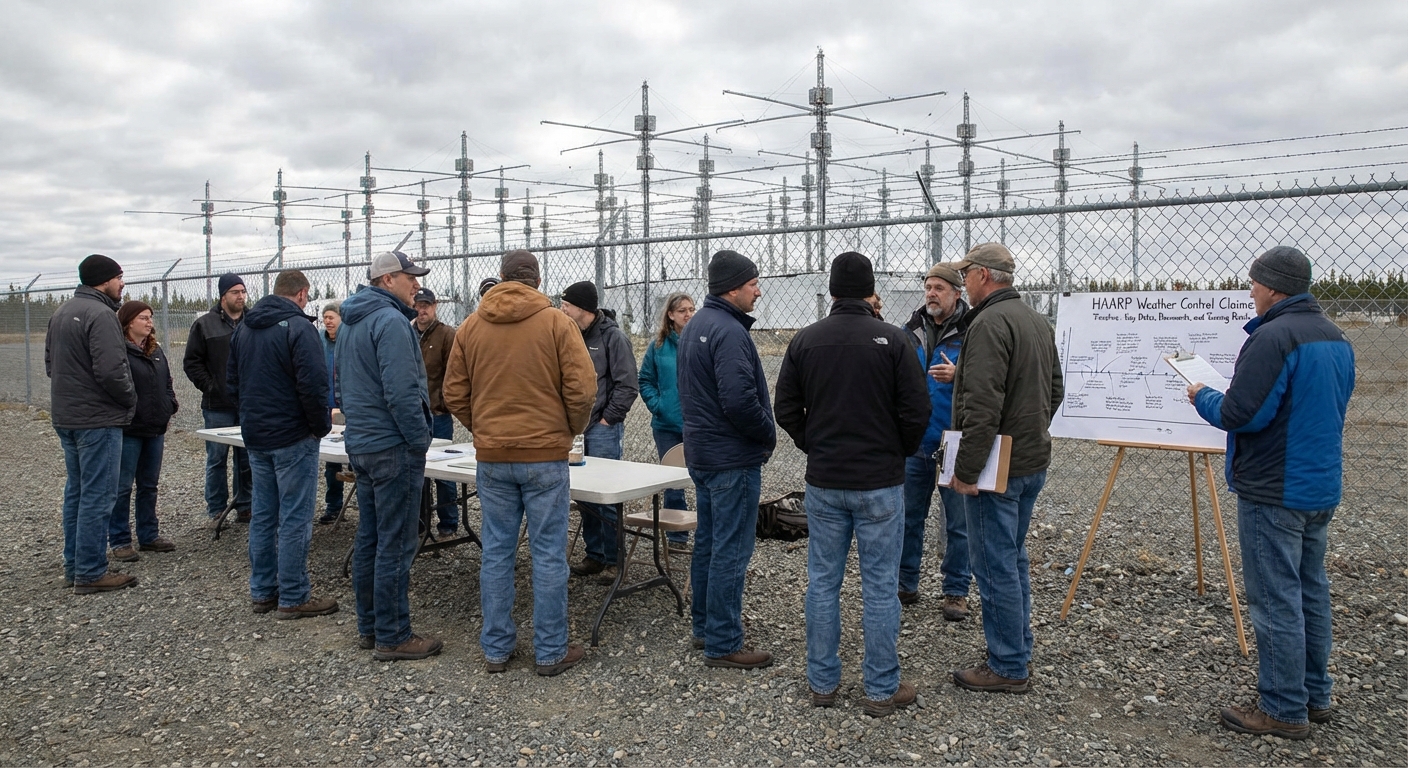
Scope and purpose: This timeline surveys the claim that HAARP can control the weather. It collects primary documents, official statements, notable media events, and scientific papers so readers can see what is documented, what is disputed, and what remains unproven. The article treats “HAARP weather control claims” strictly as a claim and does not assume it to be true.
Timeline: key dates and turning points — HAARP weather control claims
- August 11, 1987 — Patent published (US 4,686,605). Bernard J. Eastlund was granted U.S. Patent 4,686,605, titled “Method and apparatus for altering a region in the earth’s atmosphere, ionosphere, and/or magnetosphere.” The patent describes high-power electromagnetic techniques in broad terms that later became focal points for speculation. (Patent document — primary source).
- 1993–2007 — Construction and commissioning of HAARP facility in Gakona, Alaska. Construction and phased transmitter upgrades occurred across the 1990s and 2000s, with the site built to host HF transmitter experiments for ionospheric research. The facility’s technical purpose — active ionospheric experiments for communications and geospace science — is recorded in program materials and later institutional descriptions. (Program descriptions, construction summaries).
- 1995 — Publication of popular book raising public alarm: Angels Don’t Play This HAARP. Authors Nick Begich and Jeane Manning published a book that compiled speculative connections between HAARP-like technology and potential weather, communication, and control applications; the book is widely cited in later conspiracy-materials as a formative source. (Book — secondary source that influenced public discourse).
- 2000s — Scientific ionospheric-heating experiments and peer-reviewed/technical reports. Experiments at HAARP and related heaters (and at other international ionospheric heaters) documented localized ionospheric effects such as weak artificial ionization, plasma irregularities, and radio-wave scattering. These results are reported in technical reports and academic papers describing highly localized, small-scale ionospheric perturbations — not large-scale weather modification. (Technical reports, arXiv preprints).
- 2007–2009 — Media coverage highlights scientific aims and conspiracy claims. Major outlets (e.g., Wired, Nature coverage) described HAARP’s scientific program while also reporting on conspiracy theories; coverage broadened public awareness and helped shape later online claims. (High‑profile journalism).
- December 2, 2009 — Television episode amplifies claims: “Conspiracy Theory with Jesse Ventura” (HAARP episode). A mainstream cable program devoted an episode to HAARP-related claims, bringing conspiracy framings to a broader audience. (Television episode — secondary media event).
- May–June 2014 — Air Force announces program shutdown and end of experiments. The U.S. Air Force notified that HAARP operations by the military would cease; a final period of military experiments ended in summer 2014 and plans to shutter the program were publicized, which in turn affected public debate and online sharing. (Official military program announcements, press coverage).
- August 11, 2015 — Formal transfer of HAARP facilities and equipment to University of Alaska Fairbanks. Responsibility and operation of the Gakona site transferred from the Air Force to UAF’s Geophysical Institute; UAF published FAQs about the facility’s purpose and listed subsequent research campaigns organized under university management. (University of Alaska official pages and news reporting).
- 2015–2022 — Continued research campaigns, public openness, and recurrent claims. Under UAF stewardship, HAARP ran multiple research campaigns (2017 onward listed on the HAARP FAQ), while periodic extreme-weather events and online narratives continued to revive claims that HAARP was responsible for storms, droughts, or earthquakes — often citing the Eastlund patent or linking photographs of the antenna array to alleged effects. (UAF campaign logs; ongoing fact checks).
Where the timeline gets disputed
Disputes fall into three broad categories: (1) interpretation of primary technical documents (for example, whether Eastlund’s patent is evidence of deployed weather‑control capability), (2) scaling and physics (whether the documented, localized ionospheric effects could plausibly cause large-scale weather changes), and (3) inference from coincidence or temporal correlation (claims that HAARP transmissions coincided with a weather event imply causation).
- Patent interpretation — The Eastlund patent is sometimes presented as a blueprint proving HAARP’s weather‑control role. The patent exists and uses broad language about manipulating ionospheric regions, but a patent is an asserted invention, not evidence of system deployment or operational capability at weather‑control scale. Primary patent text is available.
- Physics and energy scale — Scientific and program documents show HAARP heats very small ionospheric volumes for diagnostic experiments; peer-reviewed work and program reporting indicate the effects are localized and energetically minuscule compared with the total energy in tropospheric weather systems. Where sources disagree is mainly about the magnitude of effect and whether localized ionospheric changes could cascade into weather changes at surface levels; mainstream scientific literature and program statements note such scaling is not supported by available evidence.
- Official denials and fact checks — Institutional statements and multiple fact-checking organizations state HAARP is not a weather-control weapon and cannot plausibly cause major weather events. Skeptics and some investigators point to the patent language and historical funding for military research to argue for continued concern about dual-use risks. These positions conflict in emphasis: official pages describe scientific aims and limits, while critics highlight patents and program history as circumstantial evidence. Readers should note the sources differ in type and evidentiary weight.
Evidence score (and what it means)
Evidence score: 18 / 100
- Score drivers: Primary official documentation (program descriptions, UAF FAQ) clearly documents HAARP’s stated research purpose and lists experiments, which reduces the plausibility that HAARP is a documented operational weather‑control system.
- Score drivers: The Eastlund patent is an authenticated primary document that describes high‑power electromagnetic concepts; however, patent claims are not the same as deployed capability, and the patent is not direct evidence HAARP implemented those large-scale functions.
- Score drivers: Peer‑reviewed and technical literature describes only localized ionospheric effects from HF heating; these do not demonstrate large‑scale tropospheric weather control and thus weaken claims of weather manipulation.
- Score drivers: Repeated fact checks and institutional statements explicitly state HAARP cannot be used to control weather; these are authoritative but do not directly disprove every speculative inference drawn from patents or historical military interest.
- Score drivers: Much of the public narrative rests on correlation, media amplification, and secondary sources (books, TV episodes) rather than on primary operational documents proving weather control.
Evidence score is not probability:
The score reflects how strong the documentation is, not how likely the claim is to be true.
FAQ
What exactly are the “HAARP weather control claims”?
These claims assert that the HAARP transmitter array in Gakona, Alaska, or related technologies can purposefully modify large‑scale weather (storms, hurricanes, droughts) or trigger earthquakes by beaming energy into the ionosphere. The documented basis for the claim commonly cited includes the Eastlund patent and HAARP’s ionospheric‑heating research activities; however, patent language and small‑scale ionospheric experiments are not direct evidence of operational weather control.
Does the Eastlund patent prove HAARP was built to control weather?
No. The Eastlund patent (US 4,686,605) is an authenticated inventor’s patent that outlines theoretical methods for altering atmospheric regions; patents describe possible inventions, not necessarily implemented systems. Independent analyses and HAARP program descriptions show HAARP’s installed transmitter power and experimental aims did not match the large‑scale weather‑control scenarios described by some interpreters of the patent.
Have scientists observed any HAARP effect that could change weather?
Scientists observed localized ionospheric responses to HF heating (for example, small artificial ionization and plasma irregularities). These effects are measurable at ionospheric altitudes and useful for communications and space‑physics research, but published experiments and technical reviews do not demonstrate the ability to control tropospheric weather systems such as hurricanes or large storm tracks.
Why do these claims keep resurfacing after HAARP was transferred to UAF?
Several factors keep the claims alive: (1) the presence of a visually striking antenna array, (2) the prior existence of patents and military funding that attract attention, (3) amplification by books, television, and online communities, and (4) the human tendency to seek simple explanations for extreme weather events. UAF’s transfer and public access efforts have reduced secrecy, but public distrust and selective citation of patents or technical language keep the narratives circulating.
This article is for informational and analytical purposes and does not constitute legal, medical, investment, or purchasing advice.

Science explainer who tackles space, engineering, and ‘physics says no’ claims calmly.