
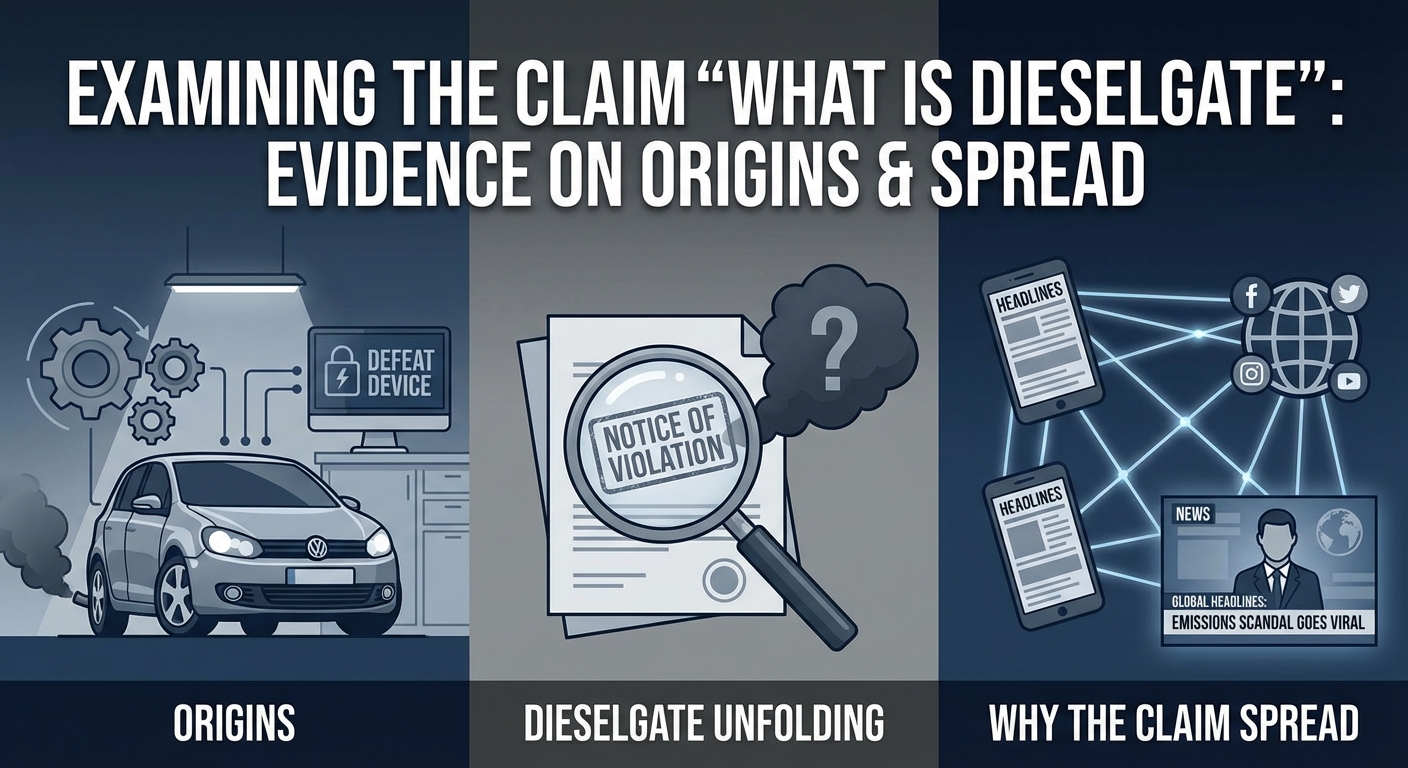
This article examines the claim framed as “What Is Dieselgate (Volkswagen Emissions Scandal)”. It treats the subject as a claim and asks: what is documented in primary sources, what conclusions are inferred from those documents, and where important disputes or gaps remain. The text below separates documented records (agency notices, court filings, settlements), plausible but unproven inferences, and contradictions or limits in the public record.
What the claim says
Broadly summarized, the claim known as “Dieselgate (Volkswagen Emissions Scandal)” alleges that Volkswagen installed software in certain diesel-powered vehicles that detected emissions testing conditions and changed engine controls so the cars met laboratory emissions limits during tests but emitted far higher levels of nitrogen oxides during normal driving. The claim includes related allegations that the company misled regulators and consumers and that millions of vehicles were affected worldwide. Primary government notices and later legal filings describe these assertions and the regulatory response.
Where it came from and why it spread
The earliest documented technical trigger for the investigation was research commissioned by the International Council on Clean Transportation and carried out by researchers at West Virginia University. That work used portable emissions measurement systems in on-road testing and found that two Volkswagen models produced substantially higher NOx in real-world driving than laboratory test reports indicated. The ICCT publicly shared these findings with regulators, which helped prompt formal regulatory inquiries.
Regulatory escalation followed. The U.S. Environmental Protection Agency and the California Air Resources Board issued notices in September–November 2015 alleging the presence of a prohibited “defeat device” (software or hardware that bypasses emissions controls) in specified VW, Audi and Porsche diesel models; the EPA’s Notice of Violation is a central primary document cited in legal and regulatory actions. Those notices, and subsequent DOJ criminal filings and civil settlements, were widely reported by international media; the combination of an independent academic finding, government action, and large corporate and legal consequences helped rapid dissemination across mainstream and social media channels.
Volkswagen’s own public statements and the company’s announcement that a broad set of models might require refitting (commonly reported as up to ~11 million vehicles worldwide) further amplified coverage and public interest. Different outlets used the shorthand “Dieselgate” (echoing the “-gate” convention) which increased searchability and social sharing; this coinage also framed the story as a high-profile corporate scandal.
What is documented vs what is inferred
Documented (primary evidence):
- Regulatory notices and filings: The EPA issued a Notice of Violation alleging defeat-device software in model-year 2009–2015 2.0L vehicles and later for certain 3.0L vehicles; those notices describe the testing findings and legal theory under the Clean Air Act.
- Independent technical testing: ICCT-funded on-road testing using PEMS (conducted with West Virginia University) documented large discrepancies between lab-cycle and real-world NOx emissions in specific VW models; ICCT’s public materials identify that research as the trigger for regulator inquiries.
- Legal action and resolutions: U.S. Department of Justice criminal information and plea agreements, plus multi-billion-dollar civil and consumer settlements with EPA/CARB/FTC, are part of the public record and document charges, plea terms, and settlement amounts in the U.S. context.
Inferred or plausibly interpreted (but not fully documented in a single public record):
- Scope of internal decision-making: Court filings and indictments allege long-running conspiratorial conduct and name some individuals, but the full internal deliberations and who authorized specific programming choices remain partly inferred from fragmentary documents, testimony, and redacted filings. DOJ filings document some conspiratorial allegations, but many corporate-level motivations and communications remain redacted or contested.
- Technical intent vs engineering trade-offs: Public filings and admissions indicate that software caused altered emissions behavior; inferring corporate intent (e.g., intentional deception versus aggressive engineering choices that crossed legal lines) depends on combining multiple documents, witness statements, and settlements rather than a single incontrovertible record. That nuance is why many legal actions targeted both corporate liability and individual prosecutions.
Contradicted, uncertain, or limited items:
- Precise global vehicle counts: Volkswagen and regulators gave different numeric scopes at different times (U.S. model counts differ from later global estimates reported by news organizations). Multiple reputable sources report ~11 million vehicles worldwide and roughly 482,000–500,000 in the U.S., but specific engine families and model-year inclusions were clarified over time and varied between jurisdictions. Readers should treat single global totals as estimates derived from company statements and regulator testing rather than immutable facts.
- Health-impact quantification: Several analyses estimate public-health impacts from increased NOx, but translating higher tailpipe emissions into concrete, localized health outcomes requires atmospheric modeling and assumptions about exposure—some studies quantify impacts, others are more circumspect. The basic link between NOx and respiratory harms is well established, but the magnitude attributable to these vehicles at specific locations remains a modeling exercise with uncertainty.
Common misunderstandings
- “The EPA simply proved VW cheated” — partial simplification: The EPA issued Notices of Violation and DOJ filed criminal charges; these are formal legal steps that reflect allegations and charges, and subsequent plea agreements and court actions resolved many U.S. claims. Saying “proved” oversimplifies the legal process and ignores that some jurisdictional investigations continued or produced different remedies.
- “All Volkswagen diesels everywhere were identical” — not accurate: The problem involved specific engine families and model years; regulators and VW treated 2.0L and certain 3.0L engines separately, and fixes/recalls varied by engine family and region. Different national approval systems and testing cycles complicated any single global statement about affected cars.
- “Dieselgate is only a US story” — incorrect: The U.S. regulatory action was a focal point, but European regulators, prosecutors, and other national authorities also investigated, and many vehicles outside the U.S. were part of the scope reported by the company and press. Responses (recall formats, approvals, consumer remedies) differed by jurisdiction.
Evidence score (and what it means)
- Evidence score: 85/100
- Drivers of the score:
- 1) Strong primary documentation: EPA Notices of Violation, DOJ case filings and plea agreements, and multi-billion-dollar settlements provide high-quality primary documentation about regulatory allegations and legal resolutions.
- 2) Independent technical tests: ICCT-funded on-road testing (WVU PEMS data) is a transparent, reproducible technical source that initiated regulatory review.
- 3) Multiple corroborating media and regulatory reports: National and international coverage, plus EPA/FTC settlement notices, corroborate the broad contours of the claim and its public consequences.
- 4) Remaining uncertainties: Some corporate internal actions, the precise chain of command, and exact numeric scopes in all jurisdictions remain partly redacted, litigated, or dependent on company disclosures over time. This reduces a perfect score.
- 5) Scientific vs legal gaps: While emissions measurements and legal allegations align, converting emissions differences into exact public-health totals or attributing all internal decisions to explicit criminal intent involves inference from available documents.
Evidence score is not probability:
The score reflects how strong the documentation is, not how likely the claim is to be true.
What we still don’t know
Several important gaps remain in the public record or are litigated and partially sealed: the full content of internal communications that would definitively map authorization decisions; the detailed chain of responsibility across different VW brands and suppliers; precise global counts by engine family as they were corrected over time; and fully transparent independent assessments of the long-term health and environmental impacts attributable to these particular vehicles across different cities. Where documents are missing or redacted, researchers and journalists have used court filings, whistleblower testimony, and company statements to build a working narrative—this is useful but incomplete.
FAQ
Q: What Is Dieselgate (Volkswagen Emissions Scandal) — is that an official name?
A: The term “Dieselgate” is a media shorthand, not an official legal term. Regulators and courts use formal descriptions such as the Volkswagen emissions violations, the EPA’s Notice of Violation, or specific case names (for example, United States v. Volkswagen). The nickname follows a familiar pattern (\”-gate\”) used by press and commentators to label scandals.
Q: Who first reported the discrepancy that led to the investigation?
A: Independent researchers working under an ICCT project—technicians and researchers from West Virginia University—conducted on-road PEMS testing in 2013–2014 and found discrepancies between lab-certified emissions and real-world NOx emissions for two Volkswagen models. The ICCT publicly shared these results with regulators, which helped trigger formal regulatory inquiries.
Q: Did regulators find a “defeat device” and what does that mean legally?
A: The EPA and CARB issued Notices of Violation alleging that certain VW vehicles contained software meeting the statutory definition of a “defeat device”—a system that bypasses or reduces the effectiveness of required emission controls under test conditions. Those notices form the core of administrative and civil allegations under the Clean Air Act; subsequent DOJ filings and settlements addressed criminal and civil liability in the U.S. context.
Q: How many vehicles were affected?
A: Reported totals evolved. The EPA’s early U.S. notices referenced roughly 482,000–499,000 U.S. vehicles for specific engine families, while widely reported company statements and press coverage described an estimated ~11 million vehicles worldwide as potentially affected. Exact counts vary by engine family, model year, and jurisdiction, and some figures were refined as regulators and the company provided more information. Treat all totals as estimates based on company statements and regulator testing records.
Q: What were the legal outcomes in the U.S.?
A: In the U.S., Volkswagen and related entities reached multi-billion-dollar civil settlements addressing consumer compensation and environmental mitigation, the company entered into a guilty plea and paid criminal penalties under a DOJ agreement, and several individuals and suppliers faced charges, plea agreements, or sentences. The DOJ maintains case pages and filings that summarize charges, plea terms, and sentencing for corporate and individual defendants.
This article is for informational and analytical purposes and does not constitute legal, medical, investment, or purchasing advice.

History-focused writer: declassified documents, real scandals, and what counts as evidence.