
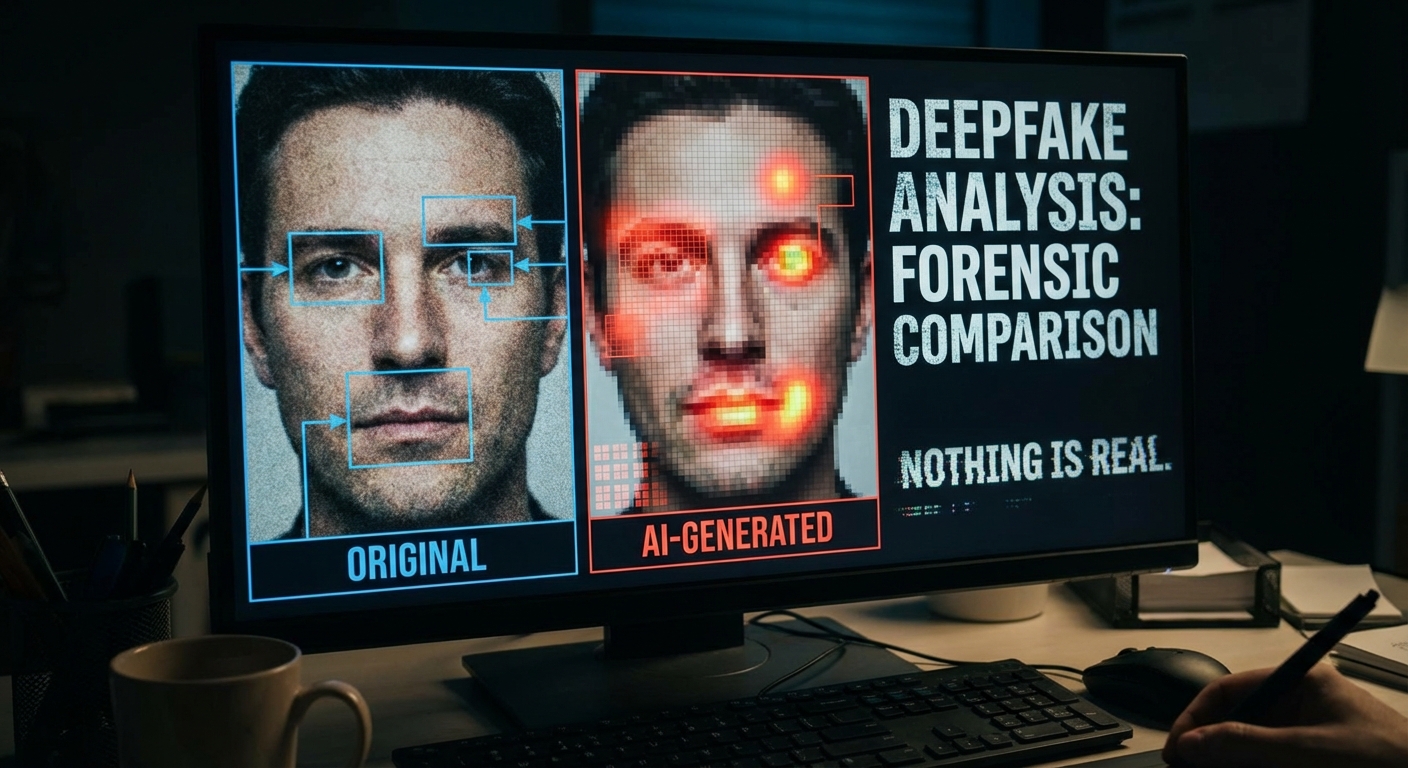
This article tests the claim “Deepfakes and ‘Nothing Is Real’ Panic” against the strongest counterevidence and expert explanations. We treat the phrase as a claim about societal risk and public perception, not as an established fact, and summarize where documentation is solid, where findings conflict, and what remains unproven.
The best counterevidence and expert explanations
- Laboratory studies show humans frequently struggle to identify deepfakes, but machine detectors currently outperform unaided humans in controlled tests. Multiple experiments comparing human viewers to state-of-the-art detection models found better average model performance on the same test sets, indicating that human intuition alone is an unreliable defense.
Why it matters: this undermines the idea that ordinary viewers can reliably police authenticity by eye alone. Limits: many lab datasets are curated and may not reflect real-world, platform-driven mixes of content quality and context.
- Detection research has advanced rapidly, with new prototype- and multimodal detectors reporting high accuracy on benchmark datasets; these improvements show technical progress that counters the claim that detection is hopeless. Recent academic work presents frameworks that achieve strong performance on established test sets.
Why it matters: available technical countermeasures reduce the “nothing is provable” narrative. Limits: high benchmark scores do not guarantee robustness against unknown generation methods or adversarial manipulation in the wild.
- At the same time, adversarial research demonstrates practical vulnerabilities: attacks that introduce subtle attribute changes or pixel-level perturbations can defeat many detectors and remain largely imperceptible to humans. This line of work documents realistic pathways for bad actors to bypass automated systems.
Why it matters: it contradicts simple optimism that detectors alone make deepfakes a manageable problem. Limits: most adversarial attacks are shown in controlled settings; translating them to mass-scale abused content involves operational hurdles for attackers.
- Policy and platform responses are active and evolving, not absent. Governments and legislatures have proposed or enacted measures targeting non-consensual or harmful deepfakes and labeling requirements, indicating institutional recognition and partial mitigation steps rather than universal helplessness. Reporting and bills show policy attention to labeling, removal, and legal remedies.
Why it matters: the existence of policy responses and legal proposals counters the narrative that institutions are entirely powerless. Limits: laws and platform rules vary by jurisdiction and often lag technical change.
- Public-trust empirical surveys indicate complexity: people’s trust in experts and institutions is mixed but not uniformly collapsed. High-level surveys of public trust in scientists or institutions show nuance rather than universal disbelief, which challenges broad claims that society has entered a permanent “nothing is real” state.
Why it matters: social resilience and selective trust reduce the likelihood of a total epistemic collapse. Limits: trust metrics are indirect evidence and may not track rapid, localized misinformation spikes.
Alternative explanations that fit the facts
- Technological progress plus hype: improvements in generative models increase sensational headlines, but incremental detection and policy responses moderate net risk in many contexts. The interplay of hype cycles and real capability gains explains why public alarm can overshoot measured harms.
- Context amplification: platform algorithms, viral trends, and selective sharing — not every deepfake — determine visibility and harm. Social dynamics often exacerbate a small number of high-profile incidents into broader panic.
- Adversary-level constraints: creating widely persuasive, high-volume, targeted deepfakes at scale requires resources, data, and operational tradeoffs. This limits how many convincing forgeries can be weaponized for specific populations or events.
What would change the assessment
- Stronger evidence of mass, successful campaigns using undetected deepfakes to change election outcomes, public policy, or large financial transfers would increase concern. Documentation would need to include traced attribution and measurable impact.
- A demonstrated collapse of detection systems in live platforms (e.g., adversarial techniques reliably evading deployed detectors at scale) with corroborated case studies would downgrade confidence in current mitigations. Peer-reviewed replication would be key.
- Conversely, independent audits showing robust, generalizable detector performance across diverse real-world content, plus effective platform labeling and rapid takedown procedures, would strengthen the counterevidence to the panic claim.
Evidence score (and what it means)
- Evidence score: 58/100
- Score drivers: multiple peer-reviewed and preprint studies show humans are poor at detecting many deepfakes but models often outperform humans in lab settings.
- Detection methods have improved on benchmarks, supporting a partial counter to the “nothing is real” claim, but robustness gaps remain, especially against adversarial attacks.
- Policy activity and platform responses provide real-world mitigation, but laws and enforcement are inconsistent.
- Public-trust data suggest nuance: distrust is not uniform or absolute, reducing the plausibility of total epistemic collapse.
- Missing elements: large-scale, well-documented cases linking undetectable deepfakes to decisive real-world harms are limited or contested.
Evidence score is not probability:
The score reflects how strong the documentation is, not how likely the claim is to be true.
This article is for informational and analytical purposes and does not constitute legal, medical, investment, or purchasing advice.
FAQ
Q: Can ordinary viewers tell real videos from deepfakes — is the “Deepfakes and ‘Nothing Is Real’ Panic” claim justified?
A: Controlled studies show ordinary viewers often cannot reliably detect deepfakes and may overestimate their skill; however, automated detectors in research settings often outperform humans on benchmark tests. This combination explains public worry but does not by itself prove that “nothing is real” across media ecosystems.
Q: Do detectors solve the problem?
A: Detection systems have improved and can be effective on many datasets, but they are not foolproof. Research documents adversarial methods that can evade detectors, and operational deployment on platforms introduces new challenges. Evidence therefore supports cautious optimism rather than certainty.
Q: Are policymakers acting, and does that reduce the risk?
A: Yes — legislatures and regulatory proposals in multiple countries have targeted labeling requirements, non-consensual content, and platform duties; this activity shows institutions are responding, which mitigates some risks but does not eliminate technical or enforcement gaps.
Q: What should journalists and platforms do differently?
A: Best practices derived from current evidence include: corroborating sources before amplifying suspicious media, using forensic tools and expert review for high-stakes content, applying transparent labeling and provenance metadata where feasible, and funding independent audits of detection tools. The literature supports multi-layered defenses rather than reliance on a single method.
Q: How confident are researchers about current conclusions?
A: Researchers report both progress and meaningful uncertainty: model-based detection outperforms humans in many lab comparisons, yet adversarial vulnerabilities and real-world complexity mean assessments can change as new methods or attacks appear. When sources conflict — such as high benchmark accuracy versus demonstrated adversarial bypasses — we note the disagreement and do not speculate beyond the cited work.

Beginner-guide writer who builds the site’s toolkit: how to fact-check, spot scams, and read sources.