
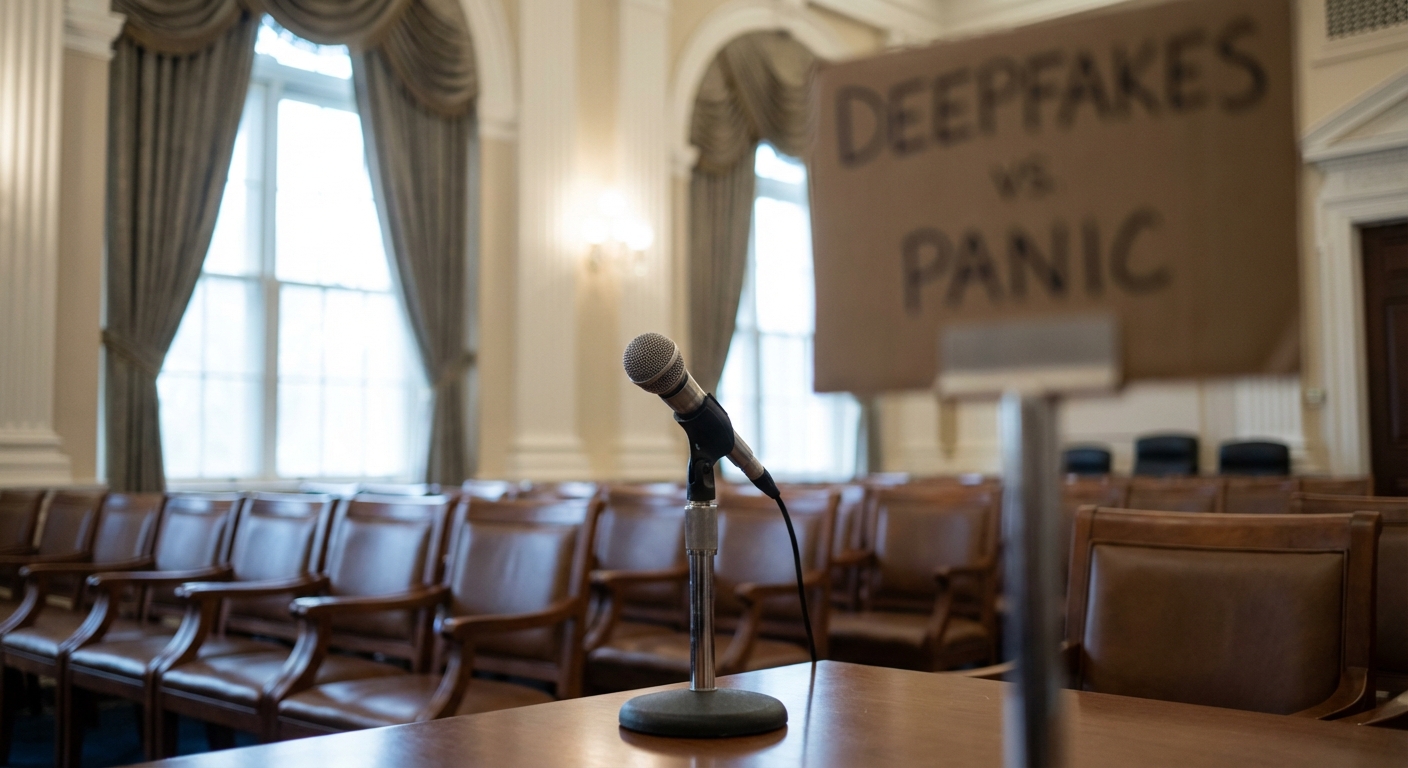
Scope and purpose: this timeline examines the claim known as the “Deepfakes and Nothing Is Real panic” by collecting documented dates, primary documents, technical milestones, major media events, and policy responses. We treat the phrase as a CLAIM and analyze what is documented, what is disputed, and where uncertainties remain.
“This article is for informational and analytical purposes and does not constitute legal, medical, investment, or purchasing advice.”
Timeline: key dates and turning points
- 1997 — Video Rewrite (research demonstration). Academic work showed automated lip-sync and facial reanimation concepts as early as the SIGGRAPH paper “Video Rewrite,” demonstrating that speech-driven visual edits could be created from existing footage. (Research paper / conference proceedings).
- 2014 — Generative Adversarial Networks published. The foundational GAN architecture, introduced by Goodfellow et al., provided a general-purpose method for training generative models that later enabled photorealistic image and video synthesis. (Peer-reviewed conference paper / NIPS 2014).
- 2016 — Face2Face (real-time reenactment research). The Face2Face project demonstrated near–real-time facial reenactment from ordinary RGB video, showing how live expressions can be transferred between people in video. (CVPR paper / project demo).
- 2017 — “Synthesizing Obama” and wider research demonstrations. A University of Washington project produced a highly publicized audio-driven lip-sync demo of President Barack Obama (SIGGRAPH 2017), making clear how research can realistically change what appears to be said in existing footage. (SIGGRAPH paper / project page).
- Late 2017 — The term “deepfake” originates in a Reddit community. The username and subreddit “deepfakes” began circulating AI-swapped celebrity porn and face-swap videos; this moment is widely cited as the coinage and cultural origin of the word “deepfake.” (News reporting / retrospective summaries).
- 2018–2019 — Rapid spread of non-consensual deepfake pornography and detection research launch. Reports and datasets documented many pornographic deepfakes and non-consensual imagery; platforms and researchers responded by initiating detection efforts and datasets. Facebook and partners launched a Deepfake Detection Challenge in late 2019 to accelerate detection research. (Investigative reporting; industry challenge announcement).
- May–June 2019 — Viral altered videos and mainstream attention. A slowed/edited video of Speaker Nancy Pelosi circulated widely (described by some experts as a low-tech edit rather than an AI deepfake), prompting platform moderation debates and congressional attention about manipulated video. (News reporting; expert analyses).
- June 2019 — DeepNude release and rapid takedown. The DeepNude app (which algorithmically created fake nude images from clothed photos) went viral, was publicly condemned, and the official service was shut down days after release; clones and copies remained available on forums. (Technology reporting / investigative articles).
- Late 2019 — U.S. intelligence and congressional attention. In 2019 hearings and the U.S. intelligence community’s public statements, officials warned that adversaries could use machine-manipulated media to influence elections and public trust, elevating the technology as a national-security concern. (Senate hearing transcripts / intelligence community statements).
- 2019–2020 — Policy responses and patchwork regulation. Federal measures in defense/ research funding (NDAA directives for reporting and detection research) and many state-level statutes began to address nonconsensual or political deepfakes; comprehensive federal criminal law remained limited and fragmented. (Legal analysis; legislative summaries).
- 2019–2020 — Detection arms race and limits revealed. Public detection challenges and research demonstrated progress but also limits: models trained on specific datasets often under-perform on novel manipulations, highlighting an ongoing adversarial dynamic between generation and detection. (Industry/technical reporting).
- 2023–2024 — High-profile nonconsensual image events and renewed platform scrutiny. New waves of nonconsensual synthetic images and videos, including high-profile celebrity-targeted fake content, provoked major platform moderation debates and calls for stronger legal remedies. Coverage of incidents and survivor accounts increased policy pressure in several jurisdictions. (Investigative journalism and advocacy reporting).
- 2024–2025 — State legislation and election-focused proposals accelerate. Multiple U.S. states updated laws to address synthetic media in elections and nonconsensual imagery; Congress proposed bills focused on disclosure and research, while debates over transparency, watermarking and platform responsibility continued. (Legal briefs; policy trackers).
Where the timeline gets disputed
Several parts of the narrative are contested or often conflated; below are the main dispute areas with supporting documents and how they conflict.
- What counts as a “deepfake” vs. simpler editing: Some viral clips widely labeled as “deepfakes” have subsequently been identified as low-tech edits (speed/pitch changes, frame dropping, simple compositing) rather than generative-model synthesis. This distinction matters for assessing technical capability versus social impact. Example: the 2019 Pelosi clip was widely circulated as a deepfake by some actors, but investigative analyses and platform statements described it as a slowed/repitched edit rather than an AI-generated face-swap. These sources disagree on labels and seriousness. (News investigations / platform statements).
- Scale and prevalence estimates: Public estimates of how many deepfakes are online (and what share are pornographic) have varied by methodology and time. Private firms and startups have released differing tallies; methods and sampling frames differ, producing conflicting headline numbers. Use the underlying reports, not single headline counts, to judge prevalence. (Industry reports; academic surveys).
- Threat immediacy vs. mid-term risk: Some security analysts warn of near-term high-impact political deepfakes (e.g., fabricated orders or statements), while others emphasize that history shows many easily debunked manipulations cause more short-term noise than durable deception — and that platform dynamics, detection tools, and human verification shape outcomes. These are expert disagreements, reflected in news and policy commentary. (Policy analysis; Wired reporting).
Evidence score (and what it means)
Evidence score: 72/100
- Score drivers: strong, verifiable documentation exists for technical milestones (GANs 2014; Video Rewrite 1997; Face2Face 2016; Synthesizing Obama 2017), with peer-reviewed papers and conference proceedings.
- Major platform and industry actions (DeepNude takedown; Deepfake Detection Challenge) are contemporaneously documented in multiple reputable outlets.
- Official statements and hearings (U.S. intelligence/ Senate transcripts) provide high-quality sources for policy-level concern.
- Where the score is reduced: prevalence estimates and claims of a near-total “nothing is real” collapse are inconsistent across sources and often rely on rhetoric or extrapolation rather than systematic measurement.
- Limits: some widely circulated incidents were later shown to be simpler edits, creating classification disputes between “deepfake” and “manipulated media.”
Evidence score is not probability:
The score reflects how strong the documentation is, not how likely the claim is to be true.
FAQ
Q: What exactly is meant by “Deepfakes and Nothing Is Real panic”?
A: The phrase is a shorthand used by commentators to describe the claim that synthetic media will make recorded evidence untrustworthy and produce a near-total collapse in the public’s ability to know what is true. This timeline treats that notion as a claim and examines the documentation behind the components of the panic (technical advances, viral incidents, and policy responses).
Q: When did the word “deepfake” first appear?
A: The term entered popular usage in late 2017 from posts in a Reddit community where users shared face-swap and pornographic synthetic videos; that moment is widely cited as the social origin of the label. (News and reference summaries).
Q: Are major viral political clips (for example the Pelosi video) verified deepfakes?
A: Not always. In several high-profile cases called “deepfakes” in public discussion, subsequent technical and journalistic analysis concluded the clip resulted from simpler editing (slowing, pitch change, frame manipulation) rather than generative-model synthesis. Sources differ in labeling; consult technical analysis and platform notices for each clip.
Q: Do we have laws that criminalize creating deepfakes?
A: The U.S. has a patchwork response: some federal directives require reporting and research funding, and many U.S. states have enacted or considered statutes addressing nonconsensual sexual deepfakes and election-related synthetic media. There is not (as of these documented sources) a single comprehensive federal criminal statute specifically outlawing all deepfakes. (Legal and policy analyses).
Q: What would change this timeline assessment?
A: New primary-source disclosures (platform internal documents, court records, or validated large-scale forensic datasets) that quantify the prevalence or show proven operational uses of high-impact political deepfakes would materially alter the assessment. Conversely, robust longitudinal measurement showing few convincing synthetic-video deceptions affecting major outcomes would reduce the perceived immediacy of the panic. Where sources conflict, we list the conflict rather than speculate.
Where to read the original documents and studies cited
Key primary and high-trust sources used in this timeline include peer-reviewed and conference papers (e.g., GANs; Face2Face; Synthesizing Obama), major investigative and technology reporting on incidents and apps (e.g., DeepNude), industry research and challenge announcements (Deepfake Detection Challenge), and official U.S. government hearings and assessments on emerging threats. Citations are inline in the timeline above; consult those entries for direct source links.
Summary: The technical capability to generate realistic synthetic images and to manipulate audio/video is well documented in academic literature and demonstrations (1997–2017 onward). High-profile incidents and malicious uses have been documented and spurred industry and policy responses. However, the jump from documented technical progress and specific abuses to the broad claim that “nothing is real” (i.e., that all recorded media is rendered unusable and public truth collapses) is debated: prevalence estimates, labeling of individual incidents, and the effectiveness of detection and verification remain contested. Where sources disagree, we report the disagreement and cite the documents.

Beginner-guide writer who builds the site’s toolkit: how to fact-check, spot scams, and read sources.