
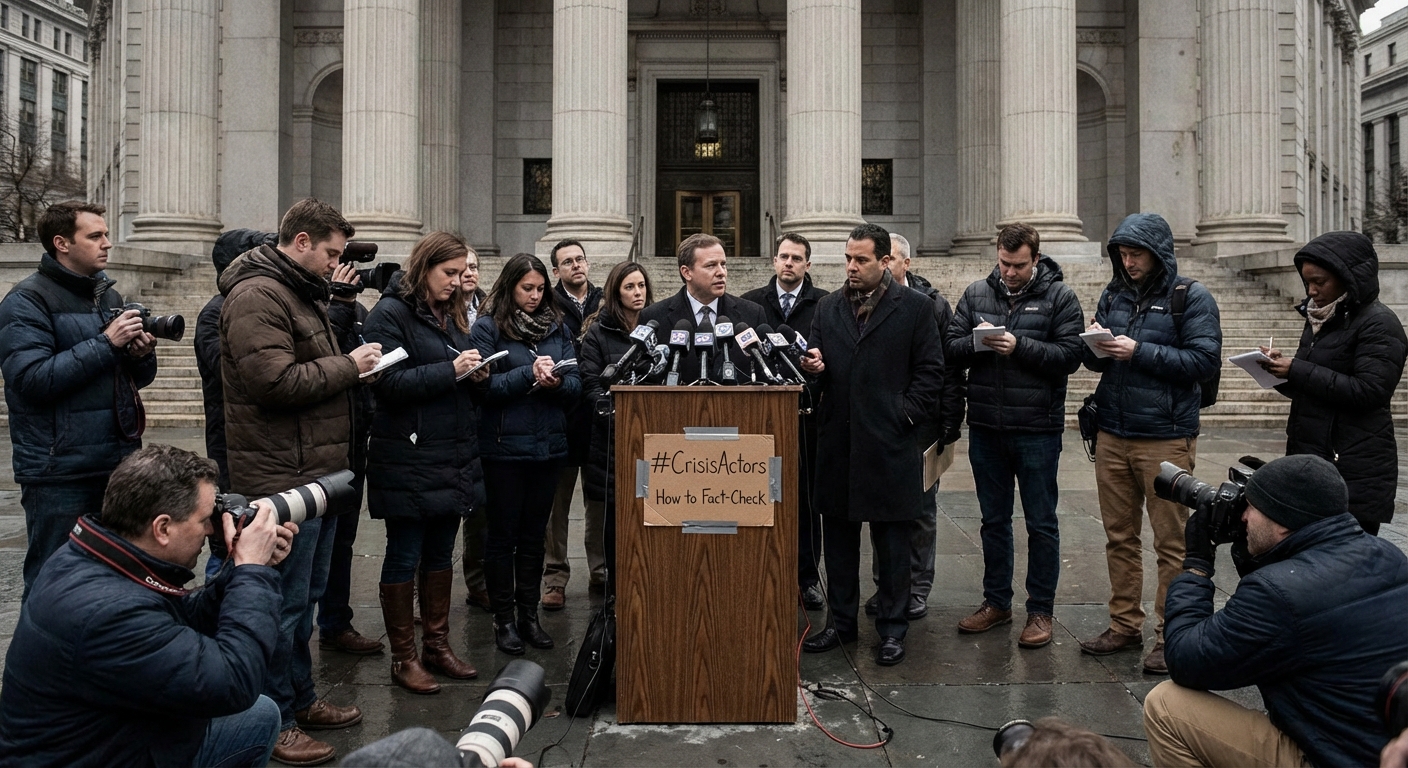
This Counterevidence piece tests the “crisis actors” claim against the strongest available counterevidence and expert explanations. We treat the subject strictly as a claim and analyze what is documented, what is plausibly inferred, and what remains unsupported. The term “crisis actors claim” refers to allegations that real-world tragedies—mass shootings, terror attacks, or other crises—are staged or that participants (victims, survivors, or relatives) are paid actors rather than real people; this article assesses that allegation against public records, reporting, and expert analysis.
This article is for informational and analytical purposes and does not constitute legal, medical, investment, or purchasing advice.
The best counterevidence and expert explanations
-
Independent fact-checks and long-form investigations have repeatedly debunked specific “crisis actors” allegations for multiple major incidents. Organizations including Snopes and FactCheck.org have documented how photos, recycled footage, and visual coincidences are mispresented to suggest the same people appear at multiple events—often due to superficial resemblance, reused stock imagery, or mismatched timestamps rather than any evidence of staging. These fact-checks walk through image-forensics and public records that counter the claim in high-profile cases.
-
Records and contemporary reporting show that the phrase “crisis actor” has two distinct, documented meanings: (1) legitimate role-players hired for emergency-response training and simulations, and (2) a conspiratorial label applied to real victims and witnesses to allege staged events. Emergency-management literature and practitioners (including FEMA-affiliated training programs and EMS publications) describe role-players as volunteers or actors used in drills, which is why the conspiratorial usage draws on a real concept but repurposes it. Understanding this distinction reduces confusion when checking claims.
-
Legal and journalistic records document real harms that followed conspiratorial “crisis actor” claims, including sustained harassment of victims and families. Reported cases include criminal threats, doxxing, and lawsuits tied to false allegations; notable civil judgments have been brought against public promoters of false claims for defamation. These records show that unfounded claims about “crisis actors” have had concrete real-world consequences.
-
Platform-aided spread explains how plausibly false visuals and short-form videos go viral: algorithmic amplification, recycled archival footage, and data voids (gaps in reliable online content) can make misleading narratives spread faster than corrections. Studies and reporting about misinformation dynamics demonstrate how small errors or selective editing can create the appearance of the same person at different events, which fuels the crisis-actor narrative.
-
Subject-matter experts in misinformation and extremism note that a handful of repeat techniques—photo recomposition, face-similarity illusions, mismatched captions, and selective sourcing—explain most crisis-actor claims without requiring coordination or staged events. Researchers recommend standard verification steps (reverse-image search, sourcing original video, checking local records, reviewing public filings) to test these claims methodically.
Alternative explanations that fit the facts
-
Coincidence and common facial features: different people can look similar, and selective cropping or low-quality images make resemblance more persuasive than it is. This is a frequent source of false identifications in viral posts.
-
Reused or misattributed imagery: a single photo or clip taken at one event can be re-captioned and redistributed as if it were from another event; this creates an apparent but false overlap of participants.
-
Role-player training vs. real victims: emergency-management exercises legitimately employ role players; some online sources conflate training participants with people appearing in unrelated news coverage, producing mistaken claims.
-
Deliberate misinformation by bad actors: in some cases, actors promoting a political or ideological agenda intentionally misrepresent images to sow doubt and polarize audiences. Platform analyses and reports show coordinated spread in a subset of incidents.
What would change the assessment
-
Primary-source, time-stamped evidence that directly links an identified, paid group of role-players to staged coverage of a specific real-world incident (for example invoices, contracts, or credible whistleblower testimony corroborated by records) would alter the current assessment. Absent such documentation, inference from similarity or social-media posts is weak.
-
Reliable official records (police reports, death certificates, hospital logs) that conflict with the public record and are validated by independent auditors would raise legitimate questions; by contrast, claims relying on selectively edited clips or anonymous posts do not meet that standard. Fact-checkers emphasize comparing claims to contemporaneous official records.
-
Credible journalistic investigations that publish verifiable chain-of-custody information for disputed media (who shot it, where, and when) would be decisive in specific cases. Until then, counterevidence offered here and in cited fact-checks remains the stronger documentation.
Evidence score (and what it means)
Evidence score is not probability:
The score reflects how strong the documentation is, not how likely the claim is to be true.
- Evidence score (0–100): 18 — documentation against the broad “crisis actors” claim is strong in high-profile examples, but the claim is heterogeneous and sometimes misuses a real concept, so the score reflects documentation quality rather than absolute truth.
- Drivers: multiple reputable fact-checks have traced specific allegations to image misuse or mistakes and have produced verifiable counterevidence.
- Drivers: emergency-management sources confirm legitimate use of role-players for training, which the conspiratorial language conflates with news-making.
- Drivers: legal records and reporting show demonstrable harms from false claims (harassment, doxxing, and defamation trials), supporting caution about repeating unverified allegations.
- Limitations: the label “crisis actor” has been attached to diverse incidents worldwide; while many specific claims have been debunked, each new allegation requires fresh primary-source checks (public records, timestamps, and original footage).
FAQ
Q: How should I begin to fact-check a “crisis actors” claim?
A: Start with basic verification steps: reverse-image and reverse-video search for the earliest appearance of the media; check reputable fact-checkers and local news archives; look for official records (police reports, obituaries, public statements); and search for name-matches across credible sources. If you find contracts, invoices, or on-the-record testimony indicating paid staging, treat that as significant—but require corroboration from independent records. Reputable fact-checking organizations provide templates for this process.
Q: Are there any documented cases where staged role-players were used in live news coverage?
A: No well-documented case shows coordinated use of paid role-players presented as real victims in mainstream news coverage of an actual mass-casualty event. Role-players are used in training and drills (documented by emergency-management sources), but claims that news coverage routinely used paid actors to simulate tragedies lack substantiated primary evidence and have been debunked in several high-profile incidents.
Q: What real harms have “crisis actor” claims caused?
A: Documented harms include harassment, threats, doxxing, and legal action. Families of victims have been subjected to sustained online abuse after being labeled “crisis actors;” in several cases, plaintiffs successfully sued promoters of false claims for defamation. These consequences underscore why careful verification matters before repeating such allegations.
Q: When is it appropriate to suspect coordination or deliberate staging?
A: Suspicion of deliberate staging becomes plausible only with strong, independently verifiable evidence: contemporaneous contracts, bank records showing payments tied to the event, credible whistleblower testimony corroborated by documents, or multiple independent sources providing matching testimony. Anonymous social-media posts, reused images, and visual resemblance do not meet that standard.
Q: What are quick red flags that a “crisis actors” post is unreliable?
A: Red flags include lack of sourcing, absence of time- and location-stamped original media, claims based on cropped or low-resolution images, accounts that cite only anonymous or partisan sources, and posts that ask readers to “share to expose” rather than providing verifiable evidence. If multiple reputable outlets and official records contradict the claim, treat it skeptically.

Beginner-guide writer who builds the site’s toolkit: how to fact-check, spot scams, and read sources.