
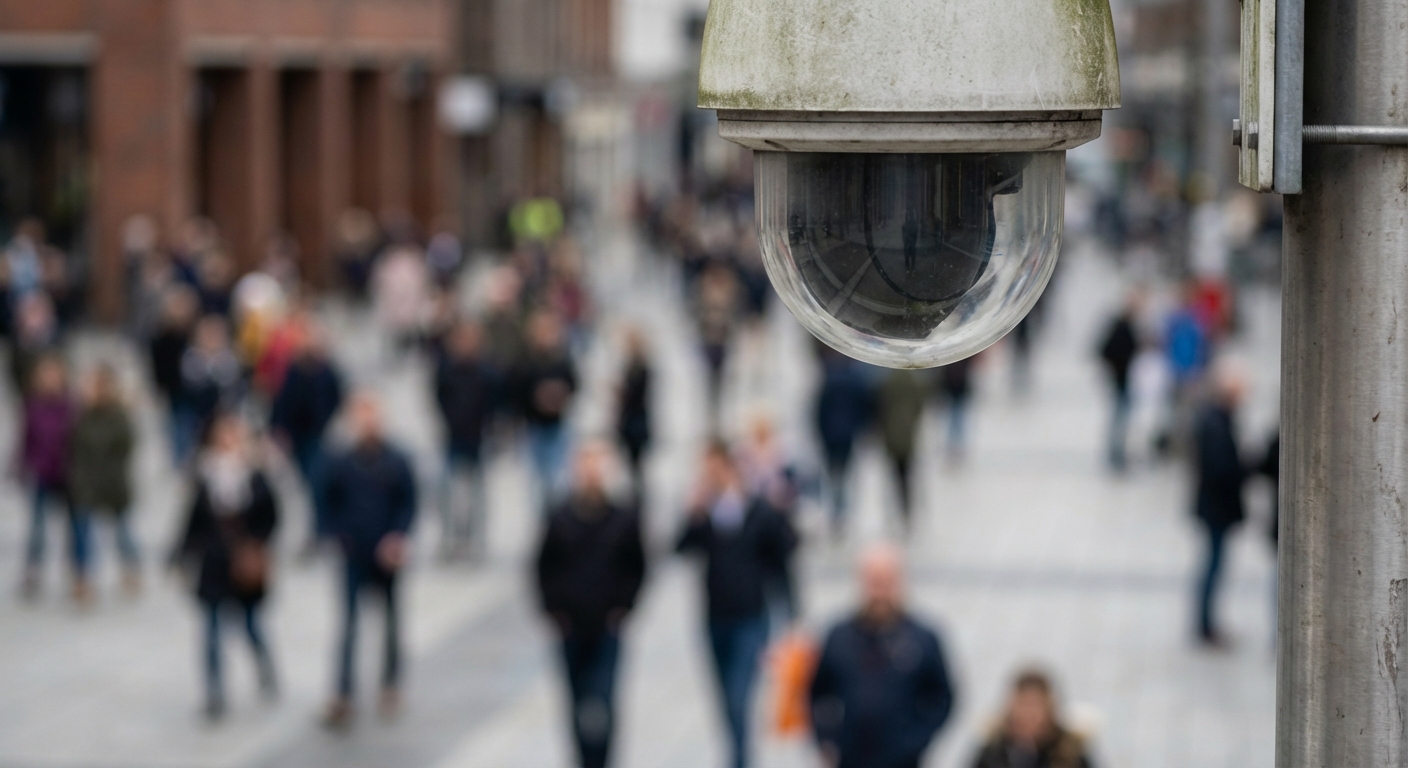
This article examines the claim commonly summarized as the “facial recognition ‘everywhere'” claim: that facial recognition technology is being deployed so widely and ubiquitously in public and private spaces that it effectively enables constant identification of people. We treat this as a claim (not as established fact), review primary reports and journalism, and separate what is documented, what is plausible but unproven, and what is contradicted or unsupported. Verdict: what we know, what we can’t prove
What is strongly documented
1) Targeted and scaled deployments exist. Law enforcement agencies in multiple countries are using live facial recognition for targeted operations, and reporting shows a sharp increase in some jurisdictions’ use recently — for example, journalistic reporting on U.K. police activity documented millions of scans and growing deployments in 2024.
2) Commercial vendors and private-sector systems are widespread enough to matter. Major vendors supply facial recognition to airports, retailers, and private security firms; a number of municipal and transit pilots are documented in public records and reporting. (See examples below under “what is plausible”).
3) Technical performance has improved but varies. Independent testing by the U.S. National Institute of Standards and Technology shows large improvements in algorithm accuracy over recent years, while also documenting variation across algorithms and measurable demographic performance differences in some tests. These findings are well-documented in NIST reports.
What is plausible but unproven
1) Ubiquity at the individual level — that any given person is constantly identifiable in public — is plausible in certain dense urban areas with many cameras and integrated watchlists, but it is not uniformly documented. Estimates of camera density and selective public pilots show hotspots rather than universal coverage. For example, camera density studies show large variation by city and neighborhood.
2) Private data aggregation (e.g., companies scraping online images to build large galleries) makes wide-reaching identification more feasible, and reporting suggests some law enforcement agencies have relied on such private databases. But the extent to which those systems are integrated into continuous, citywide identification networks is not fully documented in public sources.
What is contradicted or unsupported
1) The literal claim that facial recognition is literally everywhere (i.e., uniformly present and actively identifying people in all public spaces across most cities or countries) is not supported by the available documentation. Evidence points to uneven deployment: concentrated pilot projects, targeted LFR events, and vendor partnerships — not universal, continuous identification across all public spaces.
2) Claims that modern algorithms are free of demographic error are contradicted by NIST findings: while top-performing systems have improved substantially, NIST and other reviews identify demographic differentials and wide variability across vendor algorithms. That contradicts blanket assertions that facial recognition is uniformly accurate for all groups.
Evidence score (and what it means)
- Evidence score: 57 / 100
- Drivers: substantial, high-quality documentation of targeted LFR deployments (journalistic investigations and public deployment records) increases the score.
- Drivers: authoritative technical testing documenting both improvements and limits raises confidence about algorithm capabilities and documented weaknesses.
- Limits: major gaps in public documentation about the scope of private-sector databases and the degree of real-time, citywide integration reduce the score.
- Limits: heterogeneous global practices and rapidly changing vendor/deployment landscapes create conflicting indicators in some jurisdictions.
Evidence score is not probability:
The score reflects how strong the documentation is, not how likely the claim is to be true.
Practical takeaway: how to read future claims
1) Ask what level of “everywhere” the claim means: every country, every city, every urban neighborhood, or every public camera? The available evidence supports targeted and expanding use, not literal ubiquity.
2) Prioritize primary sources: deployment logs, municipal ordinances, procurement documents, and independent technical testing (e.g., NIST) are the strongest evidence. Journalistic investigations often assemble those materials and are useful secondary sources.
3) Distinguish between presence of cameras and presence of face-matching capability tied to watchlists or identity databases. A visible increase in cameras does not by itself prove continuous facial identification is in use. Camera prevalence studies help, but they do not measure whether facial recognition is active on all cameras.
4) Treat vendor and private-database claims with caution: contracts and usage records are the strongest proof. Public reporting has shown lawful and unlawful scraping practices; those reports merit follow-up with procurement records.
This article is for informational and analytical purposes and does not constitute legal, medical, investment, or purchasing advice.
FAQ
Q: What does “facial recognition everywhere claim” actually mean?
A: The phrase is shorthand for the assertion that facial recognition systems are so widely deployed and continuously used that most people can be identified automatically in ordinary public settings. Documentation supports expansion and hotspots of use, but not uniform, continuous identification in all public spaces.
Q: Are facial recognition systems accurate enough to support the “everywhere” claim?
A: Accuracy has improved markedly according to NIST testing, and top algorithms can be highly accurate in controlled conditions. However, performance varies by algorithm, imagery quality, operational setup, and across demographic groups — meaning accuracy alone does not prove ubiquitous, reliable identification in the real world.
Q: Have governments restricted or expanded this technology recently?
A: Responses vary. Some U.S. cities and states have restricted government use in certain contexts (for example, local school bans or municipal moratoria), while other jurisdictions are debating rules or expanding authorized uses. Recent reporting shows both pushback (bans, moratoria) and renewed proposals to legalize or regulate law enforcement use in specific cities. These policy differences affect how plausible a widespread “everywhere” deployment is in practice.
Q: If a city has many cameras, does that mean facial recognition is being used everywhere there?
A: No. Camera density matters, but so does whether those cameras run face-matching software, whether images feed into watchlists, and whether human review or retention policies apply. Studies estimating camera counts show variation across cities and neighborhoods; those counts do not automatically translate into continuous facial identification.
Q: How can a reader verify a local claim that facial recognition is in use in their city?
A: Look for procurement records, police deployment logs, city council minutes, formal vendor contracts, and public transparency reports. Journalistic investigations frequently cite those primary documents and can be a starting point. If unavailable, public-records requests (where applicable) are the standard method to obtain confirmation.

Tech & privacy writer: surveillance facts, data brokers, and what’s documented vs assumed.