
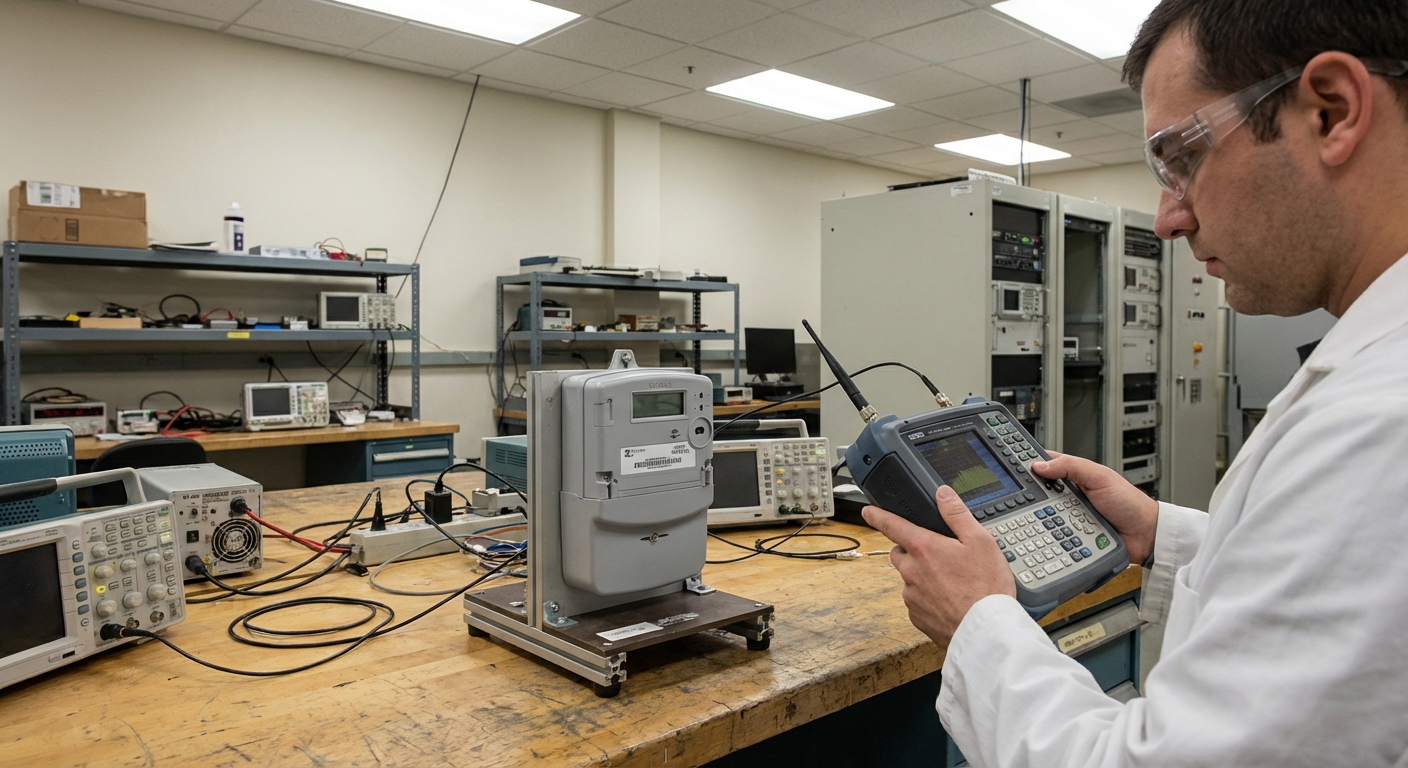
Below are the arguments people cite to support the claim often called the “Smart Meter ‘Secret Radiation’” claim. These are arguments supporters cite; they are not proof the claim is true. This article traces where each argument comes from (peer‑reviewed measurements, government health agencies, manufacturer materials, advocacy groups, or anecdotal reports) and suggests ways to test or verify the underlying assertions. The term smart meter ‘secret radiation’ is used here to refer to claims that smart meters emit harmful, hidden, or higher‑than‑reported radiofrequency or electromagnetic energy.
The strongest arguments people cite
-
Claim: “Smart meters emit radiofrequency radiation comparable to cell phones and therefore are a cancer or health risk.”
Source type: Public health pages and advocacy summaries quoting IARC/FDA/agency concerns and selective laboratory or modelling papers.
Verification test: Compare measured power, frequency, and time‑averaged exposure (duty cycle and power density) from peer‑reviewed meter surveys to public exposure limits and to typical cell phone exposures.
Context & sources: Health organizations note smart meters use RF but generally emit far less time‑averaged energy than a held cell phone because of low transmit power and short duty cycles; authoritative summaries include the American Cancer Society and national radiation agencies.
-
Claim: “Mesh networks and neighborhood collectors multiply exposure because many meters ‘chat’ constantly, creating higher ambient RF.”
Source type: Advocacy groups and technical descriptions of mesh networking used in some deployments.
Verification test: Measure aggregate ambient RF levels in neighborhoods with mesh deployments during typical operation and compare to single‑meter worst‑case measurements and exposure limits.
Context & sources: Technical descriptions confirm some smart meter systems use mesh topologies; critics highlight cumulative exposures, while measurement studies report low duty cycles and aggregate exposure well below public limits in tested deployments.
-
Claim: “Manufacturer warnings/installation notes (e.g., a 20 cm separation) show meters are not safe for close proximity, so meters are dangerous in practice.”
Source type: Excerpts from user manuals, advocacy compilations, and legal filings summarizing device warnings.
Verification test: Inspect manufacturer RF safety statements in technical manuals and compare those specified separation distances to regulatory compliance test procedures and real‑world mounting locations.
Context & sources: Advocacy groups have pointed to manufacturer separation statements used to meet FCC test procedures; regulators and independent studies note those warnings are for compliance testing posture, not proof of widespread hazard, and real‑world time‑averaged exposures measured near meters are typically far below safety limits.
-
Claim: “Smart meters cause electromagnetic hypersensitivity symptoms in some people.”
Source type: Anecdotal reports, opt‑out petitions, and advocacy group case lists.
Verification test: Conduct blinded provocation studies or controlled clinical assessments to see if symptoms consistently correlate with meter RF exposure beyond placebo/nocebo effects.
Context & sources: Many authoritative reviews (WHO, national agencies) report anecdotal reports of EHS but find no consistent causal link in well‑controlled studies; self‑reported symptoms are documented but mechanisms remain unproven.
-
Claim: “Smart meters interfere with medical or other electronic devices (pacemakers, routers, safety systems).”
Source type: Laboratory interference tests, manufacturer notes, and occasional case reports.
Verification test: Review peer‑reviewed interference tests that place meters near representative medical devices and test under worst‑case transmission rates.
Context & sources: In vitro and bench tests designed to assess interference with cardiac implantable devices found no interference in worst‑case scenarios for the models tested; such studies test specific devices and conditions and do not prove every meter/model combination is safe in every configuration.
-
Claim: “Smart meters add ‘dirty electricity’ or low‑frequency electrical noise to home wiring that causes health effects.”
Source type: Engineer reports, advocacy pieces, and a subset of non‑mainstream technical analyses.
Verification test: Measure conducted emissions on household wiring before and after meter replacement (spectrum analysis of harmonics and transients) and evaluate whether levels exceed regulatory power quality or EMI limits and whether any plausible biological mechanism links those emissions to reported symptoms.
Context & sources: The ‘dirty electricity’ claim is widely repeated by advocacy organizations; independent regulatory and measurement studies focus mainly on RF emissions and typically do not find supporting evidence that meter‑generated EMI at measured levels produces the health effects claimed.
-
Claim: “Smart meters have been linked to house fires or safety hazards caused by overheating or electronic faults.”
Source type: Media reports, fire department investigations, and liability claims.
Verification test: Check official fire incident reports, manufacturer failure investigations, and peer‑reviewed failure analyses to determine cause and whether meter design or installation was a documented factor.
Context & sources: Fire‑related claims are reported in media and by some activists; utility and safety investigations often attribute fires to wiring or installation faults rather than the RF transmitter, but each incident needs a case‑by‑case technical investigation.
-
Claim: “Regulatory exposure limits are inadequate or based on outdated science, so compliance testing doesn’t guarantee safety.”p
Source type: Scientific commentaries, advocacy critiques of exposure standards, and calls for precautionary policies.
Verification test: Compare national/international exposure standards (FCC, ICNIRP, Health Canada, ARPANSA) with the body of epidemiology, animal studies, and mechanistic research; review expert panel conclusions about the need for updated limits.
Context & sources: Some scientists and advocacy groups argue standards focus on thermal effects and do not cover all proposed non‑thermal biological mechanisms; regulators maintain current limits are protective based on available evidence, while some peer‑reviewed research remains contested.
How these arguments change when checked
When each argument is tested against primary sources (peer‑reviewed measurements, government agency assessments, and manufacturer test procedures), the overall pattern is: measurement studies of deployed smart meters repeatedly report low transmit duty cycles and time‑averaged power densities that are many orders of magnitude below international public exposure limits; national health agencies therefore conclude there is no established evidence that typical smart meter RF exposures cause adverse health effects. At the same time, advocacy groups collect incident reports, highlight manufacturer test caveats, and cite selective studies suggesting biological effects at low levels—creating a factual dispute about interpretation and policy, not a single settled outcome.
Key specific checks:
-
Measured exposures: Multiple field studies measured peak fields near meters and found instantaneous peaks and time‑averaged exposures well under FCC/ICNIRP public limits, largely because transmitters operate intermittently (low duty cycles). These results are reported in peer‑reviewed measurement studies.
-
Regulatory summaries: National radiation safety authorities (e.g., ARPANSA in Australia, Health Canada, FDA summaries cited by ACS) state there is no established evidence that the low RF emissions from smart meters cause health effects, while continuing to monitor the literature.
-
Advocacy and selected laboratory studies: Organizations and some researchers highlight possible non‑thermal biological effects, modelled absorption in children, and device manuals that include separation distances used for compliance testing; these raise policy questions but do not establish causal links at population exposure levels.
Evidence score (and what it means)
Evidence score is not probability:
The score reflects how strong the documentation is, not how likely the claim is to be true.
- Evidence score: 32 / 100.
- Drivers: Multiple independent measurement studies document low time‑averaged RF exposure levels from deployed meters, which reduces the plausibility of large population‑level effects.
- Drivers: National radiation authorities (ARPANSA, Health Canada) and expert summaries (American Cancer Society) find no established health effects from typical smart meter exposures, strengthening the documented counterevidence.
- Drivers: Advocacy groups and a subset of laboratory, modelling, or ecological studies argue for non‑thermal effects or cumulative impacts; these sources raise unresolved questions but are inconsistent and often contested.
- Drivers: Some specific technical issues (manufacturer separation notes, rare device interference or fire reports) are documented but do not by themselves prove the broad ‘secret radiation’ health claim; they warrant targeted investigation.
This score reflects the current balance of available documentation: clear, repeatable measurements and regulatory assessments exist, but concern stems from selective studies and anecdotal reports that have not produced consistent, reproducible causal evidence at real‑world exposure levels.
This article is for informational and analytical purposes and does not constitute legal, medical, investment, or purchasing advice.
FAQ
Q: What are the “smart meter secret radiation claims” and why do people believe them?
A: The phrase refers to the claim that smart meters emit a hidden or dangerous form of radiation not disclosed by manufacturers or regulators. People believe the claim for several reasons: visible manufacturer safety statements (e.g., separation distances in manuals), understandable anxiety about RF from cell phones, anecdotal symptom reports after installations, and advocacy groups highlighting selective studies. However, authoritative measurement studies and national agencies report low time‑averaged exposures and no established health effects.
Q: Do peer‑reviewed measurements show smart meters exceed safety limits?
A: No—multiple peer‑reviewed studies of deployed meters report instantaneous peaks and average exposures well below international public exposure limits, primarily because meters transmit intermittently (low duty cycles). These measurements are specific to the meters and deployments tested, so conclusions apply to those contexts.
Q: If meters are within limits, why do some people still report symptoms?
A: Symptom reports are real and serious for those affected, but controlled clinical and provocation studies have not consistently demonstrated a causal link between low‑level RF exposure and the reported symptoms. Psychosocial, environmental, or unrelated medical causes can also explain many cases. Health agencies recommend clinical assessment and, where appropriate, options such as meter relocation or opt‑out policies where available.
Q: How can I independently check a smart meter’s RF emissions at my home?
A: A practical verification path is to hire an RF‑measurement professional or contact your national radiation agency for guidance. Measurement should record peak and time‑averaged power density at representative distances and during typical and worst‑case transmission patterns, and results should be compared to the regulatory public exposure limits referenced by the agency. Peer‑reviewed studies use calibrated instruments and long observation periods to capture duty cycles.
Q: Are regulators and health agencies in agreement about smart meter risks?
A: Most national radiation safety agencies and health organizations conclude that typical smart meter RF emissions are far below exposure limits and currently lack consistent evidence of harm; however, some scientists and advocacy groups argue limits ignore potential non‑thermal effects and call for more research or precaution. This creates a documented policy and interpretation dispute rather than unanimous consensus on every detail.
Q: Where can I read the primary measurement studies referenced here?
A: Representative peer‑reviewed measurement studies include characterizations of smart meter RF emissions and duty cycles in deployed systems; see the Pacific Gas & Electric territory measurements and other published measurement reports for detailed methods and results. These studies are cited in the measurement and regulatory literature.

Tech & privacy writer: surveillance facts, data brokers, and what’s documented vs assumed.