
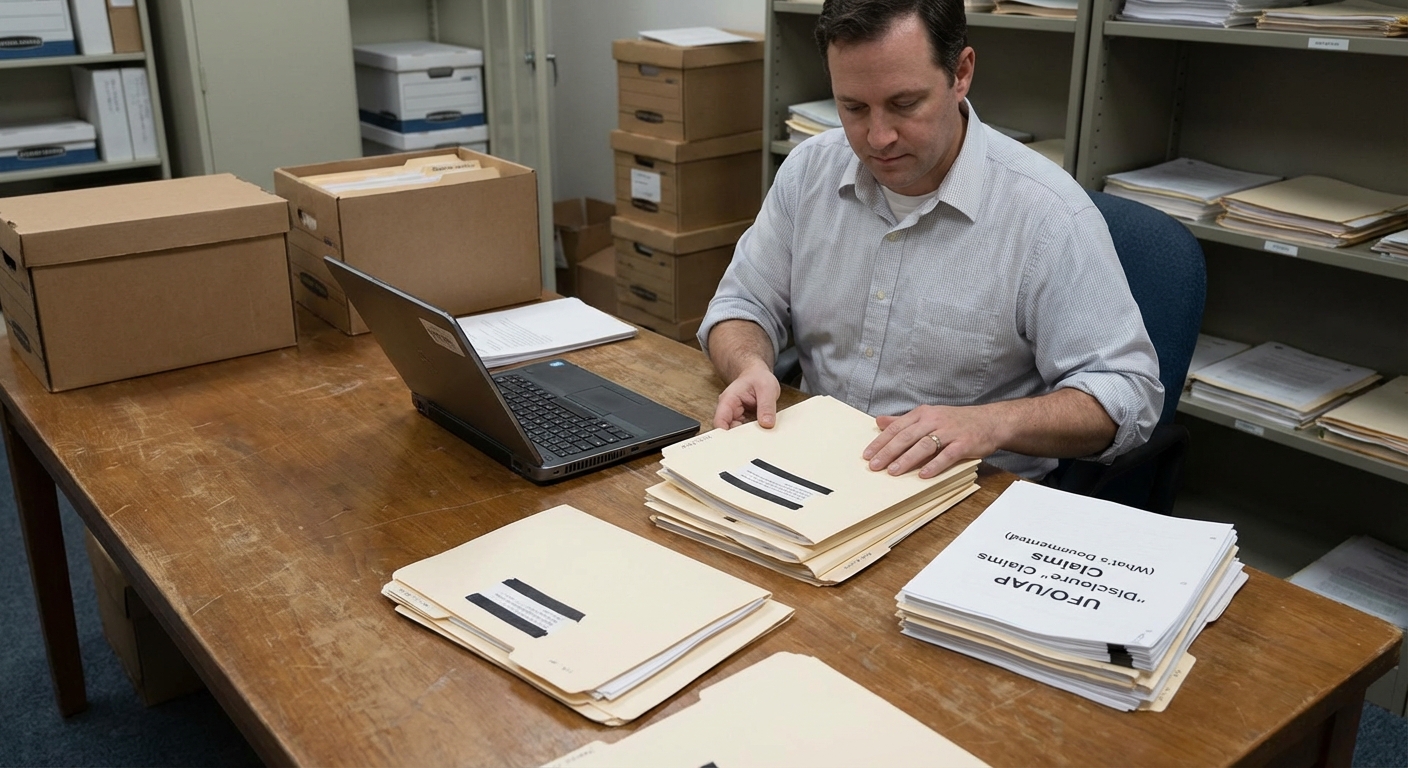
Below are the strongest arguments people cite when advancing UFO/UAP “disclosure” claims. This piece treats those claims as claims — not established facts — and focuses on what primary sources, official reports, and high‑quality journalism actually document about the allegations. The phrase UAP Disclosure claims appears throughout to anchor the scope of examination.
The strongest arguments people cite
-
Claim: The Pentagon ran a secret program that collected recovered materials and studied exotic alloys, implying possible recovered non‑terrestrial technology.
Source type: Investigative newspaper reporting and released program documents (e.g., New York Times coverage of AATIP and contractor records).
How to verify: Obtain and review original program contracts, contractor deliverables, government chain‑of‑custody records for alleged materials, and any peer‑reviewed analyses of samples.
Documentation: The New York Times reported on the Advanced Aerospace Threat Identification Program and related contractor involvement starting in 2017; follow‑up FOIA releases and contractor documents have been cited by journalists and researchers. The existence of a Pentagon program to study aerial anomalies is documented in reporting and some released records, but the reporting does not by itself prove recovered non‑terrestrial materials.
-
Claim: Declassified or “authenticated” military sensor videos (often referenced as FLIR, GIMBAL, GOFAST and later clips) prove encounters with craft exhibiting impossible performance.
Source type: Declassified/unclassified military infrared videos plus Department of Defense statements about those clips.
How to verify: Examine full‑resolution sensor files, associated radar/telemetry logs, aircraft positional data, and the DoD chain‑of‑custody/authentication documentation for those clips.
Documentation: The Department of Defense publicly acknowledged and cleared the release of several Navy infrared clips in 2020 and has confirmed they originated from Navy aircraft; official statements and multiple reputable outlets document that the videos exist and were taken by military sensors. Official commentary, however, emphasizes that while the footage is authentic as Navy sensor imagery, available public clips lack sufficient metadata to derive reliable size, range or g‑loads without additional sensor logs.
-
Claim: High‑level whistleblowers and some former intelligence officials have testified or publicly claimed that the government possesses recovered craft and even non‑human biological remains.
Source type: Congressional testimony, public interviews, and whistleblower complaints.
How to verify: Inspect closed‑session testimony, Inspector General filings, and any classified evidence submitted to congressional oversight committees or IG offices; corroborate witness accounts with documentary or forensic material traceable to official custody chains.
Documentation: Public congressional hearings (including 2023 sessions) recorded witness testimony from former officials and whistleblowers that included strong and specific allegations. Official responses from the Department of Defense and oversight offices have stated they have found no verifiable information substantiating claims of possession of extraterrestrial materials. Independent fact‑checks and reporting note that the whistleblowers provided assertions but little publicly available documentary proof.
-
Claim: Historical incidents (for example, the 2004 “Nimitz” Tic‑Tac encounter) involved multiple independent sensors and credible pilot testimony, showing truly anomalous behaviour.
Source type: Pilot testimony, ship logs, radar contacts, and contemporaneous after‑action reports referenced in long‑form journalism and congressional briefings.
How to verify: Release and analysis of shipboard radar logs, ATFLIR sensor data, pilot/aircraft positional logs, and any other contemporaneous records that can be independently analyzed.
Documentation: Detailed reporting and interviews with involved pilots (and subsequent inclusion of these encounters in official reviews) document that multi‑sensor events were reported and investigated; however, some investigative accounts stress that the available public material is incomplete for definitive physical interpretation.
-
Claim: Recent official reviews (for example, work by AARO and intelligence community reports) implicitly confirm that there has been a long history of government interest and programs, which disclosure advocates interpret as evidence of suppression.
Source type: Official agency reports and DoD/AARO public statements.
How to verify: Read the unclassified sections of AARO and ODNI reports, and, where possible, request the classified annexes or underlying datasets via oversight channels.
Documentation: The Office of the Director of National Intelligence published a 2021 Preliminary Assessment documenting UAP reporting and data limitations; the Department of Defense’s All‑Domain Anomaly Resolution Office has since produced public annual and historical reports reviewing cases and archival records. Those official documents confirm government investigation activity but do not provide public proof of recovered extraterrestrial technology.
-
Claim: The government has previously attempted (or proposed) reverse‑engineering programs (names like “Kona Blue” are sometimes cited), indicating covert exploitation of recovered materials.
Source type: Internal program names referenced in official reviews, investigative reporting, and agency histories.
How to verify: Locate and review the primary documents or memoranda that propose or authorize such programs, plus acquisition records and program evaluation memos.
Documentation: AARO’s historical review and subsequent press coverage note references to proposals or attempted initiatives in the historical record; AARO’s published findings say at least some proposals were considered but lacked evidence supporting extraterrestrial origins and in some cases were not pursued or were closed. The presence of historical proposals or program names in records does not, by itself, prove the success or operational status of a reverse‑engineering effort.
How these arguments change when checked
Many of the strongest‑cited arguments mix three separate things: (a) documented government activity to track and study unidentified aerial phenomena, (b) authenticated sensor footage showing unexplained objects, and (c) extraordinary inferences about recovered alien hardware or bodies that go beyond the available documentation. Official records and agency statements reliably support (a) and (b) in various degrees, but they do not publicly corroborate the more extraordinary inferences in (c). When each argument is checked against primary sources, these patterns recur:
-
Documentation of study and investigation: Multiple official reports and institutional responses (ODNI, DoD/AARO) confirm that UAPs have been monitored, that offices were formed to collect and analyze reports, and that many historical records have been reviewed. These official activities are documented.
-
Authenticated sensor data: The Pentagon’s public statements and media reporting confirm that certain Navy infrared clips are genuine military sensor recordings; the public clips themselves lack the complete sensor logs needed to derive definitive physical parameters. That limits what can be concluded from those clips alone.
-
Extraordinary claims about recovered materials or biological remains: Such claims have been made publicly by witnesses and whistleblowers, but public, verifiable documentary evidence (for example, traceable chain‑of‑custody records for physical specimens accessible to independent analysts) has not been produced in the public domain. Official DoD statements and AARO reviews state they have not found verifiable evidence to substantiate those allegations.
-
Historical proposals vs. proven programs: Records show program proposals, studies, and contracts at times, but not all proposals became operational programs with successful outcomes. Where proposals appear in the archival record, follow‑up documentation is required to determine what actually occurred.
In short: the factual base supports that the U.S. government has investigated UAPs and that some sensor data are authentic; the factual base does not publicly support the most definitive “disclosure” claims (recovered alien craft or bodies) without additional verifiable documentation. Where sources conflict, the conflict is often between testimonial claims and the absence of corroborating documentary or forensic records in the public record.
This article is for informational and analytical purposes and does not constitute legal, medical, investment, or purchasing advice.
Evidence score (and what it means)
Evidence score: 35/100
- Score drivers: Existence and public acknowledgement of formal programs, task forces, and authenticated sensor videos (raises baseline documentation strength).
- Score drivers: Multiple credible witnesses (pilots, former officials) and congressional hearings provide corroborated testimonial threads (moderate weight).
- Score drivers: Lack of publicly accessible chain‑of‑custody records, peer‑reviewed forensic analyses of alleged materials, or classified evidence released to oversight (lowers score significantly).
- Score drivers: Official agency reviews that find many cases unresolved but report no verified evidence of extraterrestrial technology (reduces support for extreme claims).
- Score drivers: Persistent data gaps — many public cases lack the full sensor/telemetry/radar datasets needed to draw robust physical conclusions (reduces confidence in inferences).
Evidence score is not probability:
The score reflects how strong the documentation is, not how likely the claim is to be true.
FAQ
Q: What do official reports say about UAP Disclosure claims?
A: Official unclassified reviews (the ODNI 2021 preliminary assessment and subsequent DoD/AARO public reports) document that the U.S. intelligence and defense communities have recorded and investigated many UAP reports, that data quality often limits analysis, and that unclassified reports do not contain verifiable evidence proving possession of extraterrestrial technology. These official reports confirm investigation activity but do not corroborate the most extraordinary disclosure assertions. For source detail, see the ODNI 2021 report and DoD/AARO releases.
Q: Is the authenticating of Navy videos the same as proving alien technology?
A: No. Authentication establishes that the released clips are genuine recordings tied to Navy sensor platforms. Authentication alone does not provide the full metadata and corroborating sensor streams (radar, GPS, raw ATFLIR files) publicly required to derive reliable physical parameters; without those additional datasets, the footage cannot by itself prove exotic origin. Official statements that the clips are genuine are documented; their interpretation remains limited by available data.
Q: How should I evaluate claims that recovered materials exist or were reverse‑engineered?
A: Treat such claims as extraordinary and demand proportionally strong, verifiable evidence: chain‑of‑custody records, independently reproducible laboratory analyses published in venues that allow peer review, and oversight records from Inspectors General or congressional intelligence committees. To date, public records show proposals, allegations, and some investigative activity, but not public, independently verifiable forensic results that confirm non‑terrestrial origin. Official AARO/DoD statements say they have not found verifiable evidence substantiating possession of extraterrestrial materials.
Q: Why do disclosure narratives persist despite official denials?
A: Several reasons: (1) authenticated or high‑profile incidents (pilot testimony, circulated videos) create durable public interest; (2) whistleblower testimony is persuasive to many even when direct documentary evidence is not public; (3) historical secrecy in certain defense programs fuels plausible inference; and (4) cultural drivers (media, entertainment, social networks) amplify claims. Official reviews often emphasize data limitations and investigative gaps, which disclosure proponents interpret differently.
Q: Where can new, verifiable evidence come from?
A: Verifiable evidence would most likely come from (a) release of full sensor and telemetry datasets tied to incidents, (b) authenticated chain‑of‑custody information and peer‑reviewed analyses of any physical samples, or (c) classified evidence lawfully presented to congressional oversight and then declassified with provenance. Until that kind of material is publicly available and independently examined, the strongest disclosure claims remain unproven in the public record.

Science explainer who tackles space, engineering, and ‘physics says no’ claims calmly.