
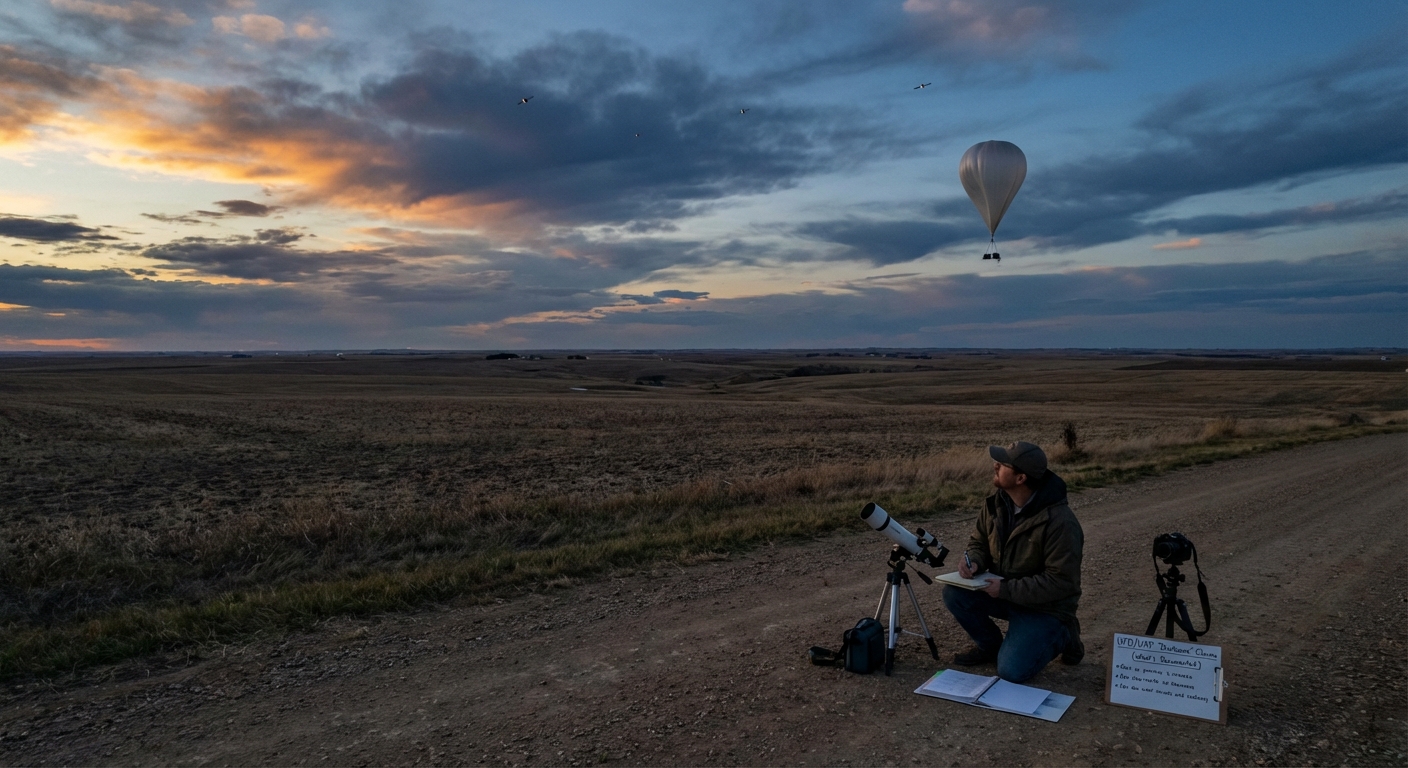
Introduction: This article tests UAP disclosure claims against the best available official records and expert analysis. We treat the phrase “UFO/UAP ‘disclosure’ claims” as a claim to be evaluated, not established fact, and we summarise which pieces of evidence are documented, which are disputed, and which cannot be independently verified.
The best counterevidence and expert explanations for UAP disclosure claims
-
DoD/AARO’s historical review found no verifiable evidence of extraterrestrial technology: The Department of Defense’s All-domain Anomaly Resolution Office released a 2024 historical review that concluded it found “no verifiable evidence” that any U.S. government investigation or official review panel confirmed a UAP was extraterrestrial or that the U.S. government had access to non‑human technology. This report is a central, official piece of counterevidence to public claims that the government has long-held alien hardware.
Why it matters: the AARO review was authorized by Congress and reviewed decades of records, interviews, and classified and unclassified archives. Its conclusions directly address the strongest public version of the disclosure claim (that there exists verifiable government possession of off‑world materials). Limitations: AARO itself notes many incidents remain unresolved or limited by data quality, and Volume I covers specific historical windows rather than every possible dataset.
-
Congressional testimony exists but is often hearsay or undocumented in the public record: High-profile testimony—most notably former intelligence official David Grusch’s statements to a House Oversight subcommittee in July 2023—alleged recovered non‑human biologics and multi‑decade crash retrieval programs. The official public hearing transcript records these assertions, but Grusch did not provide publicly releasable documentary evidence during that hearing; many of his most specific claims have not been published or independently verified in open sources. That discrepancy is a key reason investigators and agencies treat the testimony as an allegation requiring corroboration rather than a documented fact.
Why it matters: Congressional testimony places allegations on the public record and prompted further review. Limits: testimony under oath can contain second‑hand reports and may be limited by classification; absence of public documentation reduces its evidentiary weight for independent researchers.
-
Official denials and focused investigations into alleged secret programs: Following whistleblower allegations and media reports, DoD spokespeople and AARO investigators publicly stated they found no evidence of secret programs holding extraterrestrial hardware that were withheld from Congress. The DoD statement and AARO’s methodology (which asserted significant access to classified programs during the review) function as formal counterclaims to allegations of an ongoing concealment campaign.
Why it matters: a denial from the same institutions alleged to be concealing material is material evidence: either the institutions are correct and the allegation is unsupported, or their statements are false—an extraordinary claim that would itself require extraordinary evidence. Limits: absence of public proof is not proof of absence; if evidence remains highly compartmentalized in unacknowledged special access programs, public verification is structurally difficult. AARO reports it had access according to its public briefings, but independent researchers cannot personally verify that access.
-
Published sensor- and incident‑level analyses explain many sightings without exotic hypotheses: Government reports (including the Office of the Director of National Intelligence’s 2021 Preliminary Assessment) and aviation analyses emphasize how sensor limitations, misidentification (balloons, drones, aircraft, satellites, astronomical phenomena), and poor-quality data can produce ambiguous results that do not require exotic physics. Those technical explanations form a body of counterevidence against claims that specific incidents are proven alien artifacts.
Why it matters: technical assessments show why unresolved cases do not automatically validate extraordinary explanations—insufficient or noisy data, complex sensor fusion problems, and report biases are common confounders. Limits: not every unresolved incident has an identified mundane cause; some remain legitimately unexplained because key measurements are missing.
-
Declassified military videos confirm some encounters but do not constitute proof of extraterrestrial technology: The Navy publicly acknowledged and released footage (e.g., “Gimbal,” “GoFast,” and other encounters) confirming the authenticity of recorded sensor data; those releases demonstrate that real UAP reports occurred in operational contexts. However, official acknowledgement of footage authenticity is distinct from evidence that the observed objects are of non‑earth origin—military videos are inputs to analysis, not by themselves definitive proof of ET technology.
Why it matters: video authenticity reduces the argument that sightings are hoaxes or fabrications. Limitations: videos can still be ambiguous due to sensor artifacts, perspective, auto-tracking errors, or lack of corroborating telemetry. Robust attribution requires multi-sensor, high‑fidelity data and transparency about sensor performance.
Alternative explanations that fit the facts
-
Misidentification of mundane objects and phenomena (balloons, drones, satellites, birds, atmospheric optics). Multiple official reviews note that a significant fraction of reports are later reclassified as mundane once more data are available.
-
Sensor and data‑processing errors (radar clutter, thermal camera artifacts, autocueing or stabilization errors in aerial video). Technical teams stress that some anomalous motion or apparent performance can be explained by how sensors record and present moving targets.
-
Compartmentalized classified programs that are conventional (experimental aircraft, classified test programs, contractor prototypes). Several investigations sought to determine whether classified U.S. programs had been misinterpreted as exotic; AARO found claims of hidden reverse‑engineering programs were largely unsupported by evidence in government archives.
-
Circular reporting and memory contamination: investigators note that repeated accounts over decades can amplify misinterpretations and produce confident but inaccurate narratives—especially in a crowded media ecosystem. AARO specifically mentions circular reporting as a likely factor behind some persistent claims.
What would change the assessment
-
Release of primary, verifiable documentation: authenticated chain-of-custody documentation, verifiable physical samples with independent laboratory analysis published in peer-reviewed venues, or multi-sensor, high-resolution telemetry tied to a recoverable artifact would materially raise the evidentiary weight of disclosure claims. Currently, public sources do not contain such independently verifiable artifacts.
-
Transparent public access to previously classified program records showing possession of non‑terrestrial materials and corroborating witness testimony with contemporaneous records would also change the balance. AARO reports to date do not contain such corroboration for the strongest disclosure allegations.
-
Independent scientific analyses of any recovered materials, openly published with methods and raw data, would be decisive for researchers outside government. The absence of such open, peer‑reviewed material is a limiting factor for independent validation.
Evidence score (and what it means)
Evidence score: 25 / 100
- Score driver — Official, congressionally mandated reviews (AARO, ODNI) document UAP events and institutional responses but explicitly report no verifiable evidence of extraterrestrial technology.
- Score driver — Public whistleblower testimony (e.g., July 26, 2023 hearing) places allegations on record but lacks publicly releasable primary documents or independently verifiable physical samples.
- Score driver — Declassified military videos confirm real, unexplained observations but do not themselves demonstrate non‑terrestrial origin and are limited by sensor context.
- Score driver — AARO’s historical audit explicitly investigated claims of hidden programs and reverse‑engineering and reported the majority of those claims are unsupported by archival evidence, reducing the documentation strength behind strong disclosure claims.
- Score driver — Significant gaps remain: many incidents are unresolved due to poor data quality, and classified records limit independent verification—those gaps prevent the score from being lower, but they also prevent a high score.
Evidence score is not probability:
The score reflects how strong the documentation is, not how likely the claim is to be true.
This article is for informational and analytical purposes and does not constitute legal, medical, investment, or purchasing advice.
FAQ
Q: What do official reports actually say about “UAP disclosure claims”?
A: Official, public reports—most notably the ODNI preliminary assessment (June 2021) and AARO’s 2024 historical review—document numerous UAP reports and institutional responses but state they have not found verifiable evidence that any UAP sighting represented extraterrestrial technology. These reports also emphasize data limitations and the need for better-quality, multi-sensor information.
Q: Does congressional testimony prove the disclosure claims?
A: No. Congressional testimony (for example, the July 26, 2023 House Oversight hearing) records allegations and raises important oversight questions, but testimony alone—especially when it references classified material not released publicly—does not by itself provide independently verifiable documentation. Investigators treat it as an allegation that requires corroborating, public evidence.
Q: Are there any confirmed government programs that recovered non‑human craft or biologics?
A: Publicly available, official records do not confirm the existence of programs that recovered non‑human craft or biologics. AARO’s review specifically investigated such claims in the government record and reported it found no verifiable evidence to support them. That official conclusion is a major piece of counterevidence to strong disclosure assertions.
Q: If the evidence is inconclusive, why not keep investigating?
A: Because many UAP reports are genuine operational concerns (flight safety, national security) and because better‑quality data could resolve ambiguous cases, agencies like AARO, NASA, and the FAA emphasize continued, systematic data collection and cross‑agency cooperation. The lack of current documentary proof of exotic origins means the scientific and policy priority is improved, transparent data-gathering and analysis.
Q: What would credible disclosure look like in the public record?
A: Credible disclosure would require authenticated chain-of-custody documents for physical samples, published independent laboratory analyses (ideally peer‑reviewed), corroborating contemporaneous sensor logs and personnel records, and transparent agency statements with declassification supporting those materials. Until such documentation appears in unclassified, verifiable form, strong claims of government possession of non‑human artifacts remain unproven in the public domain.

Science explainer who tackles space, engineering, and ‘physics says no’ claims calmly.