
Intro: This article examines the idea often described as a government cover-up involving Area 51 by weighing it against the strongest counterevidence and expert analysis. The aim is to clearly distinguish between what is supported by reliable documentation, what may sound plausible but remains unproven, and what is weakly supported or directly contradicted by available evidence.
The best counterevidence and expert explanations
- CIA declassified history: The CIA publicly acknowledged Groom Lake/Area 51 in a declassified history that documents the site’s long-running role in testing high-altitude reconnaissance aircraft (U-2, A-12/Oxcart) and later prototypes such as stealth aircraft. That official history links many post‑1950s UFO reports to secret, high‑altitude test flights rather than extraterrestrial materials.
Why it matters: The CIA release is a primary-source government history that explains both the secrecy around Groom Lake and a mechanism (secret aircraft) that produced many UFO reports. Limits: the CIA history documents military aircraft testing, not every claim about every alleged recovered object; it does not address all later allegations or fringe eyewitness testimony.
- Recent DoD/ODNI reviews and AARO analysis: In follow-up investigations and public reporting, U.S. government offices that now handle UAP cases (ODNI’s prelim. assessment and the Department of Defense’s All-domain Anomaly Resolution Office) have examined decades of incidents and historical archives and — in major public summaries and news reports — found no verified evidence that the U.S. has recovered and hidden extraterrestrial vehicles or biological remains. Those reviews say many sightings are ordinary objects, sensor artifacts, or lack sufficient data.
Why it matters: These are recent, official-level reviews of UAP reporting and historical records; their public findings directly counter claims that a long‑term government program is hiding extraterrestrial craft. Limits: public summaries may redact classified material and some UAP cases remain unresolved by the offices themselves; absence of proof is not the same as proof of absence, and the offices call for better data.
- Roswell and recoveries: The U.S. Air Force’s multi‑part reviews of the 1947 Roswell events concluded the most likely source of debris was Project Mogul balloon equipment, and later the Air Force offered explanations for reported “bodies” (test dummies and other conflated incidents). The Air Force reports provide an example where extraordinary claims (alien bodies/ships) were re‑examined and explained with historical program evidence.
Why it matters: Roswell is the single most cited historical case used to support a government cover‑up narrative; the official USAF reviews provide documented terrestrial explanations for the specific artifacts and procedures at issue. Limits: critics dispute aspects of the reports and point to lingering witness claims; the Roswell case is not the whole Area 51 claim set but is often linked to it.
- Investigations of central whistleblower claims (example: Bob Lazar): Key public scrutiny of high-profile witnesses often reveals gaps. The Lazar account (S‑4, reverse engineering, element 115) remains widely cited inside UFO communities, but multiple journalistic and archival checks have identified inconsistencies — missing academic records at named universities, limited or ambiguous employment records, and contested documentary support for the extraordinary technological claims. Reporting that places Lazar at best as a low‑level contractor or technician undermines the strongest, specific evidence that Area 51 contains recovered alien craft.
Why it matters: If principal eyewitness/testimonial pillars of the claim are demonstrably weak or unverifiable, that weakens the overall documentary case for an institutional, long‑running alien retrieval and concealment program. Limits: failure to fully verify one witness does not disprove unrelated, independently documented evidence (if any) — it only reduces support from that source.
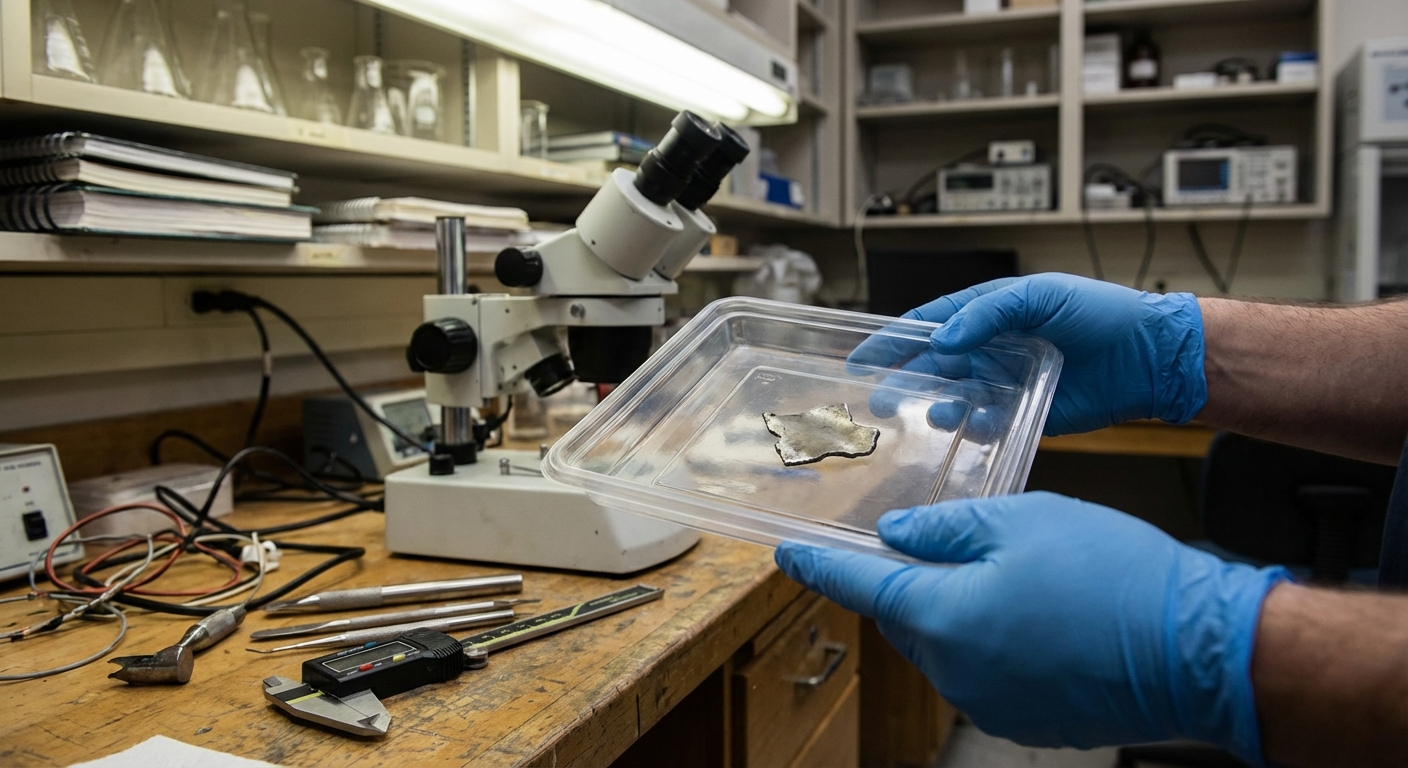
- Technical and material checks: Some alleged physical‑evidence claims have been assessed by scientists and material analysts and found to match terrestrial alloys, balloon or radar‑reflector materials, or otherwise explainable substances. Government and independent technical reviews that examined purported samples or fragments often returned mundane identifications. For example, AARO and related reviews have reported that alleged recovered samples were terrestrial alloys or otherwise unverified when scrutinized.
Why it matters: Verified, independently tested physical samples with a clear chain of custody would be the strongest form of evidence for an extraordinary claim. Existing technical checks published or summarized in official reviews do not show authenticated non‑terrestrial materials. Limits: not every sample claim has been presented to an open scientific process, and some proponents argue evidence was withheld or classified; those assertions remain unproven in publicly available records.
- Secrecy and human factors: The combination of a genuinely secret testing site, restricted airspace, and a culture of non‑disclosure provides a straightforward social mechanism that produces rumors, misinterpretations, and hoaxes. Multiple reputable histories and contemporary reporting note that secrecy around genuine black projects generated many UFO reports and conspiracy narratives.
Why it matters: A plausible explanation for persistent cover‑up narratives is simply that secrecy hides mundane programs; that context reduces the need to posit an additional, extraordinary secret (recovered alien technology) unless supported by independent documentation. Limits: secrecy also makes verification difficult, so absence of public documentation may reflect classification rather than non‑existence.
Alternative explanations that fit the facts
- Classified terrestrial aerospace testing. Historical records and declassified histories identify Area 51/Groom Lake as a site for U‑2, A‑12/Oxcart and later stealth programs; many unusual sightings match test flight profiles. This explanation fits a large portion of the documented anomaly reports.
- Misidentification, sensor errors, and natural phenomena. ODNI/DoD reviews emphasize that limited data quality, sensor glitches and normal aerial objects (balloons, drones, satellites) account for many UAP reports. This is a general technical explanation that reduces the number of unexplained cases requiring exotic hypotheses.
- Hoaxes, memory errors and social amplification. High publicity, online communities, and cultural narratives can magnify ambiguous sightings into detailed cover‑up stories. Investigative reporting on prominent claimants often finds human factors (fabrication, error, or embellishment) in at least part of the record.
- Classified but terrestrial programs (AATIP and successors). The U.S. did fund programs to study anomalous aerospace events; these programs do not equate to possession of extraterrestrial craft but do show the government has investigated anomalous reports more recently than public assumed. That work explains part of the secrecy and agency interest without implying alien technology.
What would change the assessment
- Verifiable, independently analyzed physical samples with documented chain of custody and transparent, peer‑reviewed laboratory results that demonstrate non‑terrestrial isotopic or material signatures beyond known Earth chemistry.
- Authentic, contemporaneous government records (uncut operational logs, chain‑of‑custody documents, sworn testimony from multiple, credentialed insiders with corroborating documents) that refer explicitly to recovered non‑terrestrial craft or remains and survive archival verification.
- Declassification of specific program files showing explicit procurement, reverse‑engineering budgets and deliverables tied to described non‑terrestrial artifacts, published or archived with credible documentation.
- If any of the above were produced and vetted publicly, they would materially alter the evidence score and shift the claim from largely speculative to documented; until then, counterevidence and official reviews weigh against the claim. For recent official avenues to submit historical claims or evidence, the DoD’s AARO provides a reporting mechanism and has invited former personnel to provide unclassified summary material for review.
Evidence score (and what it means)
- Evidence score: 15/100
- Score drivers: strong primary documentation that Area 51 exists and was used for classified aircraft testing (CIA declassified history).
- Score drivers: recent, official UAP reviews that report no verified evidence of recovered extraterrestrial craft or biological remains in government holdings examined to date.
- Score drivers: high dependence of the claim on testimonial sources with demonstrable inconsistencies and on poorly documented chain‑of‑custody for alleged physical samples (e.g., public scrutiny of high‑profile witnesses like Bob Lazar).
- Score drivers: plausible, documented alternative explanations (secret aircraft tests, sensor error, Project Mogul for Roswell) lower the need to posit an additional extraordinary secret without stronger documentation.
- Limitations: classification can hide records; public reviews may be incomplete or redacted, which is why the score is low rather than zero.
Evidence score is not probability:
The score reflects how strong the documentation is, not how likely the claim is to be true.
This article is for informational and analytical purposes and does not constitute legal, medical, investment, or purchasing advice.
FAQ
Q: Does the evidence show an Area 51 alien cover-up?
A: Public, documentable evidence does not support a verified government program that stores or reverse‑engineers extraterrestrial craft at Area 51. Declassified CIA histories identify Area 51 primarily with aircraft testing, and recent DoD/ODNI reviews report no authenticated recovered alien materials in the records they examined. These official sources provide the strongest counterevidence to the claim.
Q: If Area 51 tested secret planes, why do people still believe in an alien cover‑up?
A: The site’s genuine secrecy, restricted airspace, and the unusual flight profiles of experimental aircraft create a fertile environment for misidentification and rumor. High public interest, sensational media, and prominent witnesses with inconsistent records further amplify unverified claims.
Q: What about whistleblowers who say they saw alien craft at S‑4?
A: Individual testimonies are important but require corroborating documents, physical evidence, or validated employment/clearance records to move from anecdote to documented fact. Investigations into prominent claimants have found gaps and inconsistencies; absent independent corroboration, these accounts remain unproven.
Q: Could the government still be hiding something despite official reports?
A: In principle, yes — classification can conceal programs. However, official reviews (ODNI, DoD/AARO) have explicitly searched historical archives and reported their public findings: they did not find authenticated evidence of recovered extraterrestrial craft. If new, verifiable documentation or vetted physical samples appear, the assessment should be updated.
Q: Where can someone submit credible information or evidence about historical programs?
A: The Department of Defense’s AARO has published reporting channels and a tool for current and former personnel to provide unclassified summaries of historical programs or knowledge that may bear on UAP investigations. Submissions to official channels are the proper route for material that needs secure review.
Selected sources and notes on disagreement
- The CIA declassified history of U‑2 and OXCART testing at Groom Lake (Area 51).
- ODNI Preliminary Assessment on UAP (June 25, 2021) and subsequent AARO/DoD public summaries and reporting.
- Major news coverage and analysis (NPR, The Guardian, Reuters) summarizing declassified documents, the 2017 disclosures about AATIP, and later Pentagon/AARO reports.
- USAF historical reviews of the Roswell events and Project Mogul analyses.
- Investigative reporting on high‑profile eyewitness claims (e.g., reporting examining Bob Lazar’s records and public claims).
Conflicts among sources: some independent researchers and former personnel (or their advocates) say archived documents are incomplete or that not all relevant records have been provided to oversight offices; by contrast, the ODNI/AARO public reviews report that their historical reviews found no authenticated evidence of extraterrestrial possession. Both positions are documented: the former points to omissions and witness testimony, the latter to the results of official archival review. Because these sources disagree, this article does not speculate beyond the documented contents of the public records.
Bottom line: The strongest, publicly available documentation shows that Area 51/Groom Lake was and is a site for classified aircraft testing and that official UAP reviews to date do not provide authenticated evidence of recovered extraterrestrial craft or bodies. Many high‑profile claims rest on testimony or disputed documents; absent independently verifiable physical evidence or contemporaneous, corroborating records, the claim that Area 51 is the site of a long‑running alien cover‑up is poorly documented.

Geopolitics & security writer who keeps things neutral and emphasizes verified records over speculation.