
Intro: This article tests Ancient Megastructures ‘Impossible Tech’ Claims against documented archaeology, engineering studies, and expert commentary. We treat the phrase “Ancient Megastructures ‘Impossible Tech’ Claims” as a claim to be evaluated, not an established fact, and focus on published excavations, peer-reviewed research, and assessments by recognized specialists.
This article is for informational and analytical purposes and does not constitute legal, medical, investment, or purchasing advice.
Ancient Megastructures ‘Impossible Tech’ Claims — The best counterevidence and expert explanations
-
Antikythera mechanism: documented advanced mechanism, not inexplicable technology. The Antikythera mechanism is a confirmed Hellenistic analogue computer recovered from a shipwreck; detailed imaging and reconstruction work (x‑ray, tomography) demonstrated complex gear trains and astronomical functions, showing a high level of documented mechanical skill rather than a mysterious, non-human device.
Why it matters: this is an example where an object that looks “ahead of its time” has direct physical evidence, laboratory imaging, and peer-reviewed interpretation explaining how it worked and where it fits in known technological traditions.
Limits: the Antikythera mechanism is rare; presence of one sophisticated artefact does not imply lost global industrial systems. -
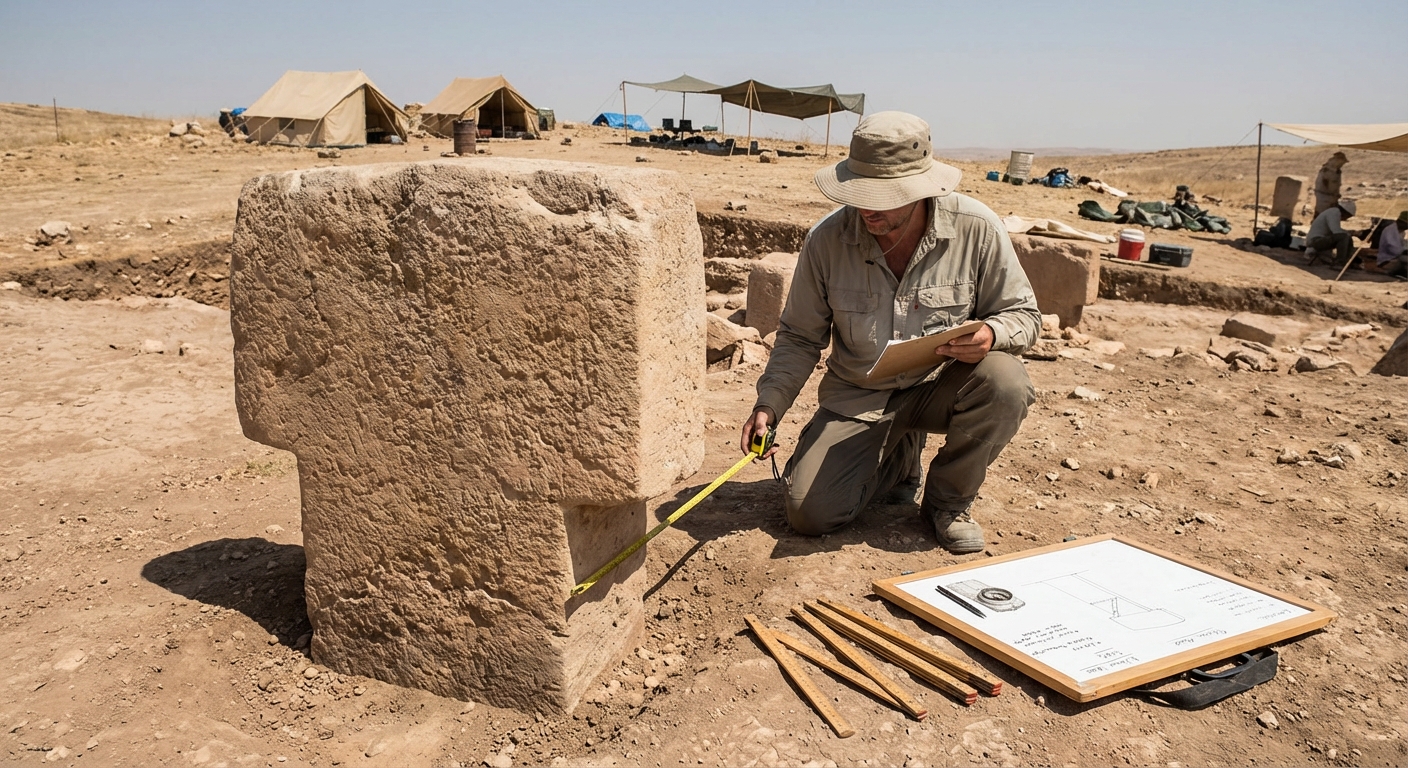
Göbekli Tepe: Neolithic monumental architecture explained by known stone‑tool technologies and social organization. Excavations and UNESCO documentation identify Göbekli Tepe as monumental T‑pillar enclosures carved from adjacent limestone by Pre‑Pottery Neolithic groups; excavation reports and the World Heritage nomination describe local quarrying, carved reliefs, and grades of tool marks consistent with contemporaneous stone‑tool industries.
Why it matters: Göbekli Tepe shows large, sophisticated construction is possible without metal tools or mechanized lifting — via organization of labor, local quarrying, and techniques within known Neolithic capabilities.
Limits: precise methods for moving some pillars are not fully documented in field reports; archaeological interpretation continues as more excavation proceeds. -
Stonehenge: geological sourcing and transport research supports human planning and transport, not glacial or non‑human intervention. Geochemical sourcing and quarry excavation work have traced many bluestones to Preseli Hills quarries in Wales and (in some recent work) to farther north; mineral fingerprinting and excavation evidence support deliberate prehistoric human extraction and transport by complex human logistical systems rather than natural glacial dumping. Different studies disagree about some stone origins, but the consensus is human agency.
Why it matters: the stones’ geological matches and evidence of quarrying provide positive counterevidence to claims that Stonehenge required unknown technology or non‑human help.
Limits: researchers disagree about the provenance of particular stones (some newer studies propose different quarry sources), so some interpretive details remain contested. -
Baalbek Trilithon and quarry blocks: large ancient blocks exist, but quarry evidence and Roman engineering explanations reduce the need for exotic hypotheses. The huge cut stones around Baalbek (including the so‑called Trilithon and larger blocks in the quarry) are real and well documented; recent field and architectural studies describe quarrying marks, undercutting and partial extraction evidence consistent with known ancient techniques and the possibility of phased building or reuse by Roman builders. Scholarly discussion continues about exact transport/placement methods, which has left room for speculation.
Why it matters: physical evidence of quarry marks and stratigraphy is usable by engineers and archaeologists to propose and test plausible methods rather than invoking unknown tech.
Limits: documentary records are sparse for specific lifting operations, and experts differ about whether Romans alone moved the largest blocks or whether earlier phases contributed large monoliths; those disagreements are why Baalbek is often cited in “impossible tech” narratives. -
Egyptian pyramids: archaeological evidence for organized labor, worker settlements, and ramp/leverage solutions. Excavations at Giza (workers’ village, bakeries, tools) and field experiments support the thesis that large teams, sledges, and ramp‑based systems — possibly combined with internal ramp or levering techniques — enabled the construction of pyramids without needing unknown machines. Field discoveries (workers’ village, quarry ramps) and engineering models make naturalistic explanations testable.
Why it matters: traces of logistics (food production, workshops, cemetery, tools) document the human organization required to build large monuments and counter claims that no workforce or technique existed.
Limits: debate continues about exact ramp geometry and lift mechanics; multiple ramp and lever hypotheses coexist because direct archaeological evidence for a single full‑scale ramp system is incomplete.
Alternative explanations that fit the facts
When alleged “impossible tech” claims are tested against the archaeological record, several alternative, evidence‑based explanations repeatedly account for the data:
- Specialized human craftsmanship and incremental innovation: skilled masons, development of better tools (e.g., stone pounders, copper alloys), and refined techniques can create outcomes that look surprising in the present day but were within contemporary problem‑solving capacities.
- Logistical scale and social organization: sustained labor mobilization, provisioning, and project management (village camps, seasonal labor, tribute systems) explain the manpower and coordination behind megastructures. Excavated workers’ villages provide direct evidence for this model.
- Phased construction and reuse: monuments often reflect long building histories and re‑use of earlier foundations; partial quarrying evidence and stratigraphic complexity can look inexplicable if phased histories are ignored.
- Engineering solutions now better modeled: internal ramps, counterweight systems, sledging with water lubrication, and levering have been modelled, experimentally tested, or demonstrated in situ or in analogous quarries. These approaches reduce the need for unknown mechanisms.
What would change the assessment
Archaeological reasoning is provisional. The assessment that ancient megastructures do not require unknown technology would change if any of the following were produced and independently validated:
- Clear, datable inscriptions or documents describing machines or materials unknown to contemporaneous cultures and not consistent with known metallurgy, stonework, or engineering.
- Recovered artefacts composed of alloys, composites, or manufacturing features demonstrably outside the plausible range for the stated period, confirmed by multiple independent labs with reproducible results.
- Stratigraphic or contextual evidence that conclusively separates a megalithic phase from any documented cultural phase, with no intermediate technology or workforce evidence explaining the work.
- Replicable experimental demonstrations showing that all observed features (tool marks, precision fits, transport paths) cannot be produced by any combination of known ancient techniques under realistic resource assumptions.
Evidence score (and what it means)
- Evidence score: 68 / 100
- Score drivers:
- Strong physical documentation for some items (Antikythera mechanism, workers’ village at Giza, quarry marks at Baalbek, Göbekli Tepe pillars).
- Multiple peer‑reviewed studies and imaging results for select artefacts (Antikythera, Stonehenge sourcing studies).
- Uncertainty remains where documentary records or full process traces are missing (exact lifting methods at Baalbek, full ramp evidence for the Great Pyramid).
- Some high‑profile claims rely on absence‑of‑evidence arguments or misinterpretation of technical data, reducing overall claim strength.
- Consensus among domain specialists favors testable, human‑based explanations where direct evidence exists; contested cases remain under active research.
Evidence score is not probability:
The score reflects how strong the documentation is, not how likely the claim is to be true.
FAQ
Q: Are Ancient Megastructures ‘Impossible Tech’ Claims credible?
A: Credibility varies by claim. Some items that sound miraculous (for example, the Antikythera mechanism) are documented and understood through scientific analysis; others hinge on gaps in records or sensational interpretations. Where archaeology has physical context, excavation reports and lab analyses offer the strongest tests.
Q: What is the strongest single counterevidence against “impossible” explanations?
A: The strongest counterevidence is physical context: quarry marks, tool marks, settlement remains, and datable stratigraphy that connect megaliths to human industries and logistical systems (e.g., workers’ villages at Giza, quarrying evidence at Stonehenge and Baalbek, excavation reports for Göbekli Tepe). Those direct field data are how archaeologists test extraordinary claims.
Q: How do scholars respond to popular “ancient aliens” or “impossible tech” narratives?
A: Professional archaeologists and historians typically treat such narratives skeptically. They emphasize methodological rules: require primary evidence, testable hypotheses, reproducible lab results, and contextualization of artifacts within known cultural and technological trajectories. Scholarly critiques point out how many popular claims rely on misreading iconography, ignoring comparative technological evidence, or using absence of documentation as proof of impossibility.
Q: What would count as proof that an ancient structure involved unknown technology?
A: Proof would require reproducible, independently verified physical materials or inscriptions that cannot be explained by known processes, plus secure archaeological context and dating tying them to the claimed period. Without that, the preferred standards are direct documentation and testable engineering reconstructions.
Q: How can a non‑specialist evaluate new claims they see online?
A: Check for primary sources (excavation reports, peer‑reviewed papers, reputable museum statements). Look for independent lab confirmations rather than single sensational headlines. Consider whether the explanation invokes absence‑of‑evidence rather than presenting positive evidence. Scholarly outlets and established heritage organizations are the most reliable first checks.

Science explainer who tackles space, engineering, and ‘physics says no’ claims calmly.