
This article offers a responsible, evidence-focused verdict on the Atlantis lost civilization claims. It assesses what is documented in primary sources, how later authors and popularizers expanded the story, what archaeology and geoscience do and do not support, and which assertions cannot be proven with available evidence. The analysis treats the Atlantis lost civilization claims as a claim to be evaluated, not as established fact.
Verdict: what we know, what we can’t prove
What is strongly documented
Plato’s dialogues Timaeus and Critias (written c. 360 BCE) are the primary and earliest textual sources describing Atlantis: an island polity portrayed in detail as a moral and political allegory. The dialogues describe geography, concentric rings of land and water, and a catastrophic end by earthquake and inundation; these texts are preserved in classical manuscript traditions and modern translations.
From a historiographical perspective, mainstream reference works and many classicists treat Plato’s account as a philosophical story—most often an invented or adapted myth—rather than a reliable historical report of a specific prehistoric nation. Major summaries and encyclopedia entries present Plato’s account as the origin of the legend and note that modern archaeology has not identified a direct, unambiguous archaeological counterpart to Plato’s description.
What is plausible but unproven
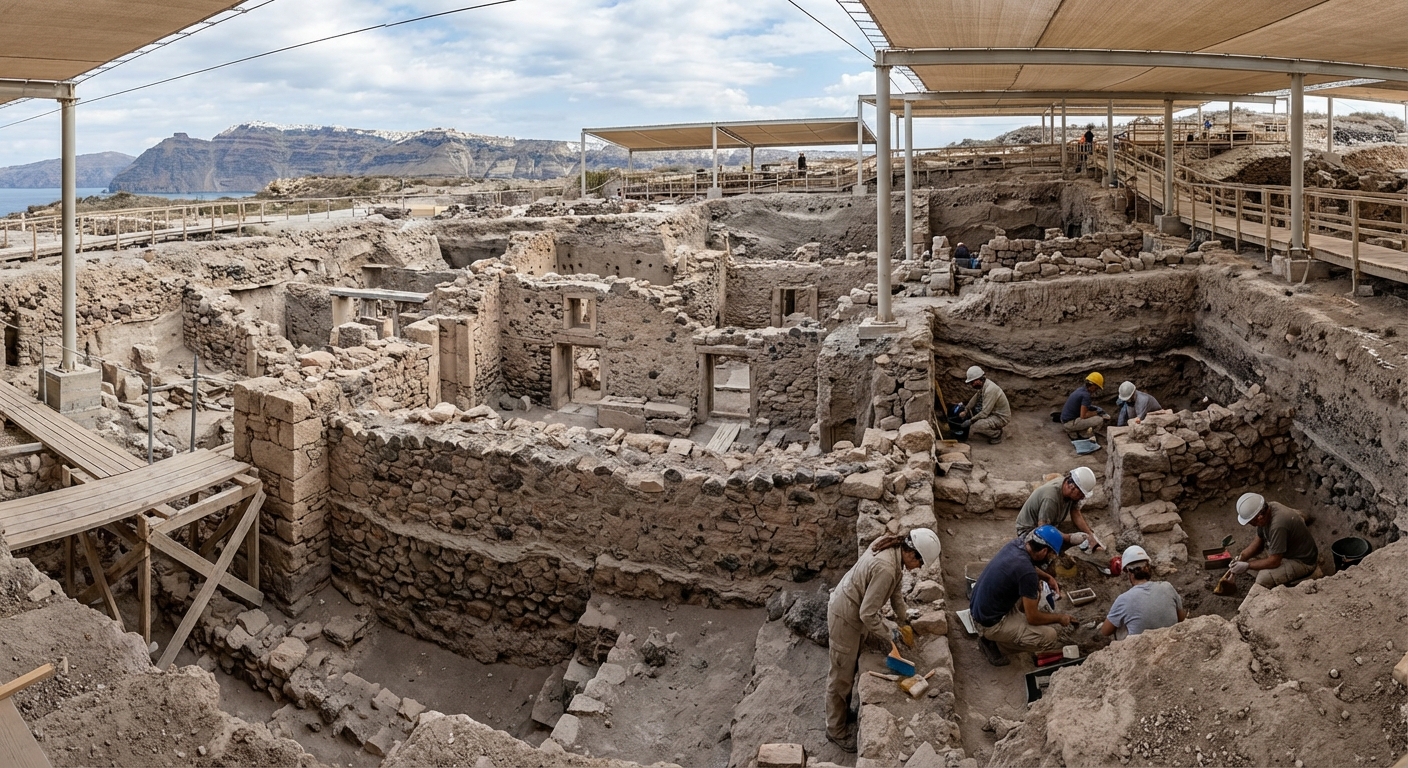
It is plausible that some elements of the Atlantis story were inspired by memories of real disasters—regional volcanic eruptions, tsunamis, or sea-level changes—that affected Bronze Age societies. For example, the Minoan eruption on Santorini in the second millennium BCE was a catastrophic volcanic event that disrupted the eastern Mediterranean and is often proposed as one possible kernel of memory or model that later became woven into stories like Atlantis. The Santorini/ Minoan context is a plausible partial analogue but does not match Plato’s entire description and timing precisely.
Large, rapid sea-level changes and the inundation of coastal settlements after the last Ice Age (including well-documented examples such as Doggerland in the North Sea and submerged Mesolithic sites in northern Europe) show that human communities have lost land to rising seas and sudden events. Those phenomena provide real-world mechanisms by which memories of vanished places could form, but they do not provide direct evidence for an advanced, global Atlantean civilization as described in later popular works. Recent geological research confirms significant post‑glacial sea-level rise and episodes of rapid coastal change.
What is contradicted or unsupported
Claims that Atlantis was a single, advanced global civilization that seeded or directly founded all known ancient civilizations are not supported by mainstream archaeology or genetic, linguistic, and material-culture evidence. Proposals that take Plato’s narrative as a literal historical report at the scale sometimes asserted in nineteenth‑ and twentieth‑century popular books (e.g., claims of a single progenitor civilization responsible for multiple discrete ancient cultures) are contradicted by the absence of corroborating archaeological strata, artifacts of a uniquely Atlantean material culture, or credible contemporaneous written records outside the Platonic texts.
Evidence score (and what it means)
Evidence score is not probability:
The score reflects how strong the documentation is, not how likely the claim is to be true.
- Evidence score (0–100): 22
- Drivers: earliest primary source is a literary/philosophical text rather than an archaeological record; no independent contemporaneous documentary evidence has been found; plausible real events (volcanic eruptions, sea-level rise) can explain parts of the story but do not confirm Plato’s specific details; a long history of reinterpretation and myth-building has layered unverified claims on top of the original texts.
- Supporting documentation: authoritative summaries and primary Plato texts exist and are well‑preserved.
- Counterevidence: mainstream archaeological and historiographical reviews treat the tale as allegorical or legendary; no widely accepted archaeological site has been identified as Plato’s Atlantis.
- Unresolved: geological and paleoenvironmental studies document rapid sea-level and catastrophic events that could seed legends, but linking a single event to Plato’s account requires multiple unproven assumptions.
Practical takeaway: how to read future claims
When evaluating new claims about Atlantis, distinguish three categories: (1) direct primary documentation (e.g., texts or dated artifacts contemporaneous with the alleged event), (2) plausible but indirect parallels (e.g., known volcanic eruptions or inundated settlements that might inspire legends), and (3) speculative reconstructions that extend beyond available evidence. Demand independent, dateable material evidence (radiocarbon, stratigraphy, in situ artifacts with secure context) before accepting claims about a specific site being ‘‘Atlantis.’p>
Also pay attention to provenance and peer review: findings published in peer‑reviewed journals or reported by qualified archaeological teams with transparent methods carry more weight than speculative books, non‑expert internet claims, or politically/ideologically motivated narratives.
FAQ
How strong is the evidence for Atlantis lost civilization claims?
Measured as documentation rather than probability, the evidence score is low (see the Evidence score section). The earliest, most authoritative source is Plato’s Timaeus and Critias, which most scholars interpret as philosophical narrative rather than a straightforward historical chronicle. Independent archaeological and geoscientific records document events that could inspire memories of lost places, but they do not verify Plato’s full account as a literal, single historical civilization.
Could the Santorini eruption be the origin of the Atlantis story?
Scholars often cite the Minoan eruption on Santorini as a plausible partial inspiration because it produced enormous ash fallout, tsunamis, and social disruptions in the eastern Mediterranean. However, the eruption’s geography, dating, and archaeological record do not match every detail of Plato’s account, and most specialists treat Santorini as one possible analog rather than definitive proof.
Are there any credible archaeological sites claimed to be Atlantis?
Multiple sites have been proposed over time (Mediterranean islands, locations off Spain, the Azores, submerged features like the Bimini Road), but none has gained broad acceptance among archaeologists. Claims relying mainly on surface formations, ambiguous sonar returns, or reinterpretations of geological features require rigorous, peer‑reviewed excavation and dating to be persuasive; such work has not produced consensus evidence identifying any known site as Plato’s Atlantis.
Why do Atlantis claims persist despite weak documentation?
The Atlantis story combines timeless attractions—advanced civilizations, sudden catastrophe, hidden knowledge—with 19th‑ and 20th‑century movements that popularized grand diffusionist narratives (e.g., Ignatius Donnelly’s speculative work). Human interest in lost heritage, together with selective readings of geological and archaeological data, sustains speculation. Media, fiction, and commercial interests further amplify unverified claims.
This article is for informational and analytical purposes and does not constitute legal, medical, investment, or purchasing advice.

Science explainer who tackles space, engineering, and ‘physics says no’ claims calmly.