
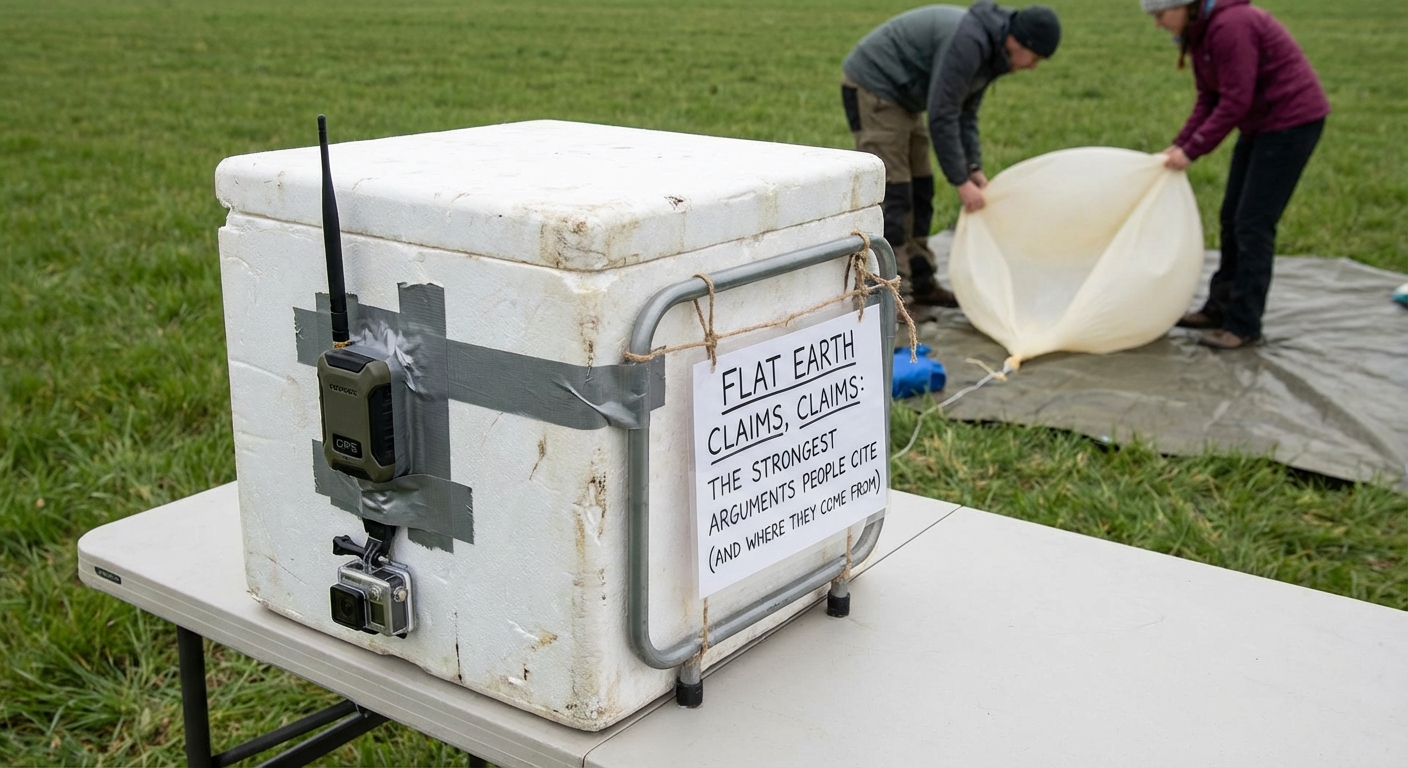
Below are commonly cited arguments used by proponents of Flat Earth claims; this piece treats them as claims presented by supporters and does not endorse them. Each entry lists the claim, the typical source type, and a simple verification test readers can use to check the underlying evidence. Wherever possible we cite primary or high-quality secondary sources about the origin or testing of these claims.
This article is for informational and analytical purposes and does not constitute legal, medical, investment, or purchasing advice.
The strongest arguments people cite about Flat Earth claims
-
Claim: The horizon always appears flat from ground level and even at aircraft altitudes, so Earth must be flat.
Source type: Personal observation, popular YouTube videos and commentary by advocates.
Verification test: Read scientific explanations of why a very large sphere appears locally flat; compare altitude vs. visible horizon distance and examine high-altitude balloon or astronaut imagery taken from well-documented sources.
Why this matters: Human-scale views only show a small portion of Earth’s surface, so local perception is insufficient to infer global shape. Scientific explainers note that from typical ground elevations patients can only see a few miles of horizon; the curvature becomes visually apparent only at much higher altitudes or from sufficiently wide fields of view.
-
Claim: Water always finds its level, and large bodies of water appear flat, so oceans cannot curve around a sphere.
Source type: Historical pamphlets, modern polemics referencing simple physical intuition.
Verification test: Examine measured sea-level geodetic data and observations of ships disappearing hull-first over the horizon; consult surveying methods used for large-scale mapping that account for curvature.
Why this matters: “Water finds its level” refers to local tangential equilibrium; over long distances the local horizontal is tangent to the curved surface. Professional surveying and global geodesy treat sea level as an equipotential surface (the geoid) that is consistent with Earth’s large-scale curvature; these are documented in geodetic literature (see professional sources cited in regional geodesy, cf. national mapping agencies). (See also the historical Bedford Level experiments discussion below.)
-
Claim: Classic 19th‑century experiments (e.g., the Bedford Level observations) were cited by early flat‑Earth proponents as proof the surface is flat.
Source type: Historical experiments and pamphlets (Samuel Rowbotham et al.).
Verification test: Review primary descriptions of the Bedford Level measurements and later repeat experiments and analyses that control for atmospheric refraction.
Why this matters: The Bedford Level experiment is historically central to modern flat‑Earth advocacy because Samuel Rowbotham interpreted its results as evidence for a flat surface. Later investigators, notably Alfred Russel Wallace, re‑examined the setup and accounted for atmospheric refraction, finding results consistent with a spherical Earth. The historical record and critiques are documented in contemporary historical summaries.
-
Claim: Photographs from space agencies (NASA and others) are faked; therefore satellite imagery that shows a spherical Earth cannot be trusted.
Source type: Conspiracy assertions, selective forensic claims about image editing, and arguments from alleged institutional dishonesty.
Verification test: Review provenance of orbital imagery (satellite metadata, published mission logs), cross-check independent observations (e.g., amateur satellite tracking and ISS live streams), and consult statements by agencies about image processing standards.
Why this matters: Accusations of fakery shift the debate to institutional trust and provenance. Space agencies publish mission details and metadata for many missions; independent amateur tracking, radio telemetry, and multiple international space agencies provide overlapping lines of evidence about satellites and crewed missions. The Flat Earth movement’s responses to satellite images have a documented rhetorical history (see historical notes on reaction to satellite imagery).
-
Claim: Flight routes and times (especially in the Southern Hemisphere) allegedly don’t match a globe model or would be different if Earth were spherical.
Source type: Mapping misinterpretations, anecdotal route queries, and misreadings of great‑circle routing.
Verification test: Use official airline schedules, published flight distances and times, and great‑circle routing calculators; consult aviation navigation explanations about why some routes appear indirect on certain map projections.
Why this matters: Airline routing follows great‑circle paths and airspace agreements; distortions from map projections (for example, Mercator) can make logical routes look non‑intuitive. Official aviation sources and flight data can be used to verify route distances and typical flight times.
-
Claim: The lack of easily repeatable small‑scale experiments that definitively show curvature for non‑specialists proves the curvature is fabricated.
Source type: Epistemic challenge — demanding simple demonstrations with household equipment.
Verification test: Review well‑documented, repeatable experiments (Eratosthenes’ shadow measurement, long‑baseline surveying, high‑altitude balloon footage with calibrated GPS/timestamps) and follow published protocols to reproduce them.
Why this matters: Some classical measurements (Eratosthenes’ method) provide simple, reproducible ways to test curvature using geometry and timed observations; modern hobbyist projects also produce high‑altitude footage and instrumented measurements. Historical documentation shows methods that produce consistent estimates of Earth’s circumference.
-
Claim: If Earth were spinning and curved, we would notice strong effects (e.g., objects thrown vertically would fall far behind), so the absence of such everyday evidence implies a stationary flat Earth.
Source type: Intuitive physical reasoning without accounting for frames of reference and rotational dynamics.
Verification test: Consult elementary physics treatments of rotating frames (Coriolis effect, inertial frames) and practical demonstrations (projectiles, Foucault pendulum) that test Earth’s rotation on human‑observable scales.
Why this matters: Rotational effects can be small at human scales and are measurable by controlled instruments. The Foucault pendulum and Coriolis‑influenced weather systems provide documented, measurable phenomena consistent with a rotating Earth; explanation requires applying classical mechanics rather than pure intuition.
-
Claim: Historical and scriptural interpretations (various literal readings) support a flat Earth cosmology.
Source type: Religious texts and historical pamphlets (e.g., 19th‑century zetetic literature).
Verification test: Compare historical exegesis with mainstream historical scholarship on medieval and ancient cosmology; examine the emergence of modern flat‑Earth publications and societies to trace how scriptural readings were repurposed.
Why this matters: Modern flat‑Earth advocacy often builds on 19th‑century zetetic publications and selective scriptural readings; historical studies show that classical and medieval scholarly traditions largely accepted a spherical Earth well before modern times, and the modern movement has traceable origins in specific 19th‑century actors.
-
Claim: Controlled experiments (e.g., gyroscopes or level measurements) are misinterpreted by mainstream science to hide a flat Earth.
Source type: Technical‑sounding claims invoking instrumentation.
Verification test: Review instrumentation specifications and peer‑reviewed literature on gyroscope evidence, plus independent demonstrations by universities and independent labs.
Why this matters: Instrumentation claims require detailed methodological review. Peer‑reviewed and educational demonstrations of inertial navigation, gyroscopes, and satellite navigation show internal consistency with a spherical rotating Earth when properly interpreted and calibrated; unsupported reinterpretations often omit critical technical details.
-
Claim: Antarctica is a giant ice wall that bounds a flat disc Earth; access restrictions and treaties hide the edge.
Source type: Speculative reconstructions, conspiracy narratives tied to limited tourist access in certain zones.
Verification test: Consult public maps, scientific expeditions, satellite imagery, and international research station records about Antarctica’s coastline and logistics; examine the Antarctic Treaty System’s public documentation.
Why this matters: Antarctica is a mapped continent with multiple national research stations, public logistical records, and satellite imagery available from international sources. Claims about a concealed “edge” rely on a broad conspiratorial premise and contradict the availability of independent observations and international scientific activity around the continent.
How these arguments change when checked
When each argument is examined against documented sources and reproducible tests, several patterns recur:
-
Scale mismatch: Many claims rest on local human perception extrapolated to global conclusions. Scientific explanations frequently point out how local geometry and optics differ from global geometry; authoritative explainers show that a sphere of Earth’s size will appear locally flat at human scales.
-
Historical continuity: The modern flat‑Earth movement can be traced to identifiable 19th‑century figures (Samuel Rowbotham and later organizations) and to specific polemical works; this helps explain which experiments and pamphlets are repeatedly cited by advocates. Historical summaries document these origins and the movement’s rhetorical strategies.
-
Reproducibility and instrumentation: Claims that depend on misread instrumentation or misapplied optics generally collapse when tests are performed under controlled conditions with attention to atmospheric refraction, instrument calibration, and known physical effects (for example, the Bedford Level re‑measurements that accounted for refraction).
-
Multiple independent evidence streams: Spherical‑Earth conclusions are supported by many different methods (geometric measurements dating to Eratosthenes, modern orbiter imagery and telemetry, geodesy, physics experiments showing rotation, and consistent international observational data). When advocates challenge one class of evidence (for example, NASA imagery), other independent lines remain. The classical Eratosthenes-style measurement remains a simple, independent geometric check.
-
Conflicting interpretations: In some cases, proponents and mainstream sources interpret the same data differently (for example, a photo’s editing vs. provenance). Where different interpretations exist, the proper method is to check provenance, metadata, and independent corroboration rather than accept the most conspiratorial explanation by default.
Evidence score (and what it means)
- Evidence score: 12 / 100
- Most cited arguments rely on local perception, historical pamphlets, or conspiracy assertions rather than convergent, independently verifiable measurements.
- Classical measurements, repeatable geodetic methods, and orbital telemetry provide high‑quality documentation supporting a non‑flat model; proponents’ counterclaims typically require dismissing multiple independent data streams.
- Some historical experiments cited by advocates (e.g., Bedford Level) were re‑examined and shown to be affected by confounding factors such as atmospheric refraction.
- Claims that rely on institutional fakery rest on broad conspiratorial premises that are difficult to test; such claims shift the burden of proof to demonstrating large‑scale, coordinated deception.
- There is extensive, open documentation from multiple countries and independent observers on the topics most relevant to global shape (satellite telemetry, navigation, geodesy).
Evidence score is not probability:
The score reflects how strong the documentation is, not how likely the claim is to be true.
FAQ
Q: What do people mean when they say “Flat Earth claims”?
A: The phrase refers to a set of related claims that Earth is not a globe but instead a flat disc or plane bounded in various ways. This article treats those statements as claims and analyzes evidence and origins rather than endorsing them. The modern movement has identifiable 19th‑century roots (Samuel Rowbotham and zetetic literature).
Q: Can ordinary people repeat a simple test to check curvature themselves?
A: Yes—classical geometry experiments (Eratosthenes’ shadow method) and well‑documented long‑baseline observations can be reproduced with planning, trustworthy timing, and clear controls for local refraction. Eratosthenes’ method and later reproductions are well described in scientific outreach literature.
Q: Why do some historical experiments like the Bedford Level get cited as proof?
A: Bedford Level experiments were historically important because they were simple and public; however, later re‑examinations showed atmospheric refraction and measurement details can change outcomes. The original proponents did not always control for these effects, and later investigators documented curvature when accounting for confounders.
Q: Do multiple independent sources support Earth’s sphericity?
A: Yes. Independent lines include geometric measurements (ancient and modern), geodesy, satellite telemetry, international space missions, and physical experiments that measure rotation and gravity effects. When one line is questioned, several others remain, and many are publicly documented and reproducible.
Q: Where did modern Flat Earth claims spread in recent years?
A: The Internet era and social media broadened the reach of flat‑Earth advocacy by making niche arguments and videos widely available; modern flat‑Earth organization histories and analyses document this resurgence and how online platforms facilitated community formation.

Science explainer who tackles space, engineering, and ‘physics says no’ claims calmly.