
This article tests the Atlantis lost civilization claims against the best available counterevidence and expert explanations. It treats Atlantis as a claim rooted in Plato’s dialogues and asks: what is documented, what is disputed, and what cannot be proven? The review relies on primary texts and mainstream archaeological and geological sources rather than speculative or pseudo‑archaeological accounts.
The best counterevidence and expert explanations
-
Primary literary context: Plato’s account appears in Timaeus and Critias and reads like a philosophical and political allegory rather than straightforward history. Modern classicists and encyclopedic references treat Plato’s Atlantis mainly as a literary device illustrating political and moral points, not reliably as a documented civilization. This weakens any claim that Plato provides a direct historical record of a trans‑Atlantic advanced state.
-
Lack of corroborating archaeological evidence consistent with Plato’s scale and chronology: Plato mentions an island empire larger than Libya and Asia Minor combined and places its destruction many thousands of years before his day. No archaeological finds in the Mediterranean or Atlantic reliably match a polity of that size and complexity at the dates implied by Plato’s chronology. Major archaeological surveys and syntheses conclude that the textual claim lacks independent material corroboration.
-
Thera eruption as only a partial match: The large Bronze‑Age eruption of Santorini circa the mid‑second millennium BCE has been proposed as a historical kernel for Atlantis stories, but mainstream volcanology and archaeology do not see it as a direct match to Plato’s description (not least because Plato’s supposed date for Atlantis is much older). While the eruption was catastrophic for some Aegean communities and likely contributed to later myths, scholars caution that equating Thera with Plato’s Atlantis overstates the alignment of details and chronology.
-
Natural seabed features and mapping artifacts explain many “underwater city” claims: High‑resolution bathymetry, sonar grids, and natural geological formations (for example, basalt columns, exposed strata, or sediment patterns) commonly produce shapes that can be misread as man‑made structures by non‑specialists. Agencies that map the ocean and marine scientists warn that visual patterns, survey tracks, and sonar artifacts frequently generate false positives for “lost cities.” These technical explanations counter claims that odd sonar images are clear proof of an Atlantis‑scale civilisation.
-
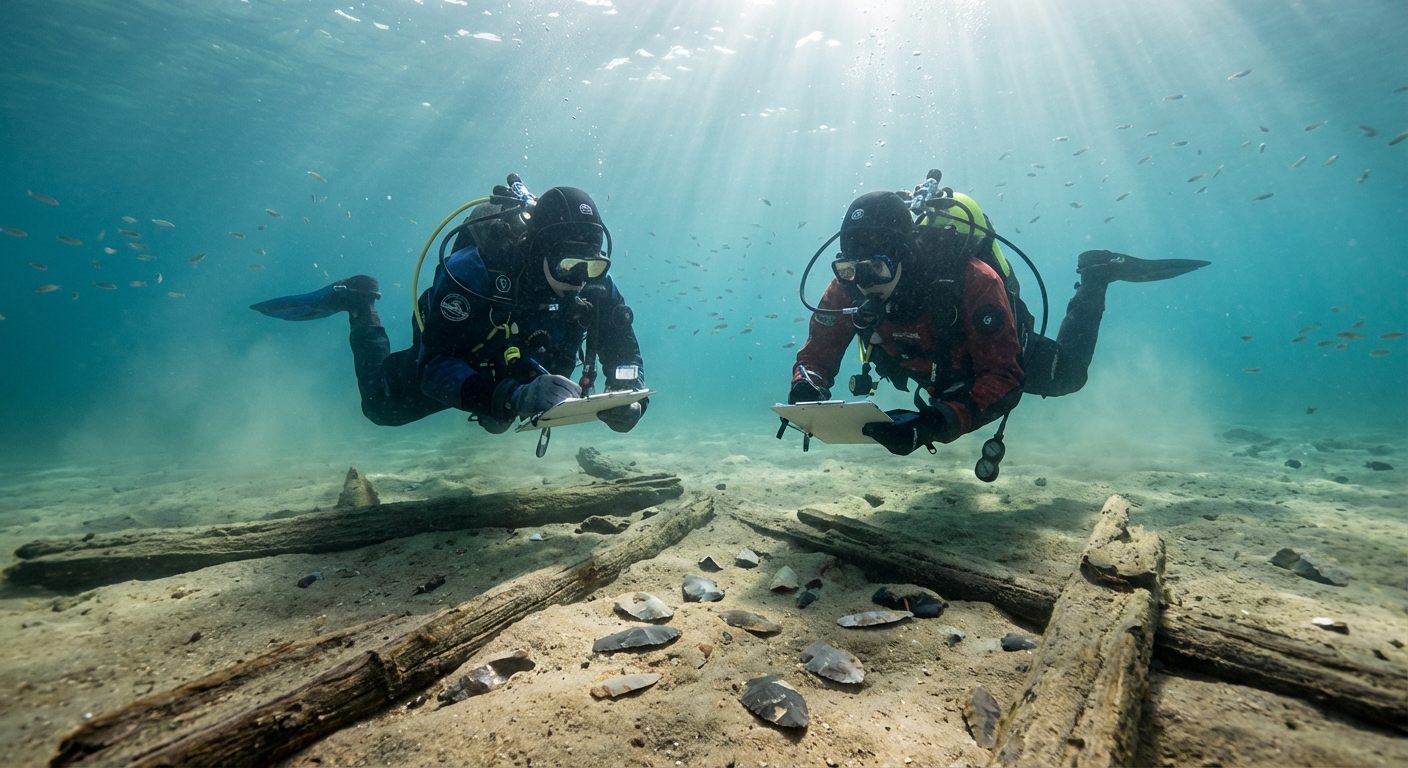
Examples of real submerged human landscapes differ in scale and date: Well‑documented cases such as Doggerland (the drowned Mesolithic plain in the southern North Sea) and submerged Mesolithic or Neolithic sites show that humans did live in landscapes now underwater. However, these are regional, gradual inundations or tsunami events consistent with known post‑glacial sea‑level rise and are not equivalent to Plato’s description of a vast, sophisticated island empire disappearing in a single day and night. Recognizing these real examples helps explain why people conflate any submerged remains with the Atlantis narrative.
-
Pseudo‑archaeological lineage and modern mythology: Since the 19th century various authors and popularizers (e.g., Ignatius Donnelly and later writers) treated Plato as a factual source and layered speculative reconstructions or hyperdiffusionist claims over limited evidence. Histories of the Atlantis idea show how imaginative reconstructions, nationalistic agendas, and commercial media contributed to persistent but poorly supported claims. Modern scholarship separates this reception history from evidence‑based archaeology.
Alternative explanations that fit the facts
When people look for a historical basis for the Atlantis story, several better‑documented explanations fit fragments of Plato’s narrative without requiring a trans‑Atlantic, Plato‑sized empire:
-
Local catastrophe myths: Powerful regional events — volcanic eruptions, earthquakes, or tsunamis — can create vivid generational memories that later appear in literary forms. These real disasters can help explain flood and destruction motifs in oral traditions and later philosophical stories. However, matching a single event to the full set of Plato’s claims requires leaps not supported by the archaeological record.
-
Gradual post‑glacial submergence: In northern Europe and elsewhere, slow sea‑level rise and episodic events submerged inhabited landscapes over millennia; archaeological remains now lie under shallow seas. These are documented processes and sites, but they differ in scale, technology, and timing from Plato’s narrative. Treating all submerged sites as “Atlantis” conflates distinct phenomena.
-
Literary invention and ideological allegory: A large portion of academic work interprets Plato’s account as rhetorical and pedagogical, created to make philosophical points about ideal states, decadence, and divine punishment. Under this explanation, Atlantis functions primarily as a philosophical tool rather than as a historical report.
What would change the assessment
The current assessment rests on the mismatch between Plato’s literary context and the absence of independent, well‑dated material evidence for an empire matching his description. The claim would require at minimum:
-
Archaeological finds with reliable stratigraphy and radiometric dates clearly linked to a polity of comparable scale and complexity in the places people propose (Mediterranean rim or Atlantic margins). Any such finds would need peer‑reviewed publication and wide scholarly verification.
-
Independent, multidisciplinary geological evidence showing a sudden catastrophic inundation at the relevant time and location that is consistent with the human record Plato describes (rather than a gradual or regional inundation).
-
Primary documentation (inscriptions, contemporaneous records) from independent cultures that corroborate a far‑reaching empire and the specific events Plato narrates.
If new, verifiable evidence meeting those standards emerged and withstood peer review, scholarly opinion would appropriately update. Until then, claims that Atlantis was a historical trans‑Atlantic civilisation remain unsupported by the best available evidence.
Evidence score (and what it means)
Evidence score is not probability:
The score reflects how strong the documentation is, not how likely the claim is to be true.
- Evidence score (0–100): 18
- Drivers: primary textual source is ancient and literary rather than documentary (Plato’s dialogues).
- Drivers: no independent, securely dated archaeological complex matching Plato’s description has been published and accepted by mainstream archaeology.
- Drivers: plausible historical kernels (e.g., Thera eruption, regional inundations) exist but do not align cleanly with the text’s scale, dates, or geographic specifics.
- Drivers: many supposed “underwater cities” are explained by sonar artifacts, mapping grids, or natural geology—technical counterevidence weakens interpretation of imagery as proof.
FAQ
Q: Could the Santorini eruption be the historical basis for the Atlantis lost civilization claims?
A: Santorini’s mid‑second millennium BCE eruption is a powerful candidate for a regional historical kernel because it produced catastrophic local effects and later cultural memories. However, most scholars do not accept Santorini as a full match for Plato’s account because of chronological and scale mismatches and because Plato’s narrative functions within a philosophical literary framework. In short: Santorini may have influenced later storytelling, but it does not provide direct proof of the Atlantis polity Plato describes.
Q: Are there any real submerged human cities that validate Atlantis claims?
A: There are well‑documented submerged sites and landscapes (for example, Doggerland and several Mesolithic sites) that demonstrate humans have inhabited areas now underwater. These cases are documented with core samples, artifacts, and surveys, but they represent different scales and processes (post‑glacial sea‑level rise, regional flooding) than the grand island‑empire described by Plato. They do not validate the specific Atlantis claim as stated in the dialogues.
Q: What explains modern images or sonar scans people say show Atlantis?
A: Many modern “underwater city” claims are explained by mapping artifacts, survey ship tracks, natural seabed geology, or misidentified rock formations. Agencies that map the seafloor warn that grid patterns or geometric appearances are often survey artifacts rather than ruins. Caution and expert analysis (marine geology, underwater archaeology) are necessary before treating an image as evidence.
Q: What would count as convincing evidence that Atlantis was a real ancient state?
A: Convincing evidence would include: (1) archaeological remains with secure context and dates matching the claim; (2) multiple independent lines of scientific data (geoarchaeology, radiocarbon dating, sedimentary evidence) showing a catastrophic event consistent with the narrative; and (3) corroborating, contemporaneous textual evidence from independent cultures. Absent those, extraordinary claims remain unproven.
Q: Why do Atlantis claims persist despite limited evidence?
A: The Atlantis story is culturally resonant—it mixes moral lessons, dramatic catastrophe, and the idea of lost knowledge. Popular media, nationalist or ideological reinterpretations, and selective readings of ambiguous data have kept speculation alive. This is compounded by the human tendency to fit intriguing anomalies into familiar narratives rather than waiting for robust, peer‑reviewed research. Recent improvements in underwater mapping also produce visuals that inflame speculation.
This article is for informational and analytical purposes and does not constitute legal, medical, investment, or purchasing advice.

Science explainer who tackles space, engineering, and ‘physics says no’ claims calmly.