
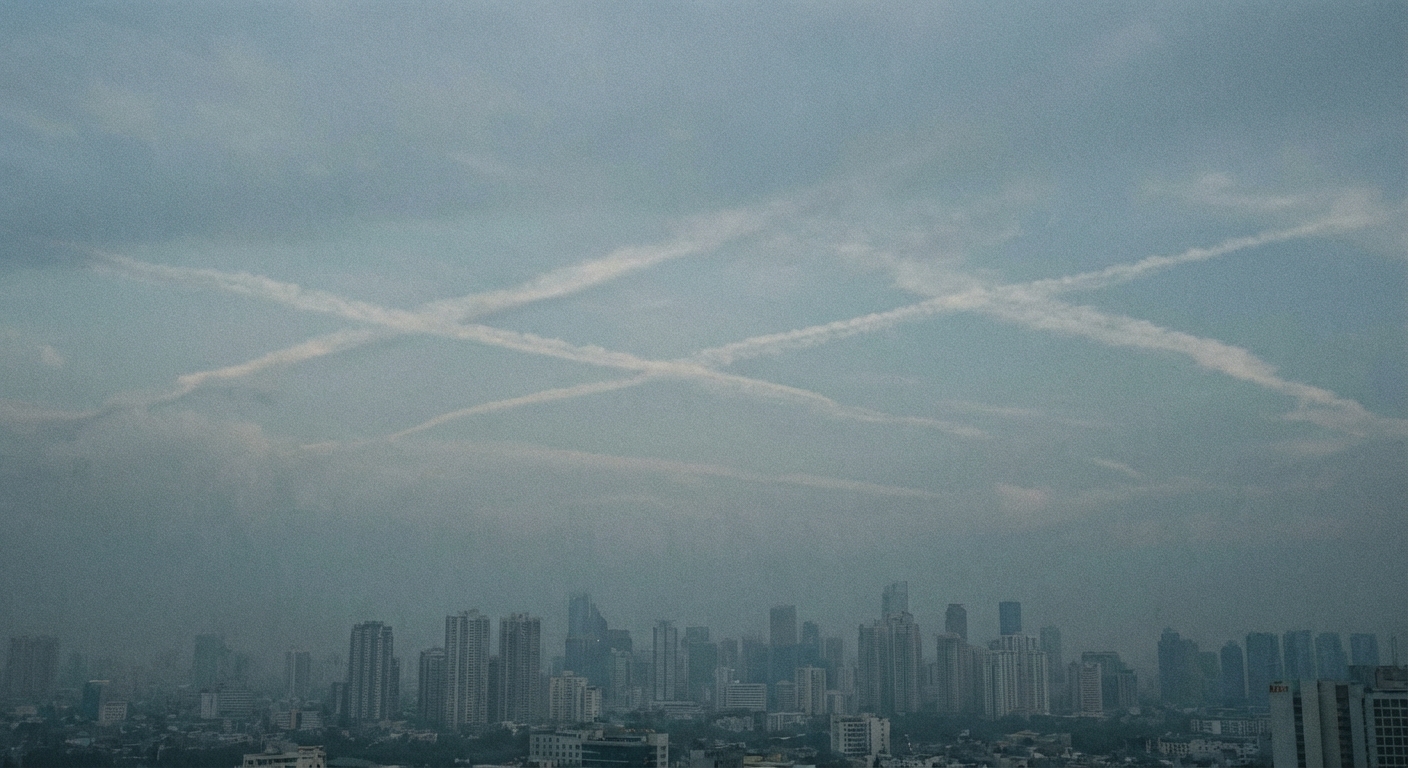
Chemtrails claims argue that some airplane trails are not ordinary condensation trails, but deliberate chemical or biological spraying carried out in secret. This article tests chemtrails claims against the best available counterevidence and expert explanations, while separating what is documented, what is disputed, and what remains unproven.
This article is for informational and analytical purposes and does not constitute legal, medical, investment, or purchasing advice.
The best counterevidence and expert explanations
- Federal agencies publicly describe the trails as contrails (ice-crystal clouds), not covert spraying. The U.S. Environmental Protection Agency explains contrails form when water vapor condenses and freezes in cold air behind jet exhaust, and notes “chemtrails” is a term often inaccurately used as a synonym for contrails. Why it matters: this directly addresses the central “what are we seeing?” question. Limits: agency statements are not, by themselves, a complete audit of every aircraft, but they are clear, attributable explanations grounded in atmospheric physics.
- The FAA and EPA say they are not aware of deliberate releases of harmful chemical or biological agents from airplanes. The Federal Aviation Administration states it and the EPA are not aware of deliberate actions to release harmful chemical or biological agents, and notes it would address substantiated claims. Why it matters: chemtrails claims often presume aviation regulators are covering for a program; this is a direct, accountable denial and a commitment to investigate substantiated evidence. Limits: “not aware” is not identical to “impossible,” but it shifts the burden onto verifiable documentation.
- Contrails can persist for hours (or longer) without any “extra chemicals.” EPA explains contrails can evaporate quickly in dry conditions or persist and grow in high-humidity layers; persistent contrails can last from minutes to longer than a day and can evolve into cirrus clouds. FAA similarly explains persistence depends strongly on cold, humid upper-atmosphere conditions (which may differ from ground-level humidity). Why it matters: “it lingers, therefore it’s sprayed” is one of the most common inferences; persistence alone is not a distinguishing test. Limits: persistence can still be visually confusing and is not easy to predict from the ground without atmospheric data at flight altitude.
- Common “grid” or crosshatch patterns are consistent with flight routes and changing humidity layers. EPA notes contrails can appear as straight lines, grids/cross patterns, fragmented, curved, and more depending on winds, atmospheric conditions, and flight patterns. FAA explains contrails can appear to start/stop when aircraft enter/leave humid “ice supersaturation regions.” Why it matters: visual patterns often get interpreted as “coverage” operations; the same patterns arise from routine routing plus patchy upper-level humidity. Limits: proving any specific pattern is “only routing” would require correlating flight tracks, altitude, and humidity fields—something most viral images do not provide.
- Peer-reviewed expert survey evidence strongly rejects a secret large-scale spraying program. A 2016 study reported in Environmental Research Letters (summarized by Carnegie Institution/ScienceDaily) surveyed relevant experts and found 76 of 77 said they had not encountered evidence of a secret spraying program; they also said the evidence commonly cited by believers can be explained by ordinary contrails and sampling/data issues. Why it matters: this is a systematic check of “what do domain experts actually see in the data?” rather than an anecdotal rebuttal. Limits: it is a survey (not a physical inspection of every plane), but it evaluates whether the alleged signals appear in the kinds of datasets experts work with.
- There is documented research interest in contrails because they can affect climate—but that is not evidence of secret spraying. NASA’s Earth Observatory notes contrail-induced cirrus can have a warming influence (by trapping heat) and shows how contrails can spread and move with winds. FAA also describes “aviation induced cloudiness” and ongoing research into predicting/mitigating persistent contrails (including potential rerouting strategies). Why it matters: chemtrails narratives sometimes cite “they admit they modify weather” when discussing contrail climate effects; here the documented issue is an unintended byproduct of aviation emissions, not covert aerosol deployment. Limits: the climate impact of contrails is an active research area with uncertainties and depends on conditions, routing, and fuel/engine factors.
- “Why is there a reporting requirement for weather modification?” Because real weather-modification activities exist and are regulated—this does not validate chemtrails claims. U.S. regulations (15 CFR § 908.4) require an initial report at least 10 days before starting a weather modification project/activity. Why it matters: chemtrails arguments sometimes treat any weather-modification regulation as proof of a hidden mass-spraying system; in practice, the existence of a reporting framework supports the opposite: formal, declared projects are expected to be reported. Limits: a reporting requirement does not guarantee perfect compliance, but it indicates the legal structure is oriented toward documentation rather than secrecy.
Alternative explanations that fit the facts
Documented explanation #1: ordinary contrail physics. Under cold, humid conditions at cruising altitude, water vapor in exhaust can condense and freeze into ice crystals, forming a visible line that may dissipate quickly or persist and expand depending on humidity, temperature, and wind shear. This directly accounts for “lingering,” “spreading,” and “turning into haze/cirrus” reports without requiring any added spray system.
Documented explanation #2: air-traffic patterns plus patchy upper-level humidity. When many aircraft traverse common corridors, multiple contrails can appear as parallel tracks or a grid—especially when the upper atmosphere contains pockets/layers of ice-supersaturated air that allow persistence in some zones and rapid fading in others. From the ground, those zones are invisible, so start/stop segments can look “intentional.”
Documented explanation #3: contrail-driven cloudiness as an unintended climate influence. Contrails can seed or evolve into cirrus-like cloudiness that affects radiation balance (often warming at the surface by trapping outgoing heat), which can be fairly described as an impact on weather/climate—but not the kind of targeted, covert “spraying program” described by chemtrails narratives.
Plausible-but-unproven explanation in some specific cases: confusion with real, disclosed activities. Cloud seeding and other weather-modification projects (which are limited, localized, and typically disclosed) can be mistaken for “chemtrails,” especially in regions where such projects are discussed publicly. However, this confusion does not document a global, covert operation, and it does not make contrails themselves evidence of spraying.
What would change the assessment
Because chemtrails claims describe a large, coordinated, long-running activity, strong documentation would be expected to show up across multiple independent channels. Evidence that would materially change this assessment would include:
- On-record operational documentation (contracts, flight orders, procurement records, or maintenance logs) describing dispersal equipment installed and used for atmospheric spraying—authenticated and corroborated, not screenshots without provenance.
- Independent, chain-of-custody sampling at altitude that measures aerosol composition inside or immediately behind the plume (with controls), plus reproducible results across multiple flights and labs.
- Clear radar/flight/telemetry correlation showing repeated spray-specific behavior (e.g., dispersal activation signatures) that cannot be explained by standard flight operations and atmospheric conditions.
- Regulatory or legal admissions from relevant authorities, or court-tested evidence that survives cross-examination and expert review.
By contrast, the following are generally not decisive: ground-collected jar/soil samples without contamination controls; photos of contrail patterns without altitude/humidity data; or isolated “metal” readings without baseline comparisons and a validated sampling plan (all of which are specifically the types of evidence experts say are commonly misinterpreted).
Evidence score (and what it means)
Evidence score: 18/100
- Strong, consistent agency explanations for contrails and direct denials of harmful intentional spraying.
- Peer-reviewed expert survey evidence reports essentially no expert-encountered evidence for a secret spraying program.
- Observed sky patterns (persistence, grids, start/stop) have well-documented atmospheric/operational explanations.
- There is documented contrail climate research, which can be misread as “admission,” but it addresses unintended effects rather than covert programs.
- Public “chemtrails evidence” is often difficult to verify with chain-of-custody methods; high-quality, reproducible physical evidence is typically absent in public claims.
Evidence score is not probability:
The score reflects how strong the documentation is, not how likely the claim is to be true.
FAQ
Are chemtrails real, or are they just contrails?
Major U.S. agencies describe the visible white trails as contrails (ice crystals formed from water vapor in exhaust under cold, humid conditions) and say they are not aware of deliberate releases of harmful chemical or biological agents.
Why do “chemtrails” sometimes last for hours or spread into haze?
EPA and FAA explain that persistence depends on the humidity and temperature at flight altitude; in ice-supersaturated layers, contrails can persist for hours or longer, spread with winds, and evolve into cirrus-like clouds.
Do grid patterns in the sky prove spraying?
No. EPA notes contrails can appear as grids/cross patterns depending on winds and flight patterns, and FAA explains trails can appear to start/stop when aircraft cross humid pockets at altitude. These observations do not uniquely indicate spraying.
Does the U.S. government have any rules about weather modification?
Yes. U.S. regulations require an initial report at least 10 days before beginning a weather modification project/activity (15 CFR § 908.4). The existence of a reporting framework documents that some weather-modification activities are treated as reportable projects, which is different from claims of a covert, mass, undisclosed spraying program.
What does the peer-reviewed research say about chemtrails claims?
A 2016 peer-reviewed study (reported by Carnegie Institution/ScienceDaily) surveyed relevant experts and found 76 of 77 said they had not encountered evidence of a secret atmospheric spraying program, and that commonly cited “chemtrails” evidence can be explained by contrails and data/sampling issues.

Science explainer who tackles space, engineering, and ‘physics says no’ claims calmly.