
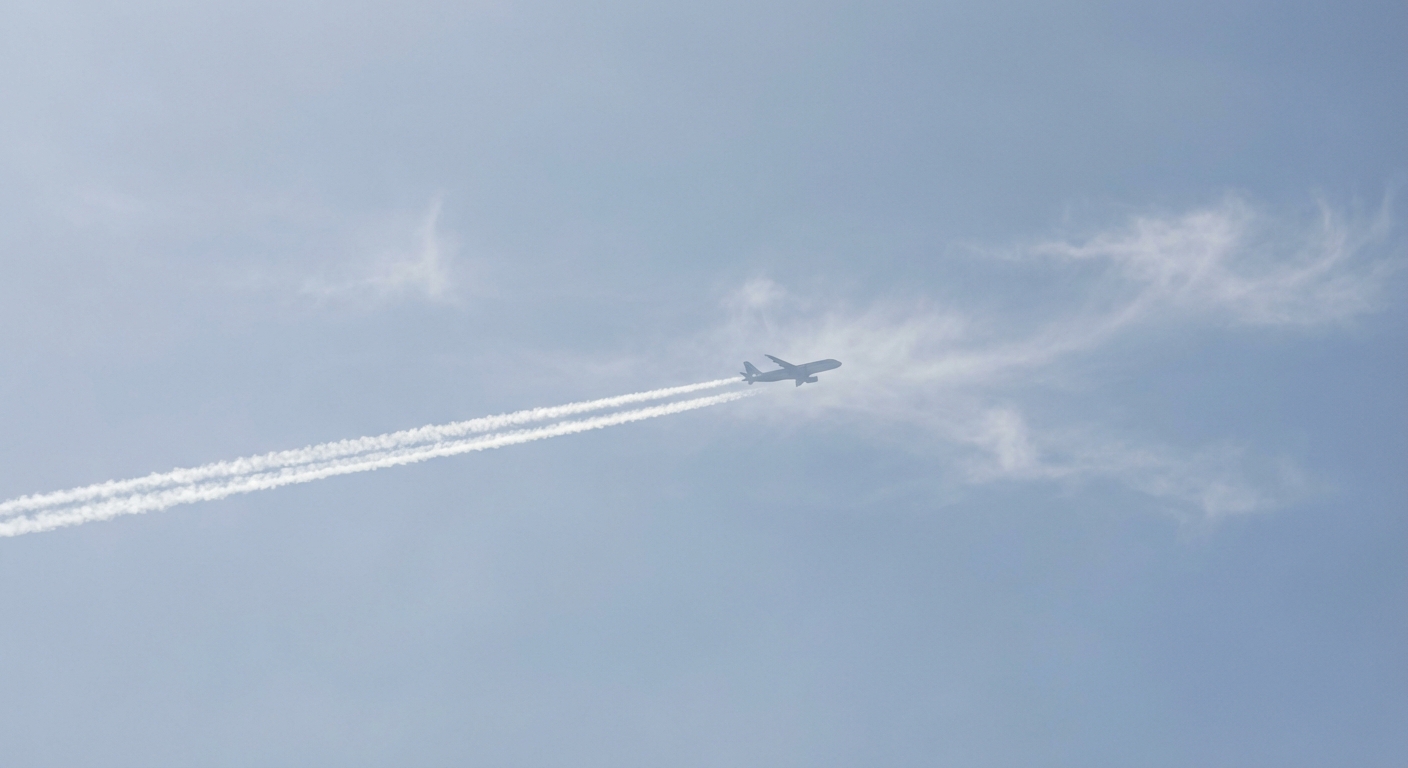
Chemtrails claims argue that some visible aircraft trails are not ordinary condensation trails, but deliberate chemical or biological spraying for purposes like weather modification, geoengineering, or population harm. The points below are the strongest arguments supporters commonly cite—but they are not proof by themselves, and many change substantially when checked against what aviation and environmental agencies document.
This article is for informational and analytical purposes and does not constitute legal, medical, investment, or purchasing advice.
The strongest arguments people cite
-
“Contrails shouldn’t last that long—persistent trails must be ‘chemtrails’.” (Source type people cite: personal observation, photos/videos, weather anecdotes.)
What it’s based on: People notice that some trails dissipate quickly while others linger for hours, spread out, and appear cloud-like. They infer that the long-lasting ones must contain additives.
What to check (verification test): Compare the claim against documented contrail science: whether persistent contrails are expected in cold, humid air at cruise altitude, and whether surface humidity can differ from humidity aloft.
What’s documented: The FAA explains contrails form when aircraft fly in cold/humid conditions and can persist and spread depending on atmospheric conditions; it also notes public interest often focuses on persistence and patterns. The EPA similarly explains that contrails may persist for minutes or even longer than a day when aircraft pass through ice-supersaturated layers, and that upper-atmosphere humidity can differ greatly from ground conditions.
-
“The sky shows grids/crosshatching—this looks like coordinated spraying.” (Source type people cite: time-lapse videos, photos, flight tracking screenshots.)
What it’s based on: Multiple contrails intersecting can resemble a deliberate pattern, especially near busy air corridors and around airports.
What to check (verification test): Verify whether aviation agencies describe how flight paths plus winds can create grids, curves, spirals, and fragmented-looking trails without implying spraying.
What’s documented: The EPA notes contrails can appear in many shapes—including grid or cross patterns—depending on wind, atmospheric conditions, and aircraft flight patterns (including common routing).
-
“Lab tests show aluminum/barium/strontium—so something is being sprayed.” (Source type people cite: home sampling, private lab reports, rainwater/soil/dust tests shared online.)
What it’s based on: People collect environmental samples after seeing trails and interpret detected elements (often metals) as evidence of aerial dispersal.
What to check (verification test): Evaluate sampling method quality and whether the measured substance is unusual for local soil/dust; check chain-of-custody; compare to background levels; and verify whether the measurement can distinguish sources (aviation vs. soil, industry, construction dust, sea salt aerosols, etc.).
What’s documented vs. disputed: In general, finding elements in environmental samples is not specific to aircraft release without rigorous controls; in many public “chemtrails” examples, critics note methodological issues such as improper sampling and inference beyond what the data can show. For instance, Science Feedback’s review highlights that long-lasting trails are still contrails and that commonly cited “metals” narratives often rely on weak inference from non-diagnostic measurements. (Science Feedback is not a government primary source, but it shows how this argument is evaluated when checked.)
-
“There are patents for spraying particles from aircraft—patents prove the program exists.” (Source type people cite: patent PDFs, Google Patents links.)
What it’s based on: Patents describing dispersal systems (sometimes unrelated) are presented as evidence of operational deployment.
What to check (verification test): Confirm what the patent actually covers, whether it was built/tested, and whether any procurement, flight ops, or regulatory documentation exists. A patent is evidence that someone filed an idea—not that a government or airline is implementing it at scale.
What’s documented: Reviews of specific “chemtrails patents” frequently conclude the cited patents do not demonstrate active weather control or mass spraying; they are often misapplied or unrelated to the claim being made.
-
“Geoengineering is real (SAI, marine cloud brightening), so ‘chemtrails’ could be the secret version.” (Source type people cite: real academic reports, climate-policy debates, research proposals.)
What it’s based on: Solar geoengineering is a real topic in scientific and policy literature. Some believers connect that reality to visible contrails, assuming ongoing covert deployment.
What to check (verification test): Separate (a) discussion of potential future interventions from (b) evidence of a current covert, large-scale atmospheric spraying program using commercial aviation. Look for institutional documentation (program charters, budgets, contracts, permits, published experiment plans, aircraft modifications) rather than inference from sky appearance.
What’s documented: The U.S. National Academies’ 2021 report discusses solar geoengineering research needs and governance, noting uncertainties and recommending transparent oversight and public registries for research—framing this as research governance, not proof of an existing covert deployment. The National Academies also discusses that controlled-release outdoor experiments might be considered under governance and permitting, again emphasizing structured research rather than secret airline-scale operations.
-
“Government agencies ‘deny it,’ which proves a cover-up.” (Source type people cite: perceived evasive wording, distrust based on historical abuses.)
What it’s based on: Some interpret official denials or limited public communication as inherently suspicious, especially given historical examples of real secrecy in other contexts.
What to check (verification test): Look for specific, falsifiable documentation: What do agencies say contrails are? Do they acknowledge uncertainty? Do they provide mechanisms, references, and research links? Are there contradictions across agencies?
What’s documented: The EPA explicitly defines “chemtrails” as an inaccurate term used to claim routine contrails are intentional releases for nefarious purposes and provides explanations for contrail formation and persistence. The FAA likewise states it is not aware of deliberate actions to release harmful chemical or biological agents from airplanes into the atmosphere. In July 2025, the EPA publicly announced new online resources on contrails and geoengineering to address public questions, describing the effort as transparency-focused communication.
-
“Military papers about weather modification (e.g., ‘Owning the Weather in 2025’) show intent/capability.” (Source type people cite: military documents, presentation slides, quoted excerpts on blogs.)
What it’s based on: Some military and strategic documents discuss weather modification concepts. These are sometimes treated as admissions of an active program.
What to check (verification test): Identify whether the document is a speculative/futures exercise versus an operational program document; check whether agencies attach disclaimers, and look for follow-on evidence (budgets, procurement, test flights, permits).
What’s documented (with limits): Public summaries note that the “Weather as a Force Multiplier: Owning the Weather in 2025” document is frequently cited in chemtrails narratives as if it were an operational plan, even though it has been characterized as a scenario/futures-style concept rather than evidence of a current program. Because this point is often repeated via secondary compilations rather than the primary document, treat it as an origin-story argument, not a verified proof of operations.
How these arguments change when checked
When the strongest “chemtrails” arguments are checked against high-trust documentation, they tend to shift from “proof of spraying” into a mix of (1) real atmospheric/aviation phenomena that are commonly misunderstood, (2) real but separate topics (like solar geoengineering research proposals) that do not automatically imply covert deployment, and (3) evidence types that are not diagnostic (like detecting common elements in environmental samples without robust controls).
In particular, the persistence and patterns of trails—often the most visually compelling “evidence”—are described by the EPA and FAA as expected outcomes of contrail physics and flight routing under certain atmospheric conditions. That doesn’t prove every specific photo is a contrail, but it does mean the observation alone does not uniquely support “chemtrails.”
Similarly, geoengineering research is documented as a subject of study with governance recommendations and acknowledged uncertainties, but that documentation is not the same thing as evidence that routine commercial flights are being used for covert aerosol deployment.
Where believers cite “official denial as evidence,” the analytical issue is that denial is not evidence either way; what matters is whether there is independent documentation of an active program (contracts, modified aircraft, operational orders, permits, measurable atmospheric signatures tied to aviation activity with strong attribution). The EPA and FAA publicly state they are not aware of deliberate harmful releases and provide scientific explanations for contrails—so the burden shifts back to positive, verifiable documentation for the claim.
Evidence score (and what it means)
Evidence score: 18/100
- Strong documentation exists for contrail formation, persistence, and variable appearance (including grid/cross patterns) from official aviation/environment sources.
- High-quality sources explicitly describe “chemtrails” as a misconception and state they are not aware of deliberate harmful releases from aircraft.
- Many cited “proof” artifacts (patents, photos, anecdotal reports) do not uniquely demonstrate an active spraying program without additional operational documentation.
- Geoengineering research discussions are real but are documented as research/governance topics, not evidence of covert airline-scale deployment.
- Some arguments rely on low-rigor sampling or attribution gaps (e.g., environmental metal detection without controls), which weakens documentation quality.
Evidence score is not probability:
The score reflects how strong the documentation is, not how likely the claim is to be true.
FAQ
What are “chemtrails” claims, in plain terms?
Chemtrails claims argue that some aircraft trails are deliberate chemical/biological releases rather than ordinary contrails. The EPA describes “chemtrails” as a term used to inaccurately claim contrails are intentional releases for nefarious purposes.
Do persistent contrails prove chemtrails?
No. Persistence alone is documented as consistent with contrails when atmospheric conditions at cruise altitude are cold and humid (including ice-supersaturated layers), and contrails may last minutes to longer than a day.
Why do contrails sometimes form grid patterns?
Grid/cross patterns can result from normal flight routing plus winds and varying atmospheric conditions. The EPA notes contrails can appear straight, curved, twisted, fragmented, or grid-like depending on weather and flight patterns.
Is geoengineering research proof that chemtrails are happening?
No. Solar geoengineering is discussed in credible scientific literature as a potential research area with recommended governance and transparency mechanisms, but that documentation is not evidence of a current covert, large-scale spraying operation using routine air traffic.
What kind of evidence would actually strengthen chemtrails claims?
Not photos alone. Stronger documentation would include verifiable operational records (contracts, aircraft modifications, flight program documentation), independently confirmed chemical measurements with rigorous attribution to aircraft at altitude (and reproducible methods), and corroboration across multiple high-trust institutions. By contrast, the FAA and EPA currently state they are not aware of deliberate harmful releases and provide contrail explanations.

Science explainer who tackles space, engineering, and ‘physics says no’ claims calmly.