
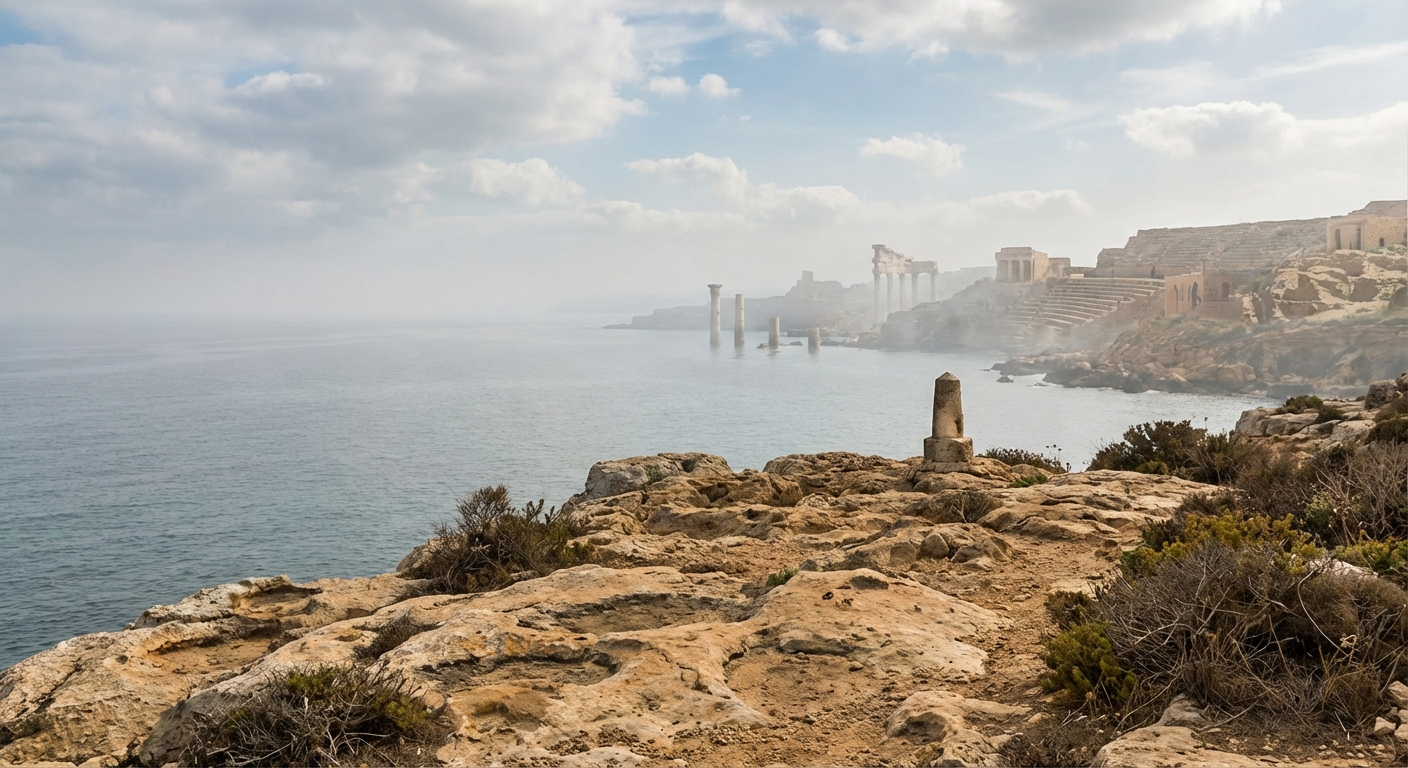
Atlantis: Lost Civilization is most commonly discussed as a claim: that a real, advanced ancient society once existed and was destroyed—often imagined as sinking beneath the ocean. What follows are the strongest arguments supporters typically cite, where those arguments come from, and what would be required to verify them. These are arguments people cite, not proof.
This article is for informational and analytical purposes and does not constitute legal, medical, investment, or purchasing advice.
The strongest arguments people cite
-
Plato’s dialogues (Timaeus and Critias) describe Atlantis in detail. Source type: ancient primary text (classical literature). Where it comes from: the story’s “core” source is Plato’s dialogues, which frame Atlantis as a powerful island state located beyond the “Pillars of Hercules,” ultimately destroyed by catastrophe. Britannica summarizes this origin and notes that the principal sources are Plato’s Timaeus and Critias.
Verification test: (a) establish what Plato actually wrote (reliable editions/translations), and (b) determine whether the text presents history, allegory, or a mix. A key limitation: the existence of a detailed narrative is not, by itself, evidence the events occurred.
-
“Plato got it from Egyptian priests via Solon, so it preserves older records.” Source type: narrative within an ancient text (secondhand claim inside Plato’s dialogues). Where it comes from: Plato’s framing device: Egyptian priests allegedly tell Solon about Atlantis and a war dating thousands of years earlier. Britannica describes this framing and the “about 9,000 years” claim.
Verification test: locate independent Egyptian records or inscriptions that clearly match the Atlantis narrative. As commonly presented, this argument depends on the assumption that Plato preserved archival history; it remains unverified without external corroboration.
-
The “Thera/Santorini eruption = Atlantis” hypothesis (a real catastrophe inspired the story). Source type: modern scholarly hypothesis tied to real geological events. Where it comes from: the Bronze Age eruption of Thera and its regional impacts are well-documented in geoscience and archaeology, and some writers propose it influenced later stories. Britannica explicitly mentions the possibility that the story may reflect records of a Thera eruption (presented as a “may”).
Verification test: show a plausible transmission chain from a Bronze Age event (mid-2nd millennium BCE) to Plato (4th century BCE), and demonstrate close correspondence between details (location, timing, political narrative) rather than broad similarity (“big eruption + disaster”). Radiocarbon work constrains the Santorini/“Minoan” eruption to a range in the 2nd millennium BCE (for example 1627–1600 BCE reported via wiggle-matching in one widely cited study).
-
“Underwater ruins” like the Bimini Road are said to be Atlantean remains. Source type: physical feature interpreted as archaeology; promoted in popular/alternative-archaeology circles. Where it comes from: Bimini Road is frequently cited in Atlantis: Lost Civilization discussions, including through the Edgar Cayce tradition that links Bimini to Atlantis.
Verification test: (a) demonstrate the feature is man-made (tool marks, quarrying, cultural material in situ), (b) date it securely, and (c) tie it to a known culture. However, summaries of specialist assessments commonly report a geological explanation: that the Bimini Road is natural beachrock broken along joints into blocky shapes, with multiple geologists/archaeologists concluding it is naturally formed.
-
Edgar Cayce “readings” as a source of specific Atlantis claims (Bimini, Hall of Records, dates). Source type:</strong 20th-century esoteric/psychic claims; organizational publications. Where it comes from: Cayce-related materials describe Atlantis as a technologically advanced civilization and describe a “Hall of Records,” including claimed sites such as Bimini, Egypt/Giza, and the Yucatán. These claims are preserved and promoted by the Association for Research and Enlightenment and related writeups.
Verification test: the test is empirical and archaeological: discoveries of verifiable structures/artifacts in the claimed locations, with clear dating, provenance, and peer-reviewed reporting. Without independently verifiable finds, these remain claims about Atlantis: Lost Civilization rather than evidence.
-
Ignatius Donnelly’s 1882 book popularized Atlantis as a real antediluvian civilization and “mother culture.” Source type: modern popular/pseudoarchaeological literature and its influence history. Where it comes from: Donnelly’s Atlantis: The Antediluvian World is widely credited with shaping modern Atlantis ideas—treating Plato’s story as largely factual and proposing diffusionist explanations for similarities among ancient cultures.
Verification test: this is less a “proof” line than an origin-of-claims line: it explains why certain Atlantis: Lost Civilization arguments recur (shared “civilization source,” pyramids, writing, etc.). To verify, one would test Donnelly-style diffusion claims against modern archaeology (independent invention vs contact, chronology, genetics, linguistics).
-
Mainstream archaeology often treats Atlantis as a literary/philosophical story rather than history—supporters cite this disagreement as evidence of a “controversy.” Source type: secondary interpretation by journalists and scholars. Where it comes from: reputable summaries (e.g., National Geographic) describe Atlantis as originating in Plato and frequently interpret it as a constructed story used for philosophical or moral purposes, not a historical report.
Verification test: clarify what experts actually claim and on what textual grounds; then distinguish “there is debate about interpretation” from “there is evidence of a real place.” A controversy about interpretation does not automatically create positive evidence.
How these arguments change when checked
1) Plato is a real source, but it is still a single ancient literary source. The strongest “anchor” for Atlantis: Lost Civilization claims is simply that Plato wrote about Atlantis in Timaeus and Critias. That is documented. What is not documented by the texts alone is that Atlantis existed as a real place in the way modern claims often describe it. The verification gap is the absence of unambiguous independent corroboration (inscriptions, settlements, artifacts, or geological evidence matching the narrative specifics).
2) “Egyptian priests told Solon” remains a story-inside-a-story unless corroborated externally. Supporters often treat the Egyptian framing as “archival credibility.” But without surviving Egyptian records that clearly correspond to Atlantis, it functions mainly as a literary device or an unverified attribution within the dialogue.
3) The Santorini/“Thera eruption” line is strongest when framed modestly: inspiration, not identity. The eruption and its dating are matters of ongoing research, with radiocarbon-based and archaeology-based chronologies historically discussed and compared. Even if a disaster inspired later stories, the Atlantis narrative includes political and geographical details that do not map cleanly onto Thera without additional assumptions.
4) “Underwater ruins” claims typically weaken at the geology-and-dating step. For Bimini Road in particular, the frequently cited mainstream conclusion is that it is naturally jointed beachrock rather than a constructed roadway or harbor. This does not rule out all submerged archaeology in the region, but it does reduce the strength of Bimini Road as a pillar of Atlantis: Lost Civilization claims.
5) Cayce-related claims are precise, but precision is not the same as verification. Cayce traditions give specific locations (Bimini, Giza, Yucatán) and timelines; this can feel “evidence-like.” Yet the appropriate test is still archaeological corroboration with publicly reviewable methods and results. A.R.E. publications present these as part of their tradition, not as independently proven findings accepted by the broader research community.
6) Donnelly explains modern belief patterns more than it proves Atlantis. Donnelly’s influence is important historically: it helps explain why modern Atlantis: Lost Civilization arguments often emphasize diffusion and “mother civilization” themes. But influence history is not evidence that Atlantis existed.
Evidence score (and what it means)
Evidence score: 28/100
- Strong documentation exists for the origin of the Atlantis story in Plato (verifiable ancient texts and well-cataloged editions/translations).
- Independent corroboration for Atlantis as a real specific civilization is weak in the form commonly claimed; key “site” arguments (e.g., Bimini Road) are widely described as natural formations by geological assessments.
- Real disasters (e.g., the Santorini/“Thera” eruption) are well evidenced, but connecting them uniquely and specifically to Plato’s Atlantis requires additional steps that remain disputed or unproven.
- Many popular Atlantis details trace to modern esoteric or pseudoarchaeological sources (e.g., Cayce traditions; Donnelly’s 1882 synthesis), which are historically important but not the same as archaeological proof.
Evidence score is not probability:
The score reflects how strong the documentation is, not how likely the claim is to be true.
FAQ
What is the best primary source for Atlantis: Lost Civilization claims?
The principal ancient sources people cite are Plato’s Timaeus and Critias, available through major classical text collections and translations.
Does Plato’s text prove Atlantis: Lost Civilization was real?
No. Plato’s dialogues document that the story was told in antiquity, but a narrative is not the same thing as independent evidence. Confirming a real Atlantis would require corroboration outside Plato (datable sites, artifacts, inscriptions, or other records that match the specifics).
Is the Santorini eruption evidence for Atlantis: Lost Civilization?
It is evidence for a major real-world disaster in the Aegean during the Bronze Age, with radiocarbon research placing it in the 2nd millennium BCE. Some writers argue it could have influenced later stories, but that connection is a hypothesis rather than a settled identification.
What about the Bimini Road—was it built by Atlanteans?
It is often cited in Atlantis discussions, including in Cayce-related traditions, but geological summaries commonly describe it as naturally formed beachrock broken into blocky shapes. That assessment weakens it as a cornerstone for Atlantis: Lost Civilization claims.
Where did many modern Atlantis: Lost Civilization ideas come from?
A large share of modern “Atlantis as a real advanced mother civilization” framing is traceable to late-19th and 20th-century writers—especially Ignatius Donnelly and later esoteric traditions such as those associated with Edgar Cayce.

Science explainer who tackles space, engineering, and ‘physics says no’ claims calmly.