
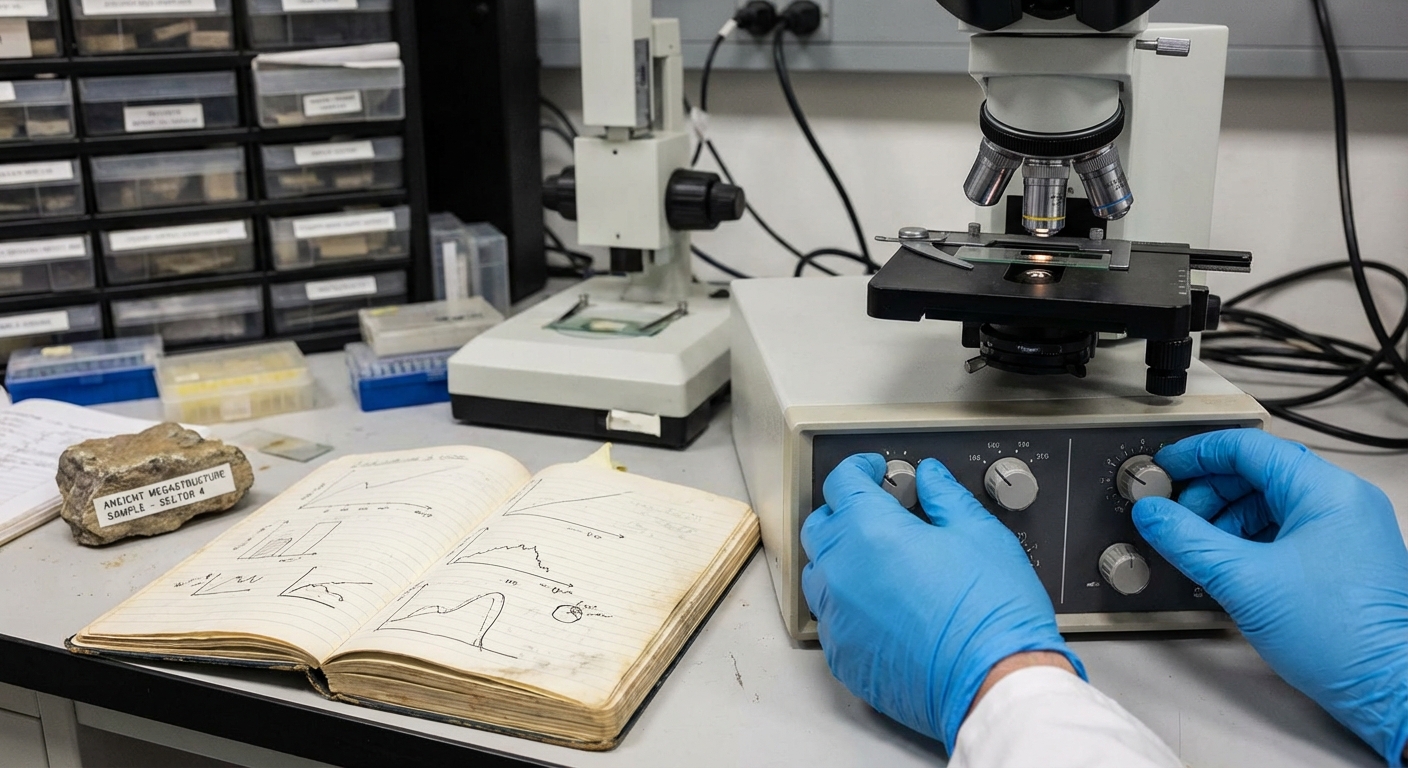
Intro: The items below are arguments supporters of the “ancient megastructures = impossible technology” claim commonly cite. They are presented as claims and source types, not as proof. Each entry notes a simple verification test that can be used to check the claim against archaeological, geological or historical evidence.
The strongest arguments people cite
-
Claim: Some sites (for example Puma Punku / Tiwanaku) show precision-cut andesite blocks and unusually smooth surfaces that, proponents argue, could not have been produced with the local tools and therefore imply a lost technology (casting or advanced cutting). Source type: laboratory petrographic studies and alternative-technology advocates (e.g., papers from the Geopolymer Institute and conference reports). Verification test: thin-section petrography, SEM/EDS mineral analysis, radiocarbon of any trapped organics, and field mapping of local quarries to confirm provenance and whether the blocks are carved or cast.
-
Claim: Megalithic blocks at Baalbek (the “Trilithon” and nearby unfinished monoliths) are so large (hundreds to >1,000 tonnes by some estimates) that their size and placement require technologies beyond known Roman or earlier capabilities. Source type: site surveys, travelogues, and modern measurements used by fringe commentators and popular books. Verification test: precise geodetic measurements of block dimensions, quarry-to-site topographic study (elevation, slope), examination of toolmarks and construction context to determine whether the stones belong to Roman-phase works or an earlier layer; consult peer-reviewed excavation reports and major reference works on the site’s chronology.
-
Claim: Stones at Stonehenge (and some other megaliths) were moved from very distant sources, implying extraordinary transport methods or unknown technologies. Source type: archaeological provenance studies (geochemical/petrological sourcing) and excavation reports (e.g., Parker Pearson et al., Antiquity). Verification test: geochemical fingerprinting of the stone (zircon/apatite/mineral signatures), matched to quarry outcrops; excavation of quarry contexts to date extraction and look for associated transport features.
-
Claim: The Great Pyramid required either unknown machines or a form of casting/advanced concrete because of the size, precision, and alignment of its blocks. Source type: popular books and alternative-technology papers; contrasted by discovery of administrative papyri (the Diary of Merer) showing organized logistics for moving limestone to Giza. Verification test: combine documentary evidence (Wadi al-Jarf papyri describing transport logistics) with archaeological evidence of ramps, tool marks, and experimental archaeology to evaluate whether available Old Kingdom methods were sufficient.
-
Claim: Artifacts such as complex ancient instruments (a common example being the Antikythera mechanism) prove the existence of “impossible” ancient engineering generally, so large stoneworks must also be products of similar unknown capabilities. Source type: peer-reviewed technical studies and museum reports (this is an example of a real advanced device used as an analog). Verification test: treat each site on its own terms—use material analysis, stratigraphy, and context to assess whether the complex-device analogy is appropriate. (Note: the Antikythera mechanism is a well-documented device that has been studied and published in peer-reviewed journals; it is not itself evidence for supernatural or non-human technologies.)
-
Claim: The idea of a lost advanced global civilization (popularized in mass-market books and TV programs) is used to link disparate megalithic sites and explain away obvious engineering questions. Source type: books (e.g., Graham Hancock’s popular works) and TV shows/pseudo-documentaries (e.g., History Channel-type programs). Verification test: evaluate each site’s primary archaeological literature, radiocarbon/stratigraphic chronologies, and peer-reviewed syntheses before accepting global-cataclysm or lost-civilization narratives.
How these arguments change when checked
When proponents’ claims are examined using archaeometry, excavation reports, and comparative archaeology, the picture usually falls into one of three outcomes: (a) the claim is supported by independent data; (b) the claim can be explained by known techniques, organization, or local geology; or (c) the claim remains unresolved because of missing data or conflicting studies. Below are concrete examples.
Stone provenance and transport: detailed sampling, petrographic fingerprinting, and excavation at presumed quarries have produced stronger, testable explanations for distant-stone transport. For example, multi-disciplinary work has linked certain Stonehenge bluestones to specific outcrops in the Preseli Hills and proposed plausible prehistoric extraction and transport sequences—supporting the interpretation that human communities moved the stones rather than invoking non-human technologies. New mineral-grain fingerprinting has reinforced human transport hypotheses and rebutted glacier-transport alternatives.
Puma Punku / Tiwanaku: here the evidence is contested. The Geopolymer Institute and allied authors have published laboratory studies arguing some blocks are artificial geopolymers, while UNESCO and mainstream archaeological teams emphasize field mapping, 3D surveys, and historical context that place Tiwanaku within a known technological horizon and note quarrying and architectural traditions. These are active, conflicting lines of research; the claim is not settled. Verification requires reproducible sampling, independent laboratory replication, and transparent provenance data.
Baalbek’s large stones: accurate measurements and quarry-context studies show the stones’ extraordinary size, but mainstream references place the surviving temple complex well within Roman-era architecture and emphasize nearby quarry sources and practical transport/placement explanations (e.g., temporary earthen banks, rollers, capstans). That does not mean the mechanics are fully documented, but the site sits inside a long tradition of heavy-lifting engineering; open questions are about methods and staging rather than invoking non-human tech. For site history and chronology, consult standard references and UNESCO/Britannica summaries.
Great Pyramid logistics: the Wadi al-Jarf papyri (the “Diary of Merer”) document work crews and boat transport of limestone blocks during Khufu’s reign—concrete administrative evidence that large-scale human organization was available for pyramid construction. That documentation does not prove every detail of how each block was raised, but it does undercut the need to assume an unknown mechanical technology existed simply because the job was difficult.
Evidence score (and what it means)
- Evidence score: 35 / 100
- Drivers of this score:
- Positive: Several claims rest on measurable, testable observations (stone weight, mineral composition, quarry proximity). Peer-reviewed provenance studies exist (e.g., Stonehenge quarry work).
- Negative: Many high-profile statements rely on secondary sources (TV, popular books) or on preliminary lab reports that lack independent replication (e.g., geopolymer claims for Pumapunku).
- Negative: For some sites, primary archaeological publication is incomplete or inaccessible; that raises uncertainty and leaves room for speculation.
- Positive: In at least one major case, primary documentary evidence (Wadi al-Jarf papyri) documents organization and logistics, increasing the quality of documentation for human-scale explanations.
Evidence score is not probability:
The score reflects how strong the documentation is, not how likely the claim is to be true.
This article is for informational and analytical purposes and does not constitute legal, medical, investment, or purchasing advice.
FAQ
Q: What is meant by “Ancient Megastructures ‘Impossible Tech’ Claims” and how should I read them?
A: The phrase describes claims that famous ancient monuments required technologies outside known human practice. Read them as hypotheses: identify the source (academic paper, lab report, popular book, or TV show) and then look for primary data—quarry surveys, toolmarks, stratigraphy, geochemical analyses or contemporary documents—before accepting a paranormal or lost-technology explanation.
Q: How can a reader check these claims independently?
A: Look for peer-reviewed publications, site excavation reports, laboratory methods and raw data, and independent replications. For stone provenance, seek geochemical fingerprinting and quarry excavations; for claims about casting or geopolymer, ask for blind replication of thin-section and SEM results in independent labs. UNESCO, major journals and recognized archaeological institutes are reliable starting points.
Q: Are TV shows and popular books reliable sources for these claims (Ancient Aliens, Graham Hancock, etc.)?
A: These sources can inspire questions but are not substitutes for primary archaeological or scientific reports. They often package speculation as narrative and do not always present negative evidence, contrary views, or the detailed lab methods necessary to evaluate claims. Use them as leads, not as proof.
Q: Does the existence of advanced devices like the Antikythera mechanism validate the ‘impossible tech’ idea for stoneworks?
A: No. The Antikythera mechanism is a well-documented, peer-reviewed case of high ancient craftsmanship and mechanical knowledge. It demonstrates that complex devices existed in some contexts—but it does not automatically transfer to claims about megalithic engineering, which require their own site-specific evidence (quarrying, toolmarks, logistics, dating). Treat each datum independently.
Q: Where do the strongest documented challenges to ‘impossible tech’ claims come from?
A: From multi-method archaeological work—field survey, excavation, petrography, and documentary finds. Examples: geochemical sourcing of Stonehenge bluestones, the Wadi al-Jarf papyri for Khufu-era logistics, and peer-reviewed debates over Tiwanaku materials. These approaches reduce the gap between extraordinary claims and verifiable evidence.
Closing note
Claims that ancient monuments were built with “impossible” technology are a mix: some rest on solid, testable observations (large stone sizes, unusual finishes), many are amplified by popular narratives, and several are actively debated in the scientific literature. The reliable way to move from claim to conclusion is reproducible, peer-reviewed evidence: clear provenance, transparent lab methods, and contextual excavation. Where such evidence is missing or contested, the correct stance is cautious agnosticism, not affirmation.

Science explainer who tackles space, engineering, and ‘physics says no’ claims calmly.