
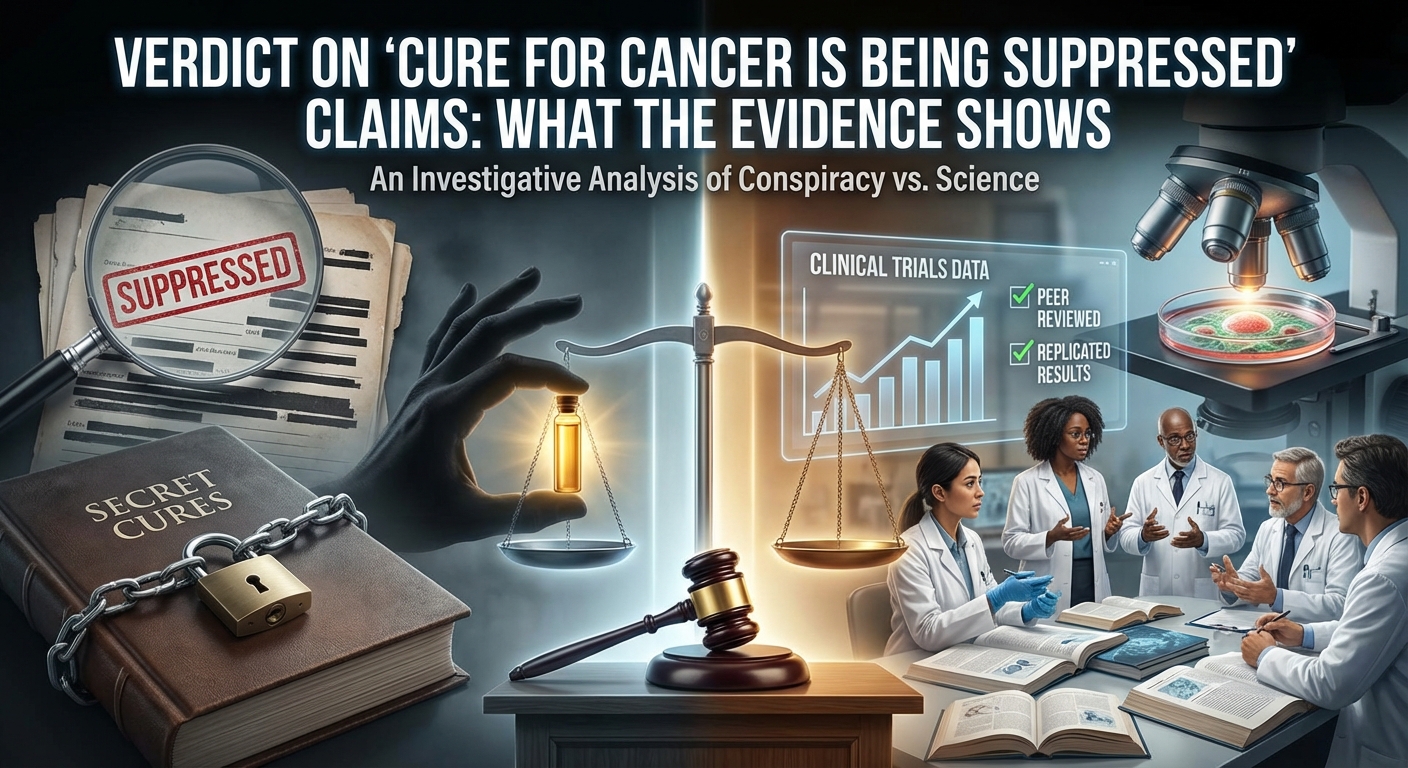
The claim that a \”cure for cancer is being suppressed\” is a widely circulated allegation that various individuals, companies, or agencies are deliberately hiding or blocking a single, broadly effective cancer cure. This article treats that idea strictly as a claim, not a fact, and examines the strongest documented evidence, the most plausible but unproven elements, and the material that is contradicted or unsupported by reliable sources. The phrase \”cure for cancer being suppressed\” is used here as the subject under review.
Verdict: what we know, what we can’t prove
What is strongly documented
1) There is no approved single, universal \”cure for cancer\” recognized by major regulatory or scientific bodies; cancer is a set of hundreds of distinct diseases with different causes and treatments, and progress is typically disease- and mechanism-specific. Clinical progress has produced cures or high long-term survival for some cancers (for example certain leukemias and Hodgkin lymphoma) but not a single one-size-fits-all cure.
2) Specific alternative treatments that have been promoted as suppressed cures—such as laetrile (amygdalin/”vitamin B17″), antineoplastons (associated with the Burzynski clinic), and GcMAF—have repeatedly been found to lack reliable, high-quality clinical evidence of efficacy and have faced regulatory enforcement or legal action in several jurisdictions. For example, laetrile has been determined to have no convincing clinical benefit and has safety risks; it was the subject of regulatory action and legal restrictions.
3) Antineoplastons (the Burzynski case) and GcMAF have notable regulatory and publication problems: antineoplastons have not produced randomized, peer-reviewed positive trials accepted by the broader oncology community and are not FDA-approved, and GcMAF-related studies were retracted and commercial promoters have faced criminal charges for illegal manufacture or distribution in some countries. These are documented regulatory, legal, and scientific facts, not proof of a broader suppression scheme.
What is plausible but unproven
1) Individual misconduct, fraud, or misrepresentation by some promoters of alleged cures is well documented in particular cases. It is plausible that bad actors deliberately misrepresent clinical outcomes or withhold data; prosecutors and journals have sometimes identified misconduct. However, individual fraud does not by itself prove a coordinated, global suppression of a real cure.
2) Regulatory mistakes, enforcement overreach, or slow-moving approval systems have impeded patient access to experimental therapies in particular circumstances. There are documented cases where access disputes (compassionate use, trial design) created intense controversy and perceptions of obstruction. That tension can plausibly be interpreted by some as suppression even when regulators cite safety and evidence requirements.
What is contradicted or unsupported
1) The broad assertion that a single, proven cure for all or most cancers exists today and is being actively suppressed by a coordinated conspiracy of pharmaceutical companies, regulators, and research institutions is not supported by high-quality evidence. The global research ecosystem is dispersed, competitive, and transparent in many respects (peer review, clinical trial registries, patents, publications)—features that make long-term, large-scale suppression of a genuine, robustly effective cure extremely unlikely. Analysts and oncologists argue that incentives in industry and science would favor disclosure of an effective therapy, not concealment.
2) Anecdotal success stories, selective patient testimonials, or small uncontrolled case series are often cited as proof of a suppressed cure; these are weak forms of evidence and are contradicted when larger, controlled studies fail to replicate results or when methodological flaws are revealed. Several high-profile small studies underpinning cure claims were later retracted or found unreliable.
Evidence score (and what it means)
Evidence score is not probability:
The score reflects how strong the documentation is, not how likely the claim is to be true.
- Numeric score (0–100): 18
- Score drivers: multiple case studies of regulatory action against specific promoters (e.g., laetrile vendors, GcMAF producers, and the Burzynski clinic) provide concrete documentation of contested therapies and legal enforcement.
- Score drivers: lack of credible, replicated, randomized clinical-trial evidence for the principal alleged \”suppressed cures\” (antineoplastons, laetrile, GcMAF) reduces evidence strength.
- Score drivers: the global research and regulatory environment (numerous independent investigators, journals, trial registries, and patent systems) makes a broad, long-term coordinated suppression highly implausible; this weakens the case for a large-scale conspiracy.
- Score drivers: however, documented examples of misconduct, selective data reporting, and enforcement disputes mean there are real, localized harms and reasons for public concern—these facts prevent an evidence score of near-zero.
This article is for informational and analytical purposes and does not constitute legal, medical, investment, or purchasing advice.
Practical takeaway: how to read future claims
1) Ask for high-quality evidence. The strongest proof that any medical treatment works comes from randomized, controlled trials with clear endpoints, independent replication, peer-reviewed publication, and regulatory review. Single case reports, patient testimonials, or small uncontrolled series are not adequate to establish a broadly applicable cure.
2) Check regulatory and publication records. If a therapy has been blocked or restricted, read the regulator’s reasons (safety, manufacturing quality, lack of evidence) rather than relying only on summaries from advocacy sites. Regulatory actions are public and documented.
3) Distinguish between localized wrongdoing and global suppression. Documented fraud, poorly conducted trials, or illegal marketing in particular cases are serious and deserve scrutiny—but they do not prove a single, hidden cure is being kept from the world. Consider alternative explanations such as misconduct, poor science, or regulatory enforcement.
4) Watch for retractions, independent reviews, and criminal enforcement. When studies are retracted or corporate actors are prosecuted for illegal manufacture/distribution, it indicates problems with those promoters’ claims—not that regulators are hiding a cure. Examples include retractions of papers underpinning GcMAF claims and criminal convictions for unlicensed manufacture and distribution in some jurisdictions.
FAQ
Q: Is there evidence that a single \”cure for cancer is being suppressed\”?
A: No reliable evidence shows a proven, single cure exists today and is being secretly suppressed. Documented regulatory actions and the withdrawal or retraction of certain small studies show problems with specific promoted therapies, but they do not establish the existence of a withheld universal cure. Readers should look for randomized trials, peer review, and regulatory approval as stronger evidence.
Q: Why do some people believe a cure is being suppressed?
A: Several factors drive belief: desperation from patients facing poor prognoses, high-profile anecdotes that seem to offer hope, distrust of large institutions, and the natural appeal of simple explanations for complex problems. Regulatory delays, legal disputes, and examples of fraud reinforce those suspicions even when the underlying scientific evidence is weak. citeturn0search13turn4search4
Q: Are there documented examples where regulators limited access to experimental cancer therapies?
A: Yes. Regulators sometimes deny or condition access to unproven treatments on safety and quality grounds. Controversial cases—such as disputes over antineoplaston use at the Burzynski clinic and enforcement actions against GcMAF producers—are documented; these episodes involved regulatory letters, court actions, publication problems, and, in some cases, criminal convictions for illegal manufacture or distribution. Those records are public and have been widely reported.
Q: Could pharmaceutical companies hide a cure because it would reduce profits?
A: Analysts and many oncology experts argue this is unlikely at large scale. Drug development is competitive—an effective therapy would be pursued, patented, and marketed by some firm or academic group because the incentives (market share, reputation, fewer follow-on costs) generally favor disclosure and commercialization. Moreover, cancer is heterogeneous; a single universal cure is biologically unlikely. Economic and structural analyses explain why long-term, global concealment would be difficult to maintain.
Q: What should a patient or caregiver do when they encounter a \”suppressed cure\” claim?
A: Consult licensed oncology professionals, look for registered clinical trials, check peer-reviewed literature, and treat anecdotal claims with caution. If considering an unapproved therapy, verify whether it is part of a legitimate, registered clinical trial and review the regulator’s public documents about the therapy. Independent second opinions are advisable. This article is informational and not medical advice.

Investigative-style editor who turns conspiracy claims into structured, source-first pages: claim → evidence → counterevidence → verdict.