
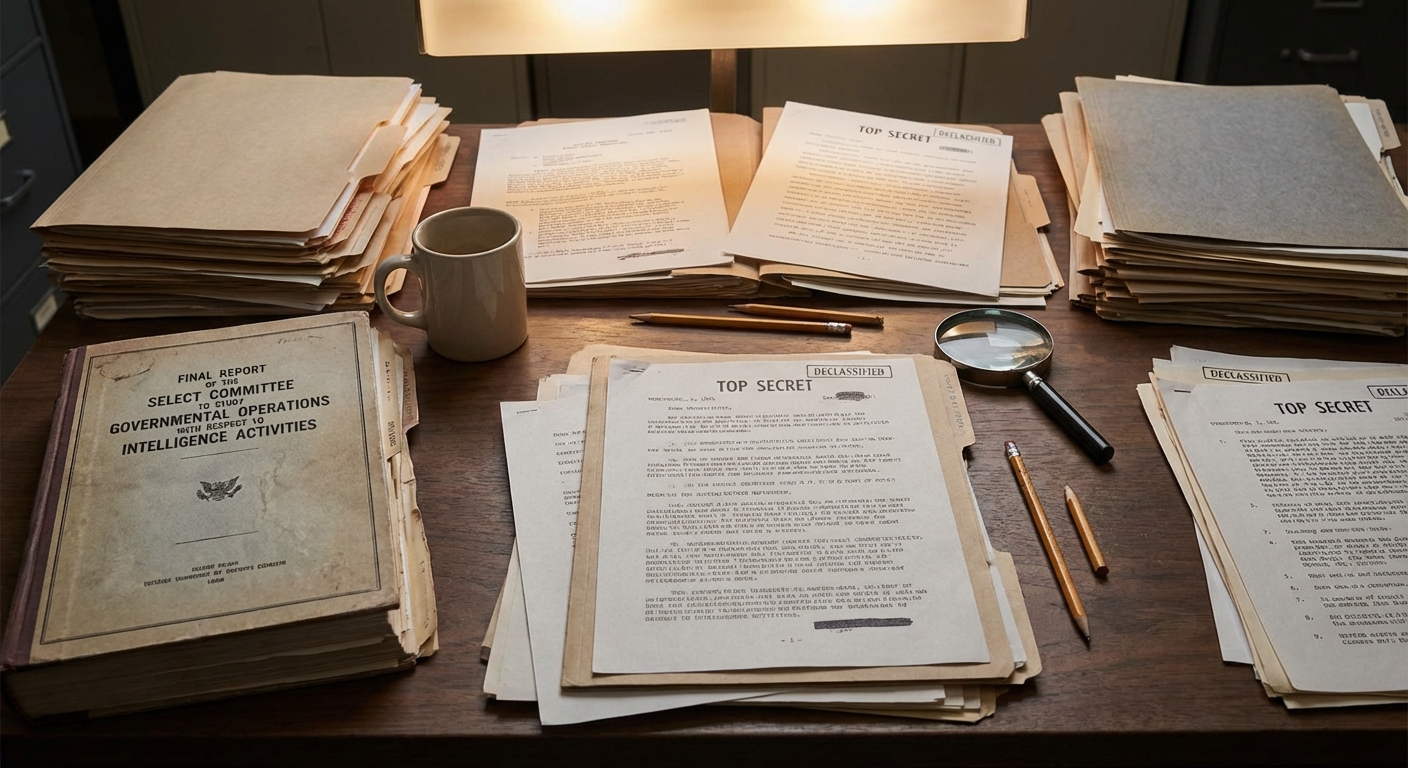
This verdict examines the Operation Mockingbird claims neutrally and evidence-first. We use declassified CIA documents, the 1975–76 Senate investigation, major investigative reporting, and later historical scholarship to show what is directly documented about CIA interactions with media, where reasonable inferences stop, and where popular summaries exceed the evidence. The phrase “Operation Mockingbird claims” is used here to anchor the review of those allegations and sources.
Verdict: what we know, what we can’t prove
What is strongly documented
Primary government records and contemporaneous oversight show that the CIA engaged in several practices that involved journalists and media-related activities during the Cold War period:
- Internal CIA files assembled in 1973 (the “Family Jewels”) include an entry labeled “Project MOCKINGBIRD,” describing a March–June 1963 telephone‑intercept of two Washington newsmen as part of an effort to trace classified leaks. This item appears in the declassified CIA “Family Jewels” collection.
- The Senate Select Committee chaired by Senator Frank Church documented covert relationships between the CIA and the media in its 1976 final report; the committee described CIA contacts with both foreign and U.S. news organizations and reported that a number of reporters or media-affiliated individuals maintained secret relationships with the Agency. The Church Committee report is the primary congressional source on these issues.
- By the mid‑1970s the CIA publicly announced tighter rules limiting paid or contractual relationships with accredited U.S. news correspondents; that policy change and later internal clarifications are documented in CIA reading-room releases.
- Investigative journalism contemporaneous to and following the Church hearings—most notably Carl Bernstein’s 1977 Rolling Stone piece—reported on dozens of covert relationships between journalists and the Agency and remains a major secondary source for claims about scope and named individuals. Bernstein’s article reviewed documents and interviews and argued the degree of press–CIA cooperation was larger than some official reports had described.
What is plausible but unproven
Several widely circulated assertions about “Operation Mockingbird” go beyond what primary records unambiguously document. Those assertions are plausible in part because the CIA did fund and run foreign propaganda outlets (for example Radio Free Europe/Radio Liberty and similar efforts) and because the Agency cultivated contacts among cultural and media elites; however, the extent and organizational form of a single, monolithic program called “Operation Mockingbird”—as often described in popular accounts—is not fully established in the primary record.
- It is plausible that early‑Cold‑War CIA offices (notably under Frank Wisner) coordinated extensive influence work abroad that used journalists, publishers, and cultural organizations; historians document complex networks of covert funding and collaboration. Scholarly work treats the metaphor of a “Mighty Wurlitzer” as a useful way to describe coordinated activity, while cautioning that influence took many forms and was not always centrally scripted.
- Reports that hundreds of U.S. journalists (often quoted as “about 400”) worked with the CIA appear in secondary reporting (e.g., Bernstein), but the Church Committee itself reported a smaller, more circumscribed set of named or described relationships; the numeric discrepancy reflects different source types and levels of evidentiary confidence rather than a settled count. Both figures are referenced in the published record and should be understood as estimates with different bases.
What is contradicted or unsupported
Several popular claims about the Operation Mockingbird story rest on weak or disputed sourcing and should not be treated as established facts:
- The specific label “Operation Mockingbird” as an Agency code name used internally for a long‑running, centralized media‑control program is not clearly supported by the primary CIA record in the form often repeated online; the name was popularized in later secondary sources and an unauthorised 1979 biography, and some later writers conflated distinct projects and memos into a single program label. Contemporary government documents use different program names; the specific term appears in later or secondary contexts.
- Claims that the CIA uniformly “controlled” mainstream U.S. editorial content across major outlets lack direct documentary proof; congressional records and declassified files show targeted relationships, cover arrangements, and propaganda operations abroad, but do not prove a simple model in which the CIA centrally dictated domestic editorial decisions across an entire media industry.
Evidence score (and what it means)
Evidence score is not probability:
The score reflects how strong the documentation is, not how likely the claim is to be true.
- Score (0–100): 57
- Drivers: primary CIA records (the “Family Jewels”) directly document specific operations touching journalists, including a named “Project MOCKINGBIRD” wiretap episode.
- Drivers: authoritative congressional oversight (the Church Committee) documents covert relationships between the Agency and media actors; those findings are public and sourced.
- Limiters: major public claims (scale, centralized command, and an enduring, single program called “Operation Mockingbird”) depend heavily on secondary reporting and contested interpretations rather than a fully declassified, program‑level CIA dossier.
- Limiters: scholarly accounts show complex, decentralized influence networks rather than evidence of continuous top‑down editorial control; historians urge caution in turning metaphors into operational claims.
- Limiters: later public debate and political rhetoric have amplified uncertain or disputed details, increasing confusion between documented actions and broader inferences.
Practical takeaway: how to read future claims
When you encounter new headlines or social posts about Operation Mockingbird claims, apply a simple checklist:
- Ask what the claim is alleging specifically (a wiretap? paid relationships? editorial control?).
- Demand primary sourcing: does the claim cite a government report, an internal memo, or only secondary commentary? If it’s a secondary source, check whether the source names documents and whether you can read them yourself.
- Distinguish documented incidents from extrapolations. The existence of targeted operations (e.g., wiretaps, covert funding abroad) is documented; extrapolating that to a single, permanent program that centrally controlled all major newsrooms is where evidentiary support weakens.
- Note that investigators and historians may reasonably disagree about scale and intent; when sources conflict, report the disagreement rather than amplifying the claim.
This article is for informational and analytical purposes and does not constitute legal, medical, investment, or purchasing advice.
FAQ
Q: What exactly are the “Operation Mockingbird claims”?
A: The phrase refers to allegations that the CIA systematically recruited and used journalists and major news organizations—domestic and foreign—to influence news coverage and public opinion. The record shows specific CIA activities involving journalists (wiretaps, paid or covert relationships, and foreign propaganda efforts), but the exact boundaries and whether a single, continuous program named “Operation Mockingbird” ran the entire effort are debated. See the CIA “Family Jewels” and the Senate Church Committee final report for primary documentation.
Q: Did Congress prove the CIA ran a nationwide program to control U.S. media?
A: No. The Church Committee documented covert relationships and influence activities, including some U.S. press contacts; it did not produce a declassified, unitary dossier proving centralized control of the entire U.S. press. The committee’s report is the authoritative congressional source; other claims about larger scale often rely on secondary reporting and interpretation.
Q: Is “Project MOCKINGBIRD” in the CIA files the same as the popular “Operation Mockingbird” story?
A: The “Family Jewels” includes an entry titled “Project MOCKINGBIRD” that documents a 1963 telephone‑intercept episode targeting two journalists. Popular usage of “Operation Mockingbird” has broadened since then to encompass a larger set of alleged CIA–media relationships; historians and FOIA documents show related but not identical items in the record. For the primary Family Jewels reference, see the CIA reading-room release.
Q: How many journalists worked with the CIA?
A: Estimates vary. Carl Bernstein reported “about 400” in a widely read 1977 article based on his reporting; the Church Committee described a smaller, document‑based set of secret relationships and noted about 50 reporters with official secret relationships at a particular time—differences arise from methods, definitions, and sources. Treat numeric claims cautiously and check the underlying sourcing.
Q: Where can I read the original documents mentioned here?
A: Key primary materials are available online: the CIA reading room publishes many declassified files including the “Family Jewels” (see the CIA FOIA reading room), and the Church Committee final report is archived in public collections. For investigative context, Carl Bernstein’s Rolling Stone article and scholarly histories like Hugh Wilford’s The Mighty Wurlitzer provide interpretation and analysis.

Geopolitics & security writer who keeps things neutral and emphasizes verified records over speculation.