
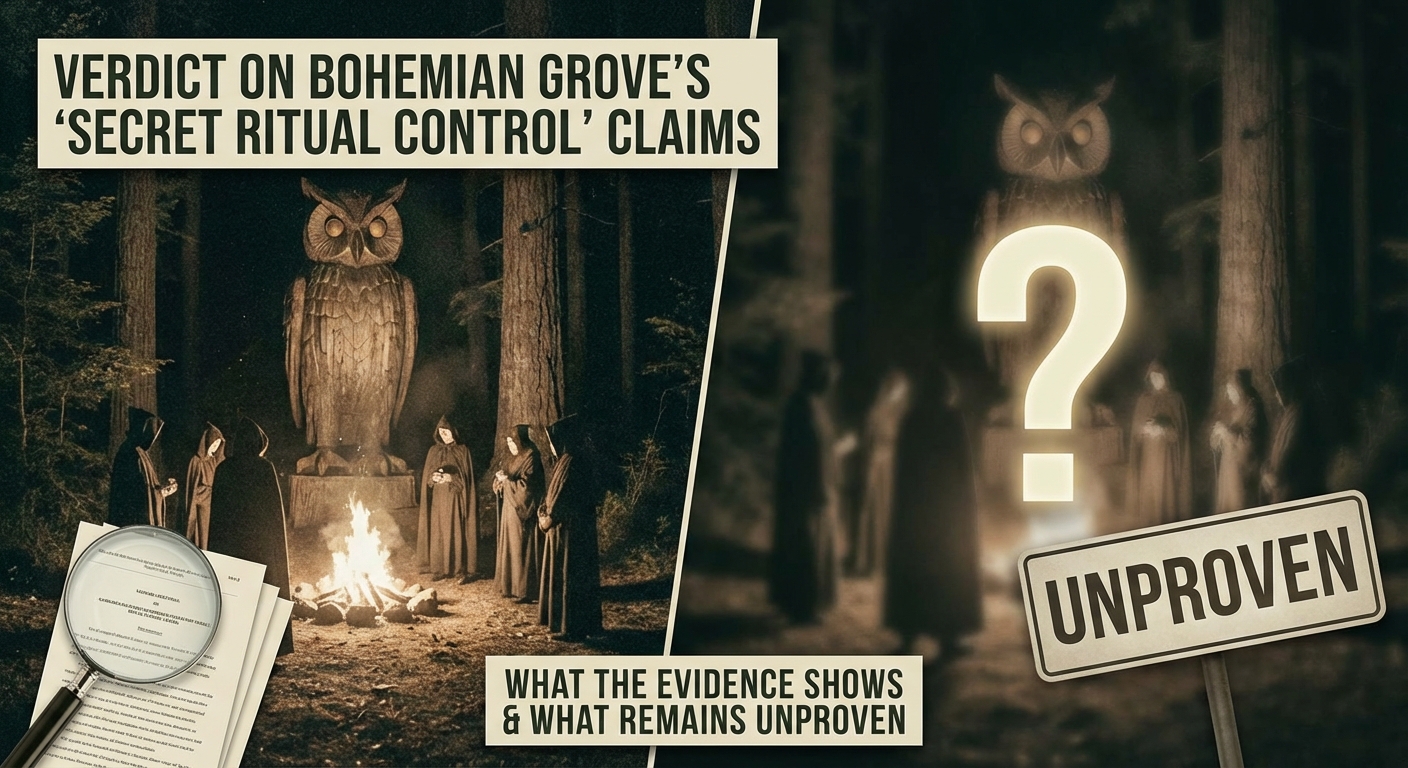
This Verdict evaluates the claim that Bohemian Grove functions as a site of “secret ritual control.” The phrase refers to assertions that ceremonies and gatherings at the Bohemian Grove directly produce coordinated policy decisions or occult power over public affairs. The basic factual elements of the Grove (a private, male-only retreat; a theatrical ceremony called the “Cremation of Care”; attendance by notable public figures) are documented, but the stronger claim — that ritual at the Grove exercises covert control over government policy or practices — is not well documented and remains a claim, not an established fact.
This article treats the topic strictly as a claim-based question and uses available primary reporting and reputable secondary sources to separate what is verifiable from what is speculative.
This article is for informational and analytical purposes and does not constitute legal, medical, investment, or purchasing advice.
Verdict: what we know, what we can’t prove
What is strongly documented
– The Bohemian Grove is a private, men-only retreat in northern California run by the Bohemian Club and held annually in mid‑July; the site and encampment’s basic facts and longtime existence are well documented.
– The event called the “Cremation of Care” is an established, long-running theatrical pageant staged at the Grove, staged in front of the Grove’s large owl statue and described by journalists and club materials as an allegorical dramatic production intended to symbolize the banishing of worldly cares. Multiple mainstream references describe the ceremony’s staging and theatrical nature.
– High-profile journalists and investigators have gained access and reported from the Grove; in 2000 Alex Jones and collaborators clandestinely recorded the Cremation of Care and distributed footage, which is one of the most widely-circulated visual sources of the ceremony. That recording and subsequent press coverage show robe-clad participants, a staged effigy burning, and the owl backdrop. Journalistic accounts and mainstream reporting have repeatedly covered this footage and the Grove’s theatrical elements.
– The Grove has a long history of attendance by prominent figures in business, media and politics; authoritative reference outlets list many well-known past members and guests. Recent reporting has also shown that some current public officials have attended as guests, which renewed public attention and ethical questions about undisclosed hospitality.
What is plausible but unproven
– Informal networking, private conversations and social bonding among elites at the Grove are plausible and documented in general terms (the camp includes talks, performances and social spaces). It is reasonable to infer that relationships and informal exchanges occur there; however, such networking is not the same as documented, binding policy decisions made as a result of ritual. Reporting characterizes the Grove’s activities as social, artistic and private, and notes the secretive nature that makes verifying behind-closed-doors conversations difficult.
– It is possible that informal agreements or introductions at private retreats can later influence public life; proving a causal chain from a particular conversation at the Grove to a specific policy outcome requires direct documentary evidence (emails, meeting notes, sworn testimony, contemporaneous corroboration) that so far has not been produced in public record for the more extreme control claims. In short: influence is plausible; ritual-driven centralized policy control is not documented. 0search13turn0search1
What is contradicted or unsupported
– Claims that the Cremation of Care or other Grove activities are occult worship, human sacrifice, or part of a documented ritual system that compels real-world policy decisions lack credible supporting evidence. The most widely circulated allegations of satanic or child‑sacrifice activity stem from interpretive readings and from sources with agendas; mainstream coverage and Grove attendees/observers characterize the Cremation of Care as theatrical pageantry rather than criminal or occult practice. No reputable investigation has corroborated claims of human sacrifice or systematic occult governance tied to policy outcomes.
– Claims that a single, coordinated “ritual control” cabal meets at the Grove and issues binding orders to governments are not substantiated by primary documents or credible investigative reporting. Where strong allegations exist, they frequently rest on inference, selective quotation, or sources with known credibility problems; the existence of influential attendees does not, by itself, prove ritual-based political control.
Evidence score (and what it means)
Evidence score is not probability:
The score reflects how strong the documentation is, not how likely the claim is to be true.
- Evidence score: 30 / 100.
- Drivers that lower the score: the claim that Bohemian Grove ceremonies exert organized, ritualized control over public policy is primarily supported by inference and by sources with credibility issues rather than by contemporaneous documentary proof (e.g., internal memos, sworn testimony, multi-source corroboration).
- Drivers that raise the score: the Grove’s existence, the Cremation of Care ceremony, and attendance by prominent figures are well-documented by multiple reputable sources, which establishes the factual basis for claims about private gatherings and symbolic ritual.
- Contributing uncertainty: the Grove’s deliberate privacy reduces public evidence and makes it hard to directly confirm or falsify claims about private conversations or informal influence. The passage of time and the closed membership structure mean many relevant interactions are not in the public record.
- Evidence gaps: no publicly available primary-source documentation (e.g., internal decision memos, binding agreements) links the ceremony or ritual performance at the Grove to formal governmental directives or confirmed criminal activity.
Practical takeaway: how to read future claims
– Demand primary-source evidence for strong assertions: specific, contemporaneous documents or credible eyewitness testimony are required to establish causation (for example, written records showing that decisions were taken at the Grove and then executed by named actors). Absent that, treat conclusions as speculative.
– Differentiate types of evidence: photographic or video proof of a theatrical ceremony documents the event; it does not by itself prove that the ritual caused policy changes or criminal acts. Be especially cautious when claims rely mainly on interpretation of symbolism or on a single anonymous source.
– Consider source reliability and motive: some widely circulated claims originate from advocates or commentators who build narratives out of symbolic readings or who have prior patterns of promoting conspiratorial interpretations. Cross-check those claims against mainstream reporting, archival documents, and independent investigations.
FAQ
Q: Are the “Bohemian Grove secret ritual control” claims proven?
A: No. The core factual elements (private retreat, theatrical “Cremation of Care,” notable attendees) are documented, but the stronger claim that ritual at the Grove translates into coordinated, documented control over policy is not proven by publicly available evidence. Demonstrating that would require direct primary documents or high-quality corroboration of causal links, which are absent from the public record.
Q: Did Alex Jones prove the Grove is involved in occult or criminal activity?
A: Alex Jones’ 2000 footage provided the first widely seen recording of the Cremation of Care and renewed public interest in the Grove, but his interpretation (including allegations of Satanic rites or child sacrifice) has not been corroborated by independent investigative reporting or by legal findings. Mainstream journalists and Grove attendees typically describe the ceremony as theatrical. Use Jones’ footage as primary visual documentation of the pageant, but not as conclusive evidence of criminal occult practice.
Q: Could decisions about policy happen at private elite gatherings like Bohemian Grove?
A: It is plausible that private social gatherings facilitate introductions, influence, or informal conversations that later matter in public life. However, plausibility is not proof. To attribute specific policy outcomes to gatherings at the Grove, researchers need documents, testimony, or records that establish direct causal chains. Without those, claims about policy decisions emerging from ritual are speculative.
Q: What would change the assessment?
A: The assessment would change if credible primary evidence appeared linking Grove gatherings or specific ceremonial activities to documented, subsequent policy actions—for example, contemporaneous internal communications, credible sworn testimony confirming decisions were made there, or archival records showing official acts traceable to Grove meetings. The appearance of such evidence would substantially raise the evidence score. Conversely, reliable debunking documents (e.g., authenticated records showing participants avoided discussing policy) would lower the plausibility of control claims.
Q: How should journalists and researchers proceed?
A: Apply standard investigative standards: seek primary-source documents, corroborate eyewitness accounts across independent sources, and be transparent about uncertainty. Focus on demonstrating concrete links if the aim is to show influence rather than relying on symbolic interpretation alone. Reputable outlets that have investigated the Grove emphasize the need for corroboration and careful sourcing.

Geopolitics & security writer who keeps things neutral and emphasizes verified records over speculation.