
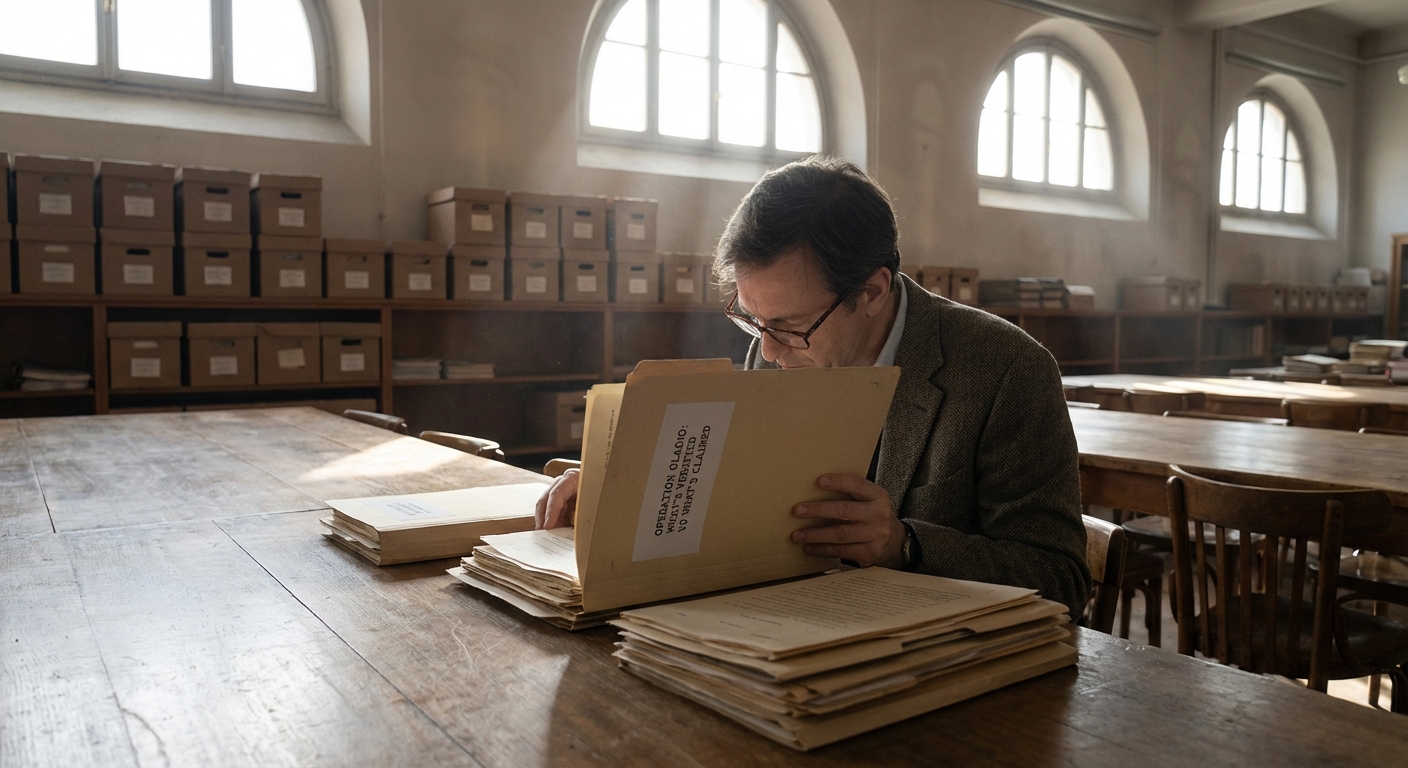
Scope and purpose: this timeline examines the claim known as “Operation Gladio” through primary documents, parliamentary inquiries, major judicial findings and official statements. It treats the phrase and associated allegations as a CLAIM to be tested — not as established fact — and highlights where documentary evidence exists, where accounts conflict, and where interpretation matters. The term “Operation Gladio timeline” is used below to orient the reader to the sequence of events and source types cited.
Timeline: key dates and turning points (Operation Gladio timeline)
- Late 1940s–early 1950s: creation of Western post‑war clandestine planning fora. Western Union and early postwar arrangements set up clandestine coordination for unorthodox warfare; these forums were integrated into NATO-era planning bodies in the early 1950s (Clandestine Planning Committee/SHAPE structures and later the Allied Clandestine Committee). Primary-source and scholarly summaries describe committee names and roles in coordinating “stay‑behind” planning.
- 12 December 1969 — Piazza Fontana bombing. A high‑profile bomb attack at the Banca Nazionale dell’Agricoltura in Milan killed 16–17 people and marked the start of Italy’s “strategy of tension” investigations. Subsequent decades of judicial work probed far‑right groups and possible state-related coverups; the event is a central datum frequently cited in later claims about covert structures.
- 31 May 1972 — Peteano car‑bomb. Three carabinieri were killed near Peteano. Judge Felice Casson later reopened the case and — while investigating — uncovered references in intelligence archives to clandestine weapons caches and networks; his work is commonly described as the judicial thread that first led investigators toward stay‑behind material in Italian service files.
- 1970s — 1980s: attacks that became focal points for allegations. Several major terrorist bombings and train attacks (Italicus, 4 Aug 1974; Bologna station, 2 Aug 1980; others) were subject to long judicial and parliamentary scrutiny; later commentators and litigants sometimes link these attacks to wider covert networks, but judicial findings and appeals histories vary by case and country. Readers should consult each case’s court records when assessing linkage claims.
- 1984 — Vincenzo Vinciguerra’s testimony at trial. Neo‑fascist Vincenzo Vinciguerra, convicted for Peteano, made statements in court and in later interviews describing a “hidden structure” inside state apparatuses and alleging coordination with right‑wing militants; his testimony later became a frequently cited element in narratives that connect stay‑behind caches with violent incidents. Vinciguerra’s statements are on the public record but are contested in interpretation and probative value.
- 13–24 July & 24 October 1990 — Judicial access and public acknowledgement in Italy. In mid‑1990 magistrates (including Casson) gained authorized access to intelligence archives; on 24 October 1990 Prime Minister Giulio Andreotti formally transmitted documentation about a clandestine network to parliamentary investigators and acknowledged that a “stay‑behind” structure had existed in Italy. Andreotti provided lists and described weapon caches and personnel to parliamentary bodies; his transmission is recorded in the Chamber of Deputies’ historical record.
- November 1990 — NATO’s public response and several national acknowledgements. After Italy’s disclosure, NATO spokespeople initially issued confusing or contradictory public comments about involvement and then declined to comment on matters of military secrecy; several NATO members (Belgium, Switzerland, others) subsequently set up inquiries and in some cases confirmed national stay‑behind structures existed. This episode produced a notable diplomatic/PR sequence (press denials, closed briefings to NATO ambassadors) that is itself documented in contemporaneous press reporting and later parliamentary minutes.
- 1991 — Belgian Senate parliamentary inquiry. Belgium established a senatorial investigative commission that documented a Belgian stay‑behind structure code‑named SDRA8 and reviewed links to NATO coordination bodies; the commission reported limits on cooperation from security services and warned of open questions about past crimes. The Belgian inquiry produced a public report and is widely cited as a national, documentary investigation.
- 1990–mid‑1990s — Italian parliamentary and judicial investigations (Commissione Stragi, other inquiries). Italy’s parliamentary commissions and several magistrates continued hearings and produced multi‑volume reports addressing Gladio‑related material, hidden caches, and the interplay of intelligence services and extremist groups; some sections were and remain classified or redacted, and findings vary across reports. The Commissione Stragi’s archival records and published volumes document numerous depositions, seizures and contested items.
- 2006 — U.S. State Department statement on contested documents. The U.S. Department of State issued a public communication noting that some alleged documentary “proof” (notably the so‑called Westmoreland Field Manual, FM 30‑31B) has been judged a forgery and cautioned against treating that document as reliable evidence that U.S. authorities ordered or directed false‑flag terrorism. That statement confirmed the existence of stay‑behind efforts generally but disputed specific documentary claims used to allege U.S. orchestration of terror.
- 2 August 2021 — Italian government directive to declassify files on Gladio and P2. The President of the Council (Prime Minister Mario Draghi) signed a directive expanding declassification of material related to Gladio and the P2 lodge, ordering deposit of selected records in the Central State Archive — an administrative step intended to improve archival access to material connected to the 1969–1984 strage period. The directive and subsequent committee actions are publicly recorded.
Where the timeline gets disputed
The chronology above records disclosures, judicial actions and official directives. Disputes arise mainly around three domains:
- Interpretation of witness testimony vs documentary proof. Testimony such as Vinciguerra’s and some depositions by intelligence officers describe “hidden structures” and suggest operational links; courts and later prosecutors, however, have treated these testimonies differently depending on case specifics. The existence of caches and stay‑behind planning is documented; attribution of particular terrorist acts to a formally directed Gladio policy remains contested in judicial and academic records.
- Reliability of contested documents (forgeries and misattributions). Certain documents—most prominently the so‑called Westmoreland Field Manual (FM 30‑31B)—have long been argued to be forgeries by scholars and were explicitly characterized as disinformation by U.S. authorities; those controversies matter because some narratives rely heavily on such contested items.
- Scope of coordination: NATO/SHAPE/ACC/CPC roles vs national control. Sources document coordination fora (Clandestine Planning Committee, Allied Clandestine Committee) and national stay‑behind units; the exact degree of central NATO command/control versus national autonomy, and whether coordination equaled operational direction over domestic acts, is disputed among participants, scholars and state statements. Some declassified minutes and commission reports document meetings and exchanges; other aspects remain secret or redacted.
Evidence score (and what it means)
- Evidence score: 62 / 100.
- Drivers that raise the score: multiple national parliamentary inquiries (Italy, Belgium, Switzerland) and magistrates’ findings document the existence of clandestine “stay‑behind” programs and weapons caches; government acknowledgements (e.g., Andreotti 1990) and archived parliamentary records corroborate institutional awareness.
- Drivers that lower the score: disputed and forged documents (e.g., FM 30‑31B) have been used to support strong claims of directed false‑flag terrorism; major official actors (NATO, U.S. authorities) have issued denials or cautions about specific documentary claims, producing unresolved evidentiary disagreements.
- Evidence is uneven across countries: some states produced public parliamentary reports (Italy’s Commissione Stragi volumes, Belgian Senate report); others handled matters privately or declined to declassify critical provenance records, leaving important gaps.
- Declassification steps since 2014 and 2021 improve the documentary base but many records remain redacted or not yet fully accessible to independent researchers.
Evidence score is not probability:
The score reflects how strong the documentation is, not how likely the claim is to be true.
FAQ
Q: What exactly does the term “Operation Gladio” refer to?
A: In public use the name “Operation Gladio” commonly designates Italy’s postwar clandestine “stay‑behind” network; journalists and researchers sometimes use the label more broadly for similar NATO‑linked stay‑behind programs across Western Europe. The term is therefore a shorthand for a contested set of national programs and coordination fora rather than a single unified operational command.
Q: What parts of the “Operation Gladio” claim are documented?
A: Documented elements include: the existence of national stay‑behind arrangements and caches in several NATO countries (parliamentary and judicial records in Italy and Belgium are primary examples); formal administrative exchanges and committee structures that coordinated planning; and government acknowledgements (e.g., Andreotti’s 24 Oct 1990 transmission to parliament). These are supported by parliamentary minutes, inquiry reports and archival material.
Q: Which parts of the claim remain disputed or unproven?
A: The most disputed assertions are that NATO or U.S. authorities directly ordered or centrally managed a deliberate campaign of “false‑flag” domestic terrorist attacks. Some documents once used to support those assertions have been judged forgeries by official reviewers (e.g., the Westmoreland Field Manual), and many courts have required stronger evidentiary links before assigning criminal or institutional responsibility. The U.S. State Department has explicitly warned about treating certain contested documents as proof.
Q: How can researchers verify specific linkage claims (for example, a named bombing was ordered by a stay‑behind network)?
A: Verification requires documentary and judicial evidence tying named individuals or chains of command to operational orders, material provenance (forensic links to caches), credible witness testimony, and corroborating archival records. Where courts have convicted individuals, read the court opinions and evidence summaries; where claims rely on single contested documents or uncorroborated testimony, treat them as unproven until supported by independent primary sources. The Italian Commissione Stragi archives and national court records are starting points.
This article is for informational and analytical purposes and does not constitute legal, medical, investment, or purchasing advice.

Geopolitics & security writer who keeps things neutral and emphasizes verified records over speculation.