
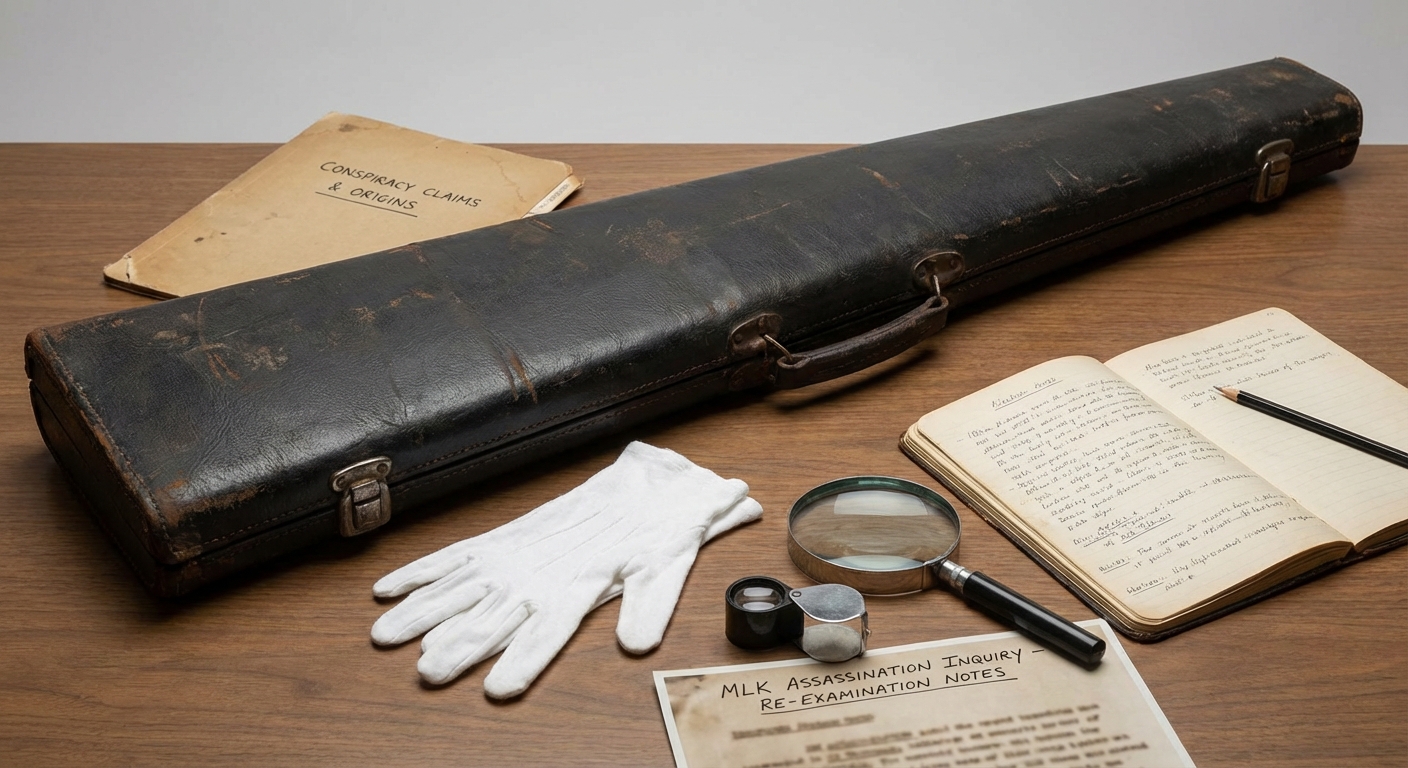
The phrase “MLK assassination conspiracy claims” refers to allegations that Martin Luther King Jr.’s April 4, 1968 killing in Memphis was the result of a coordinated plot involving people beyond—or instead of—James Earl Ray. This article treats those assertions as claims, summarizes their origins, catalogs what is documented versus inferred, and explains why the theory spread. It reviews official investigations and public records, notes where sources conflict, and highlights remaining uncertainties.
What the claim says
At its core, the MLK assassination conspiracy claim asserts that James Earl Ray was not the lone gunman, that he was framed or assisted, and that other actors—ranging in different versions from private individuals (for example Loyd Jowers) to organized crime or government agencies—planned or executed the killing. Variations of the claim emphasize different alleged accomplices and motives (racial hatred, suppression of the civil-rights movement, retaliation for King’s anti‑Vietnam stance). The claim set includes smaller, testable assertions (e.g., a second shooter fired from behind Jim’s Grill) and larger, harder-to-prove assertions (e.g., coordinated government involvement).
Where it came from and why it spread
Several developments fed the emergence and spread of conspiracy claims:
- Immediate events after the killing: James Earl Ray pleaded guilty in March 1969 and was sentenced to 99 years; he later recanted and offered shifting accounts (including an alleged handler named “Raoul”), which invited doubt about the lone‑shooter narrative.
- Official investigations and partial conclusions: multiple official inquiries—FBI, Department of Justice task forces, and the 1976–79 House Select Committee on Assassinations—reviewed the case and left some questions open, which created room for alternative narratives. The HSCA reported a likelihood of conspiracy based on circumstantial leads while also finding no evidence that a federal agency ordered the killing.
- Late claims and a civil trial: in 1993 Loyd Jowers said on television that he had been paid to arrange the killing; the King family brought a wrongful‑death civil suit in 1999, and a Memphis jury found Jowers civilly liable and concluded unidentified “others, including governmental agencies,” were involved. Civil trial publicity renewed public interest.
- Public distrust and context: the 1960s–70s context—widespread government surveillance of King under COINTELPRO, other high‑profile assassinations, and later revelations (e.g., Watergate)—meant many Americans were predisposed to question official accounts. Media coverage, books, television programs, and internet discussion amplified alternative narratives.
- Follow‑up official reviews: the Department of Justice re‑investigated the Jowers and other late claims (August 1998–June 2000) and concluded the new allegations were not credible; disagreement between a civil jury verdict and later DOJ findings fueled continuing debate.
What is documented vs what is inferred
Documented (stronger, contemporaneous records):
- James Earl Ray pleaded guilty to the murder of Dr. King on March 10, 1969, and was sentenced to prison; his fingerprints were found on the rifle associated with the killing in the original investigation.
- The FBI and local authorities conducted extensive investigations in 1968–1969; records show the bureau maintained surveillance of King in the years before his death under COINTELPRO.
- In December 1999 a Memphis civil jury (King v. Jowers) returned a unanimous verdict finding Loyd Jowers liable in a conspiracy to assassinate King; the King family publicly endorsed that verdict. That civil ruling awarded nominal damages of $100.
- The U.S. Department of Justice published a detailed June 2000 report that re‑interviewed witnesses and reviewed prior records and concluded the recent allegations (including Jowers’ claims) were unsubstantiated and not credible.
Inferred or disputed (plausible but not firmly established):
- Whether Ray acted alone or with a co‑conspirator(s). Some researchers and family members argue Ray had assistance; official investigations have not produced corroborated evidence that meets criminal‑trial standards. The HSCA reported a “likelihood” of conspiracy in its review of circumstantial leads, but did not produce proof of specific co‑conspirators tied to Ray.
- Allegations that specific government agencies (FBI, CIA, military intelligence) orchestrated or directly participated in the assassination remain unproven and are contradicted by portions of the HSCA and DOJ reviews; records show heavy, sometimes illegal, FBI surveillance of King but stop short of proving orchestration of his killing.
- Accounts naming named alternative shooters (for example, claims surfaced in the Jowers trial) rest largely on testimonial and circumstantial material that DOJ investigators later characterized as inconsistent or unreliable. These remain disputed.
Common misunderstandings
Several misunderstandings recur when the MLK conspiracy claim is discussed:
- Confusing civil verdicts with criminal proof: the 1999 civil jury used a preponderance‑of‑the‑evidence standard (more likely than not); that is not the same as the criminal standard of proof beyond a reasonable doubt. Civil findings do not equate to criminal guilt.
- Treating suspicion about FBI misconduct as proof of direct involvement in the killing: extensive FBI surveillance and attempts to discredit King are well documented, but documented misconduct by the FBI is not the same as verified evidence that the bureau planned or executed the assassination. Official reviews have repeatedly noted this distinction.
- Overreliance on late testimony or media programs: high‑profile late claims (Jowers, Donald Wilson, published books and TV segments) played a major role in reviving conspiracy narratives, but DOJ investigators found many such late accounts internally inconsistent or lacking corroboration.
Evidence score (and what it means)
- Evidence score: 42/100
- Drivers of the score:
- Contemporaneous forensic evidence and James Earl Ray’s guilty plea provide a core documented record but are weakened by Ray’s later recantations.
- Multiple authoritative investigations (FBI, DOJ task forces, HSCA, DOJ 2000 review) have produced detailed records; some investigators flagged unresolved leads, but none produced incontrovertible proof of a broad government conspiracy.
- The 1999 civil verdict introduced testimonial and circumstantial material in the public record but relied on standards and evidence that federal investigators later judged insufficient or inconsistent for criminal findings.
- Documented government misconduct (COINTELPRO surveillance of King) increases plausibility for some researchers but does not, by itself, demonstrate operational involvement in the assassination.
- Large volumes of records and later document releases have clarified some points while leaving others ambiguous; gaps and contradictory witness statements reduce the overall strength of corroboration.
Evidence score is not probability:
The score reflects how strong the documentation is, not how likely the claim is to be true.
What we still don’t know
Key unresolved questions include:
- Definitive, independently corroborated evidence proving whether Ray acted entirely alone or received material assistance that materially contributed to the killing. Existing forensic and documentary records strongly link Ray to the rifle and actions at the scene, but ambiguities in testimony and some logistical questions persist.
- Whether any currently classified or destroyed records (if they exist) could materially change the evidentiary picture. Investigators in the 1970s and 1990s raised the possibility that relevant materials had been lost, withheld, or destroyed; later releases have clarified parts of the record but not all outstanding questions.
- Which specific testimonial claims from the 1999 trial (and other late sources) can be independently verified by contemporary evidence. Many trial witnesses provided testimony that DOJ researchers later characterized as inconsistent or uncorroborated.
FAQ
Q: Who was officially found responsible for Dr. King’s assassination?
A: In criminal court, James Earl Ray pleaded guilty to the murder in 1969 and was sentenced to 99 years; that plea remains part of the criminal record. In a separate 1999 civil trial (King v. Jowers), a jury found Loyd Jowers civilly liable and concluded others, including “governmental agencies,” were involved; that civil finding is not a criminal conviction and was later reviewed and criticized by federal investigators.
Q: What did the Department of Justice conclude when it re‑investigated the 1999 trial allegations?
A: The Department of Justice published a detailed June 2000 report after re‑interviewing witnesses and reviewing prior records. The DOJ concluded that the recent allegations (including Jowers’ claims and other late allegations) were unsubstantiated and not credible, and it recommended no further criminal prosecution based on that review.
Q: Why do some members of the King family and other researchers reject the official account?
A: Family members and some researchers point to the FBI’s documented surveillance and harassment of King, late testimonial claims presented in the 1999 civil suit, perceived gaps in the early investigation, and the emotional weight of losing a prominent leader. Those factors—together with lingering inconsistencies in parts of the record—have sustained doubt for some observers. However, official reviews have repeatedly evaluated these points and found they do not amount to conclusive proof of a government‑directed assassination.
Q: How should someone evaluate the “MLK assassination conspiracy claims” when they encounter them online?
A: Treat each specific assertion separately: look for contemporaneous documents (police reports, forensic reports, original witness statements), give greater weight to corroborated physical evidence, note whether a claim relies on civil‑trial testimony or on media programs, and prefer sources that are transparent about limitations. When sources conflict, prioritize primary documents and authoritative official reviews while also noting where those reviews acknowledge gaps.
This article is for informational and analytical purposes and does not constitute legal, medical, investment, or purchasing advice.

Geopolitics & security writer who keeps things neutral and emphasizes verified records over speculation.