
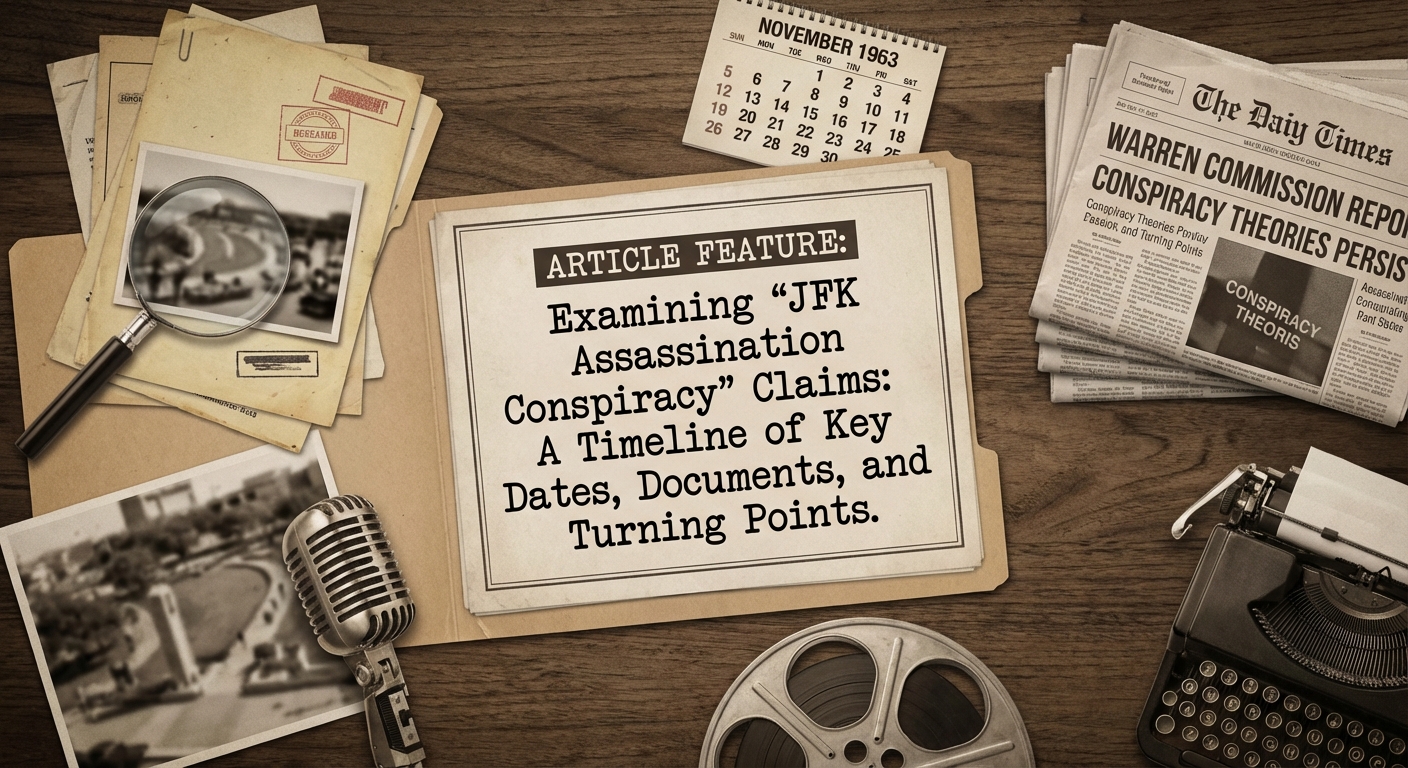
Scope and purpose: this timeline reviews claims commonly grouped under the phrase “JFK assassination conspiracy,” listing major dates, official documents, and turning points. It treats the subject as a set of claims to be tested against available records, not as established fact.
This article is for informational and analytical purposes and does not constitute legal, medical, investment, or purchasing advice.
Timeline: key dates and turning points for the JFK assassination conspiracy
- November 22, 1963 — Assassination in Dallas: President John F. Kennedy was shot while traveling through Dealey Plaza in Dallas, Texas. Immediate records include Dallas Police reports, Parkland Hospital records, contemporaneous news coverage, and early federal investigative materials.
- November 24, 1963 — Lee Harvey Oswald killed: Lee Harvey Oswald, the man charged with assassinating Kennedy, was shot by Jack Ruby while in Dallas police custody; this event ended the possibility of a criminal trial and became a major source of later conspiracy claims. Contemporary audio and visual records document the shooting.
- September 24, 1964 — Warren Commission report published: The President’s Commission on the Assassination of President Kennedy (Warren Commission) issued its final report concluding that Lee Harvey Oswald acted alone. The report and its 26 hearing volumes (testimony from ~550 witnesses) remain primary official documents for the initial federal finding.
- 1975 — Zapruder film publicly shown on television: Portions of the Abraham Zapruder 8mm home movie were first broadcast in 1975, renewing public scrutiny and prompting new congressional attention. The original film later became part of the National Archives collection.
- 1976–1979 — House Select Committee on Assassinations: Congress created the HSCA, which re-examined evidence and concluded in its 1979 report that JFK was probably assassinated as a result of a conspiracy, citing acoustic analysis as a key basis—while noting important limits and dissent among experts. HSCA records and related FOIA-released CIA materials remain central to dispute over whether a conspiracy occurred.
- 1992 — President John F. Kennedy Assassination Records Collection Act: Congress passed the JFK Records Act, establishing a centralized records collection at the National Archives and a statutory duty to release assassination-related records to the public. This law created the Assassination Records Review Board to supervise releases.
- 1998–2000 — ARRB and transfer of retained materials: Following the 1990s statute, collections and some previously withheld records were centralized at the National Archives; the Zapruder film was transferred into the federal collection and other artifacts and records were formally inventoried.
- 2017–2018 — Large releases under the JFK Records Act deadline: The National Archives began publishing large batches of previously withheld documents in 2017–2018; some records remained redacted or withheld after agency review. The White House and National Archives made many files searchable online as part of ongoing processing.
- December 2017–December 2021 — Additional scheduled releases: The National Archives listed multiple staged releases (2017, 2018, 2019, 2021) containing tens of thousands of pages; these releases added internal memos, agency cables, and other investigative files, while some files remained partially redacted or withheld for national security review.
- 2023–2025 — Ongoing document discoveries and releases: Agencies and news reports in recent years documented additional discovered records (for example, the FBI reported finding thousands of new records), and presidential actions in 2024–2025 prompted further releases; coverage of these later releases has appeared in major outlets reporting the addition of many files to the public collection. These events have renewed attention to outstanding questions and to whether remaining records contain decisive new material.
Where the timeline gets disputed
Key disputes about the chronology and significance of documents cluster around several areas:
- Conflicting official conclusions: The Warren Commission concluded Oswald acted alone, while the HSCA concluded that acoustic evidence suggested a probable conspiracy; later re-analyses and critiques have challenged the HSCA acoustic findings and highlighted methodological issues. Readers should note that these two major government reports reached different conclusions on the question of conspiracy.
- Gaps, redactions, and later discoveries: The public record expanded substantially after the 1992 JFK Records Act and the ARRB’s work, yet some records remained redacted or withheld through agency reviews. Recent agency statements and news reporting show additional records discovered and released in the 2017–2025 period, which supporters of conspiracy theories and some historians argue may alter interpretations; independent reviewers caution that many newly released pages are administrative or duplicative rather than dispositive.
- Evidence interpretation differences: Disagreements persist about how to read physical, photographic, and acoustic evidence (for example, interpretations of Zapruder frames, the single-bullet hypothesis, and the reliability of the HSCA acoustic analysis). Expert reviews have sometimes contradicted earlier technical claims; where specialists disagree, the timeline of when interpretations changed is itself part of the dispute.
- Chain-of-custody and documentary completeness: Questions about missing frames, photographic copies, or documents returned to custodians with alleged omissions have been raised; the National Archives now holds original artifacts and many primary files, but debates about whether anything material has been lost or altered continue in secondary literature.
Evidence score (and what it means)
Score: 45 / 100
- Large volumes of primary documentation exist (Warren Commission volumes, HSCA report, FBI/CIA/Secret Service records), which supports a moderate evidence base.
- Key technical analyses (for example, HSCA acoustic work, Zapruder film interpretation, medical findings) have produced conflicting expert opinions over time, reducing confidence in a single settled narrative.
- Significant late releases (post-1992 and waves in 2017–2021 and beyond) increased transparency but also revealed redactions and previously withheld agency materials, which limits completeness.
- Some elements of the record (e.g., disputed forensic interpretations, disputed acoustic evidence) remain contested within the expert literature, lowering the score for documentation that conclusively supports a conspiracy claim.
- Recent discoveries and ongoing releases have the potential to change the score, but as of the latest public releases the documentation is substantial yet inconclusive on the central claim of a coordinated conspiracy.
Evidence score is not probability:
The score reflects how strong the documentation is, not how likely the claim is to be true.
FAQ
What does the primary evidence show about the JFK assassination conspiracy?
The primary documentary record shows extensive investigation by federal and congressional bodies: the Warren Commission’s 1964 report (which concluded Oswald acted alone) and the House Select Committee on Assassinations’ 1979 report (which identified a probable conspiracy based on acoustic analysis) are the principal official summaries. These two reports and the raw materials (witness testimony, photographs/film, autopsy reports, agency records) are available for review but do not present a single, uncontested narrative.
What are the most important documents or sources to check?
Start with the Warren Commission report and hearing volumes, the HSCA final report and supporting volumes, the President John F. Kennedy Assassination Records Collection at the National Archives (including the Zapruder film custody notes), and FBI/CIA files that have been FOIA-released or transferred to NARA. These are the primary sources investigators and historians cite most often.
How have later document releases changed the timeline of claims?
Large batches of records released after the 1992 JFK Records Act (including staged releases in 2017–2021 and later discoveries reported by agencies) expanded the raw documentation available for review, revealed more internal agency communications, and allowed re-examination of previously held assumptions. While these releases clarified some administrative and investigative sequences, reviewers say they have not produced universally accepted, decisive new proof of a coordinated conspiracy; disagreements over interpretation remain.
Why did the HSCA and the Warren Commission reach different conclusions?
The two investigations differed in scope, methodology, and the evidence emphasized. The HSCA had access to later forensic techniques and citizen-accessible materials (including broader analysis of acoustic traces) and therefore reached a different conclusion regarding the likelihood of a conspiracy. Subsequent technical critiques have questioned some HSCA methods (notably the acoustic analysis), which is why the disagreement between the reports continues to shape timelines and claims. Readers should consult both reports and the technical appendices to follow specific methodological debates.
Where can I find the official files online?
The National Archives hosts the President John F. Kennedy Assassination Records Collection and provides access and processing updates; official copies of the Warren Commission material are available through GovInfo; certain HSCA materials are available through congressional records and agency FOIA releases (for example, CIA FOIA). For the most recent staged releases and processing status, the National Archives processing page and the White House JFK Files portal are primary starting points.

Geopolitics & security writer who keeps things neutral and emphasizes verified records over speculation.