
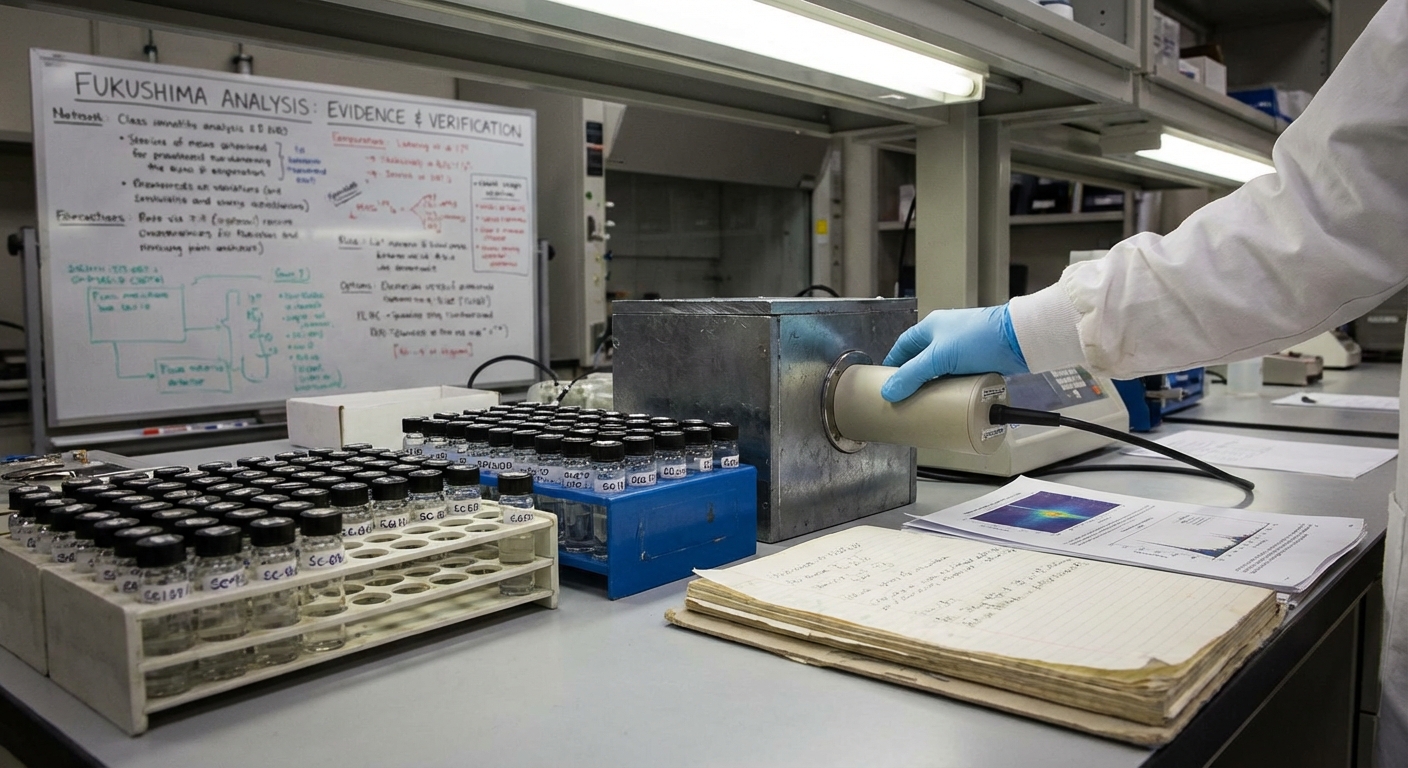
This verdict examines the claim commonly described as the “Fukushima ‘secret radiation’ claims”—the assertion that significant radiation releases or ongoing contamination from the 2011 Fukushima Daiichi accident have been hidden or misrepresented by authorities. The article assesses what is directly documented, what is plausible but unproven, and what is contradicted or unsupported by available primary reports, peer-reviewed science, monitoring data, and investigative journalism. Where authoritative sources exist we cite them; where accounts conflict we note that explicitly.
Verdict: what we know, what we can’t prove
What is strongly documented
Large radioactive releases occurred from the Fukushima Daiichi reactors during and shortly after the March 2011 earthquake and tsunami; these included volatile isotopes such as iodine-131 and longer-lived cesium isotopes (cesium-134 and cesium-137). International assessments and monitoring programs measured these releases and their dispersion.
Global and regional environmental monitoring detected Fukushima-derived radionuclides in air, rainwater, seawater and biota in 2011 and for years afterward; concentrations declined over time and were tracked by scientific cruises and monitoring agencies. Independent oceanographic studies and institutions documented cesium signals in the northwest Pacific and used cesium isotopes as tracers of ocean transport.
Major international expert bodies—the United Nations Scientific Committee on the Effects of Atomic Radiation and the International Atomic Energy Agency—have published multi-year assessments that detail measured releases, population dose estimates, and health-impact appraisals. UNSCEAR’s 2020/2021 appraisal states that no adverse health effects among the general Fukushima population have been documented that could be directly attributed to radiation from the accident.
TEPCO and Japanese authorities have repeatedly disclosed incidents at the site after 2011, including leaks of contaminated water, worker exposure incidents, and equipment failures; such incidents are documented in press releases, regulatory reports, and reporting by international media agencies. These disclosures show both documented contamination events and ongoing challenges in decommissioning.
What is plausible but unproven
Localized concealment, poor record-keeping, or selective reporting by sub-contractors or individual actors is plausible and has limited supporting evidence. Investigations and reporting have documented cases of misconduct and pressure on workers (for example, allegations of dosimeter tampering and contractors instructing staff to under-report exposures), which show there were vulnerabilities in occupational monitoring and transparency in some contexts. Those events do not, by themselves, demonstrate a systematic successful concealment of large-scale environmental releases, but they do create plausible mechanisms for localized under-reporting.
Gaps in data remain in specific domains—long-term health effects from low-dose exposure in subgroups, the full inventory of all isotopes released in the very early chaotic days, and the precise amounts of groundwater-borne releases before containment measures were completed. Peer-reviewed oceanographic work shows measurable but rapidly decreasing cesium in marine systems; however, comprehensive isotope-by-isotope quantification everywhere around the site and downstream remains incomplete. These scientific gaps mean that some granular claims (for example, specific unreported isotope inventories or individualized long-term health outcomes) cannot be fully proven or disproven with currently compiled public data.
What is contradicted or unsupported
Claims that there has been an ongoing, large-scale secret release of radiation from Fukushima in recent years that has caused widespread, unreported health crises or environmental collapse are not supported by the best-available international assessments and monitoring. UNSCEAR, IAEA mission reports, and multiple independent monitoring programs have not found evidence of continuing, large uncontrolled releases that would produce the suggested widespread effects. That does not negate all concerns about incidents or localized contamination, but it does contradict claims of continual massive secret discharges beyond the documented episodes.
Allegations of a coordinated national or international conspiracy to hide extensive off-site contamination lack corroborating primary documentation. Investigative pieces and NGO reports have raised legitimate questions about transparency, data gaps, and management decisions—but these critiques are distinct from validated evidence proving a deliberate, large-scale cover-up that concealed continuing, major releases. Where investigative reporting suggests suppression or error, those items are cited and remain under dispute or partial corroboration.
Fukushima ‘secret radiation’ claims — Evidence score (and what it means)
Evidence score is not probability: The score reflects how strong the documentation is, not how likely the claim is to be true.
Evidence score: 38 / 100
- Documented large releases in 2011 with multi-laboratory monitoring and international assessments support that radiation left the plant and was measurable regionally and globally; this is well-documented.
- Independent, peer-reviewed oceanographic and atmospheric measurements corroborate dispersion and decline of key isotopes (cesium, iodine) over time, strengthening the documented baseline.
- Credible reports of workplace misconduct, isolated leaks and data-management problems create plausible routes for localized under-reporting, but they are limited in scope and documentation.
- High-quality syntheses from UNSCEAR and the IAEA do not endorse claims of ongoing, large-scale secret releases or undisclosed population-level health impacts—this reduces the evidentiary support for sweeping “secret radiation” assertions.
- Remaining uncertainties (individual-level long-term effects, full isotope inventories in some compartments, and some local contamination hotspots) prevent a definitive closure of all claims; those gaps keep the score from being lower or higher.
This article is for informational and analytical purposes and does not constitute legal, medical, investment, or purchasing advice.
Practical takeaway: how to read future claims
When you encounter assertions about “secret” radiation from Fukushima, look for these concrete signals before treating them as established: (1) Are primary monitoring data provided (Bq measurements, detection limits, sample metadata)? (2) Do independent laboratories or international bodies corroborate the measurements? (3) Is the timeline and location specified (e.g., specific leak on a given date vs. vague ongoing release)? (4) Is there a credible chain of custody for samples and dosimetry? Official reports, scientific papers, and data repositories are stronger evidence than anonymous social-media posts or claims without sample details.
Specific helpful steps include: check UNSCEAR and IAEA summaries for population-dose-level assessments; seek peer-reviewed oceanographic and environmental monitoring studies for marine claims; and prefer primary lab reports (with methods and detection limits) over secondary summaries. Where investigative journalism alleges malpractice, look for follow-up official inquiries or corroborating documentation.
FAQ
Do international agencies confirm or deny the “Fukushima ‘secret radiation’ claims”?
International agencies (UNSCEAR, IAEA) provide detailed assessments of releases, exposure and expected health effects; their publicly available reports do not support claims of ongoing, large-scale undisclosed releases and conclude no discernible population-level health effects directly attributable to radiation have been documented to date. Those reports document the 2011 releases and subsequent measured contamination but do not validate broad “secret release” narratives.
Were there incidents or leaks after 2011 that could justify secrecy allegations?
Yes—TEPCO and regulators reported multiple incidents, including leaks from treatment equipment, accidental worker exposures, and data-management problems. These events are documented and have fueled legitimate transparency concerns; however, documented incidents do not equate to proof of a decades-long undisclosed release of high-level radiation beyond what has been monitored and reported.
Can small-scale concealment by contractors explain large unexplained contamination readings?
Localized misconduct—such as tampering with dosimeters or under-reporting—has been alleged and in some cases documented; such actions could affect occupational exposure records or localized environmental samples but are unlikely to account for large, independently measured environmental signals (for example, cesium in seawater measured by research vessels and monitoring agencies). Claims that all major monitoring was falsified would require evidence of coordinated tampering across many independent institutions.
What kinds of evidence would materially change this verdict?
Credible, independently replicated primary data showing significant, unreported releases (with full metadata, chain-of-custody, and laboratory methods) or official documents demonstrating intentional suppression of environmental monitoring results would change the assessment. Likewise, large-scale epidemiological findings directly linking excess disease to previously undocumented releases would be decisive. Until such documentation is available and verified, the evidence supporting sweeping “secret radiation” claims remains weak relative to the documented record.
Where can I find primary monitoring data if I want to check claims myself?
Primary sources include UNSCEAR and IAEA reports and data portals, national monitoring agencies (Japanese Ministry of the Environment, MEXT), TEPCO’s public data releases, and peer-reviewed oceanographic and environmental science studies. Independent research groups (e.g., Woods Hole Oceanographic Institution) and university-led cruises have published raw data and analyses that are useful for cross-checking. Links to representative sources are cited in this article.

Science explainer who tackles space, engineering, and ‘physics says no’ claims calmly.