
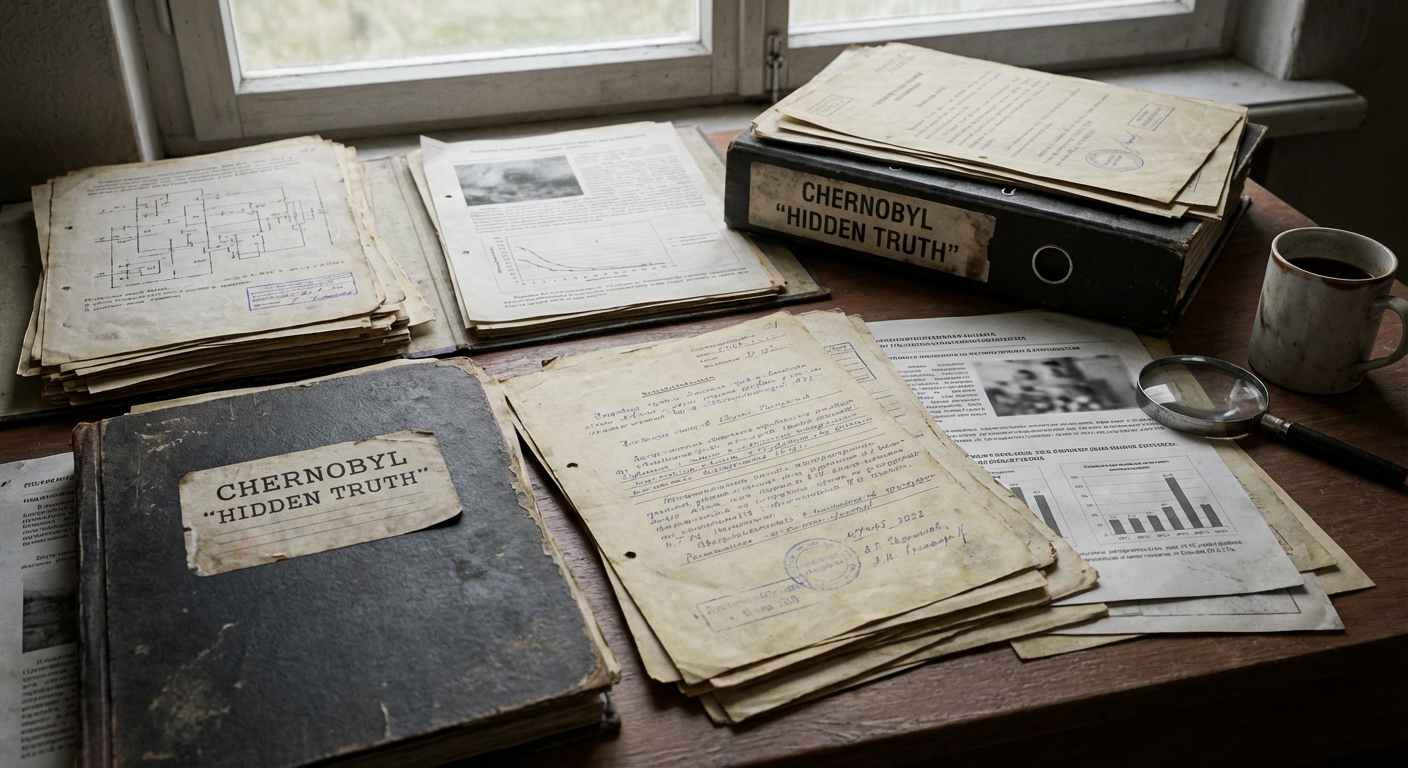
This article examines the claim commonly referred to as the Chernobyl “Hidden Truth” — here treated explicitly as a claim, not as established fact. We summarize major institutional findings, highlight high-visibility counterclaims, and separate (1) what is strongly documented, (2) what remains plausible but unproven, and (3) what is contradicted or unsupported by the available literature. Where sources disagree, we note that disagreement rather than speculate. Primary sources cited include United Nations technical reports and peer-reviewed studies.
Chernobyl hidden truth claims: overview of the controversy
The phrase Chernobyl “Hidden Truth” is used by some authors and commentators to suggest that official or mainstream scientific accounts understate the accident’s health and mortality consequences or that important data have been suppressed or distorted. Major UN reviews and specialist scientific bodies developed authoritative assessments in the 2000s that provide the baseline for comparison; alternative, higher-impact casualty estimates have been published by other groups and remain contested. Because the subject is presented as a claim, this article evaluates the documentary basis for both the mainstream assessments and the higher estimates. Key institutional summaries and data include the Chernobyl Forum reports coordinated by UN agencies and the UNSCEAR 2008 technical annexes.
Verdict: what we know, what we can’t prove
What is strongly documented
There is clear, well-documented evidence on several specific points:
- Acute radiation syndrome and early deaths among plant personnel and emergency workers: dozens of on-site workers and first responders suffered ARS; published UN/IAEA summaries list the clinically confirmed ARS cases and the acute deaths that followed in 1986–1987.
- Increased thyroid cancer incidence in those exposed as children: multiple national cancer registries and UN reviews report thousands of thyroid cancers in children and adolescents in affected areas, attributed to radioactive iodine exposure after the accident. Survival rates for many cases were high but some deaths occurred.
- Wide geographic spread of contamination and long-term environmental remediation needs: environmental monitoring and IAEA/WHO/UN summaries document the dispersion of radionuclides across Belarus, Ukraine and parts of the Russian Federation and outline remediation efforts and zoning.
What is plausible but unproven
Several assertions in “hidden truth” narratives are plausible in principle but lack robust, reproducible documentation that would allow firm conclusions:
- Higher long‑term mortality from cancer and non‑cancer causes than official estimates: some cohort studies of cleanup workers and local populations show elevated mortality for specific subgroups or causes (for example, smoking‑related cancers or circulatory disease in certain cohorts), but extrapolating these findings to a large uncounted death toll across the entire affected population requires assumptions about dose, confounding (smoking, socioeconomic status), and data completeness that are not universally accepted. Representative cohort evidence exists but is heterogeneous.
- Underestimation due to poor early reporting or missing national records: gaps in early registry-building, population movements, and inconsistent cause-of-death coding can plausibly lead to undercounting in some places, but quantifying the total missing cases is methodologically difficult and contested. The UN forum and UNSCEAR note data limitations and call for continued study rather than claiming comprehensive completeness.
What is contradicted or unsupported
Claims that posit extreme, large‑magnitude death tolls or wholesale data suppression face substantial challenges from the documented record:
- Very large mortality totals (orders of hundreds of thousands to millions attributable directly to radiation) are not supported by the major UN technical assessments or by the majority of peer‑reviewed epidemiology; the Chernobyl Forum and UNSCEAR produced much lower central projections and have described the strongest, attributable effects as limited to particular groups and to thyroid cancer in children. When high estimates are published, they are usually accompanied by methodological choices (different baseline rates, broader attributions, non‑peer‑reviewed sources) that independent reviewers have criticized.
- Widespread, coordinated data suppression by international agencies is not supported by the public record of multi‑agency engagement, open publications, and documented expert reviews led by UN bodies; these organizations publicly released methods and reports and explicitly identified uncertainties and limitations. That record contradicts claims of a single concealed consensus.
Evidence score (and what it means)
Evidence score is not probability:
The score reflects how strong the documentation is, not how likely the claim is to be true.
- Evidence score (0–100): 36/100.
- Score drivers:
- – Strong, high‑quality institutional documentation exists for early ARS cases, documented thyroid cancers in children, environmental contamination, and remediation actions (raises baseline documentation quality).
- – Conflicting high‑impact alternative estimates (for example, the Yablokov et al. compilation) rely on heterogeneous sources and have been criticized in academic reviews, lowering the confidence in those larger claims.
- – Heterogeneous cohort studies show some elevated risks in subpopulations (cleanup workers, specific national cohorts) but results vary by methodology and follow-up, producing uncertainty when extrapolating to a general population toll.
- – Data gaps, migration, and cause‑of‑death coding weaknesses are real and reduce confidence in any sweeping mortality estimate that is not transparently modeled.
Practical takeaway: how to read future claims
When you encounter new or amplified “hidden truth” claims about Chernobyl, evaluate them against these checks:
- Source transparency: does the claim provide primary data (registries, cohort identifiers, dose reconstructions) and methods that can be inspected? Institutional reports and peer‑reviewed studies typically include these details.
- Attribution method: does the analysis explicitly model radiation dose, latency, and plausible alternative explanations (smoking, occupational exposures, socioeconomic factors)? If not, the causal link is weak.
- Peer review and independent critique: has the work been evaluated by independent experts and, if published as a controversial estimate, how have other specialists responded? High‑visibility dissent about methodology is a red flag.
- Scope limits: watch for broad extrapolations from a single contaminated subgroup (for example, a particular cleanup cohort) to an entire region without clear, justified scaling. Cohort studies are valuable but not automatically generalizable.
This article is for informational and analytical purposes and does not constitute legal, medical, investment, or purchasing advice.
FAQ
Q: What is the best single source for the mainstream scientific assessment of Chernobyl’s health effects?
A: Major UN coordinated outputs — notably the Chernobyl Forum reports and the UNSCEAR 2008 annexes on health effects — are the most commonly cited, peer‑synthesized sources for mainstream assessment and they describe both documented effects (acute cases, pediatric thyroid cancer increases) and the limitations/uncertainties in long‑term extrapolation.
Q: Does the evidence support the term “Chernobyl hidden truth”?
A: The available institutional documentation does not support the implication that a unified, intentionally concealed truth exists at the international level. There are unresolved uncertainties and contested estimates, but the public record shows open, multi‑agency reporting and explicit discussion of data limitations. That pattern is inconsistent with a single, large‑scale suppression of evidence.
Q: Are there credible studies that estimate much higher deaths than UNSCEAR or the Chernobyl Forum?
A: Yes—prominent alternative compilations (for example, the Yablokov et al. compilation) present much higher mortality estimates; these works have prompted detailed criticism from many reviewers for methodological issues, selective sourcing, and limited peer review, which means their conclusions remain disputed rather than accepted. Evaluate any such study by its data transparency, dose‑response modeling, and independent review.
Q: How should a reader treat newer cohort studies reporting elevated risks in cleanup workers?
A: New cohort evidence is important and can change our understanding, but readers should check for sample size, follow‑up period, dosimetry quality, adjustment for confounders, and whether the study’s authors recommend extrapolation beyond the studied cohort. Some cohort results show statistically significant increases for certain causes in specific national cohorts, which supports targeted concern but not automatic generalization.
Q: How can I judge future claims about “Chernobyl hidden truth”?
A: Prioritize claims that reference primary, accessible data and transparent methods, and that have been subjected to independent expert review. Be skeptical of large, headline mortality totals when the supporting documentation is limited, non‑peer‑reviewed, or depends on broad extrapolations from small or selective datasets.

Science explainer who tackles space, engineering, and ‘physics says no’ claims calmly.