
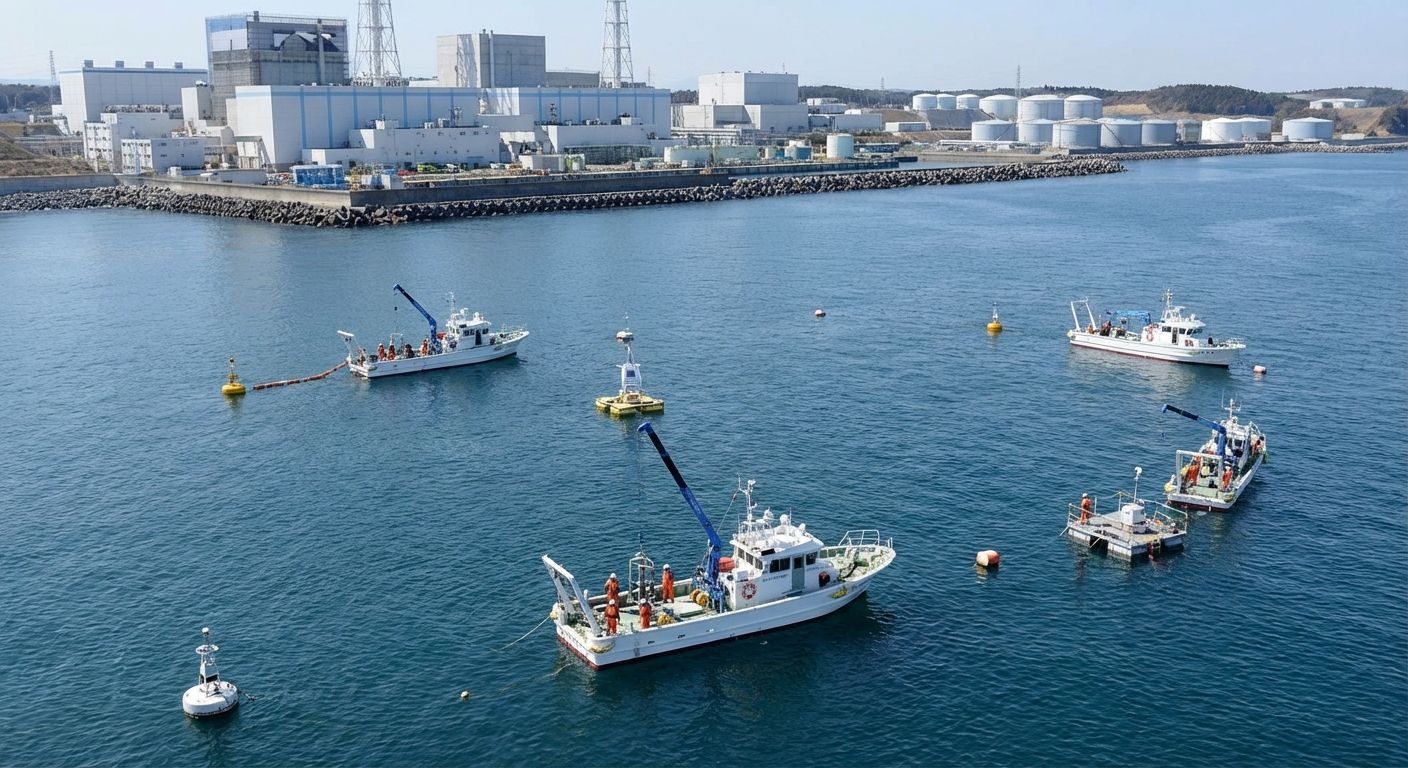
This article tests the claim commonly described as the “Fukushima secret radiation” claim against the strongest available counterevidence and expert explanations. It treats “Fukushima secret radiation claims” strictly as a claim and evaluates monitoring data, multilateral agency reviews, peer-reviewed studies, and independent sampling to show what is documented, what is disputed, and where significant gaps remain.
The best counterevidence and expert explanations about Fukushima secret radiation claims
-
Independent multilateral agency reviews: The International Atomic Energy Agency has repeatedly reviewed Japan’s monitoring and the handling of ALPS-treated water, concluding that sampling, laboratory comparisons, and regulatory oversight show results consistent with international safety standards and that discharges were predicted to have negligible radiological impact under the reviewed scenarios. These IAEA reviews include on-site sampling and interlaboratory comparisons intended to corroborate TEPCO and Japanese government data.
Why it matters: The IAEA’s work provides independent technical corroboration of the data-gathering and analytical methods used to monitor radionuclides in water and the marine environment. Limitations: IAEA reports evaluate the monitoring and modeled impacts up to the dates of their missions and are focused on the specific parameters they reviewed; independent long-term ecological effects beyond the modeled scenarios require ongoing study.
-
Comprehensive scientific assessments of exposure and effects: UNSCEAR (United Nations Scientific Committee on the Effects of Atomic Radiation) published a detailed assessment of releases, environmental dispersion, doses to the public and workers, and likely health effects following the 2011 accident. UNSCEAR’s 2013 report synthesizes monitoring and modeling work and concluded that, while there were localized elevated exposures, the overall doses to most of the public were limited and that large-scale acute health effects attributable to radiation were not observed.
Why it matters: UNSCEAR is a long-standing scientific body that aggregates national and international monitoring data and peer-reviewed research; its conclusions carry weight in evaluating claims about undisclosed, population-level radiation harm. Limitations: The 2013 report covers material submitted up to its drafting and notes that some later issues (ongoing liquid releases, later worker exposures) were not covered in that volume and need updated assessment.
-
National and site-level monitoring results: Ongoing monitoring by Japan’s Nuclear Regulation Authority, TEPCO, and independent laboratories has tracked air, soil, sea and food contamination levels. Summaries by technical organizations indicate that measured seawater and food concentrations have been low outside immediate coastal areas and that most public-dose pathways declined substantially after the initial releases. World Nuclear Association and similar technical summaries report that monitoring shows dramatic reductions from peak 2011 levels.
Why it matters: Continuous site and regional monitoring makes a secret, sustained high-level release into the environment less likely to go unnoticed if monitored parameters remain consistent. Limitations: Monitoring station density varies by location and hotspots may exist in localized soils or sediments where deposition concentrated; also, long-lived radionuclides bound to sediments are slower to decline.
-
Peer-reviewed and laboratory analyses of environmental samples: Independent laboratory counts and peer-reviewed analyses of environmental samples (for example gamma spectrometry of fish, seaweed and soil) show low or non-detectable levels of key isotopes like Cs-134 in many tested samples far from the plant, and identify residual Cs-137 primarily from the 2011 releases or earlier weapons-test fallout. Several published analyses find measurable but low concentrations consistent with expected environmental decay and dilution patterns.
Why it matters: Independent laboratory work provides a check on official reporting. Limitations: Sample selection, detection limits, and geographic coverage affect conclusions; low-level detection in some species or sediments does not by itself prove undisclosed releases.
-
Independent, ad-hoc measurements show trace signals but low risk: Early after the accident, university groups and other independent teams measured trace fission products in precipitation and environmental samples overseas (for example, measurable but tiny levels of iodine and cesium in North American rainwater samples), demonstrating that some material traveled long distances but at concentrations orders of magnitude below levels of health concern. Those independent measurements affirmed dispersion predictions rather than uncovered secret releases.
Why it matters: Independent detection in distant locations confirms atmospheric transport and dilution rather than hidden, sustained local releases at high levels. Limitations: Such distant detections do not measure local hotspots near Fukushima and cannot fully substitute for dense local monitoring data.
-
Transparency challenges and contested claims: While official monitoring programs and international reviews provide extensive data, public distrust, concerns about data handling, and reports of specific workplace violations or irregularities have contributed to narratives of secrecy. Some media reports and legal cases have focused on alleged management failures and worker exposure issues, underscoring why some observers believe undisclosed radiation releases or data manipulation are possible. These allegations require independent verification through documented evidence or legally admissible findings to change the overall assessment.
Why it matters: Institutional failures or poor communication can feed suspicion and merit independent investigation; limitations: allegations do not equal proof of undisclosed population-level releases and must be distinguished from measured environmental radioactivity data.
Alternative explanations that fit the facts
-
Misinterpretation of monitoring data and units: Radiation measurements use different units (Bq, Sv, µSv/h, counts per minute). Non-experts can confuse small increases in activity or short-lived isotopes with dangerous cumulative doses. Scientific reports show that many environmental detections after 2011 were far below health thresholds even where detectable. Proper interpretation reduces apparent contradiction between low measured concentrations and public concern.
-
Local hotspots vs. widespread releases: Deposits of radiocesium can concentrate in soil patches, sediments, or particular marine organisms, creating higher localized readings. These do not imply a secret ongoing release but rather initial heterogeneous deposition and slower migration in sediments. Modeling and field studies from Fukushima show such spatial variability.
-
Focus on tritium and treated water: Public concern often centers on ALPS-treated water releases and tritium. Technical assessments and the IAEA’s independent sampling emphasize that tritium concentrations in discharged batches remained below operational limits and that tritium’s chemical and radiological properties make it less radiotoxic than many radionuclides of concern, though some critics argue for caution. The IAEA’s interlaboratory comparisons offer corroboration of monitoring data.
-
Confusion between historical fallout and Fukushima-specific contamination: Some measured Cs-137 in the environment may be legacy fallout from atmospheric weapons testing decades earlier rather than from Fukushima. Laboratory isotope ratios and the presence or absence of short-lived isotopes (like Cs-134 soon after the accident) help distinguish sources. Peer-reviewed studies have used isotope signatures to attribute origins.
What would change the assessment
-
Credible, independently verified environmental data showing sustained, elevated concentrations inconsistent with established monitoring trends (for example, statistically robust concentrations well above modeled or observed baselines across multiple independent labs) would change the assessment. Any such data should be traceable (sample chain-of-custody) and published in peer-reviewed form or released by reputable agencies.
-
Documented internal disclosures or legal findings showing deliberate manipulation of monitoring data at scale, proven through investigations with corroborating evidence, would be material. Allegations alone, without documented verification, are insufficient to overturn broad monitoring conclusions.
-
Robust epidemiological studies, published in peer-reviewed journals, that link measured exposures from Fukushima to excess disease patterns in a way that controls for confounders and uses validated dose reconstructions would also be decisive. To date, multinational scientific bodies have not concluded that such population-level radiation effects attributable to undisclosed releases exist.
This article is for informational and analytical purposes and does not constitute legal, medical, investment, or purchasing advice.
Evidence score (and what it means)
- Evidence score: 72/100
- Score drivers:
- 1) Large body of independent monitoring and multilateral agency reviews (IAEA, national regulators) that corroborate TEPCO and Japanese government data.
- 2) Comprehensive scientific assessment by UNSCEAR synthesizing national and international data on releases, doses, and health effects.
- 3) Peer-reviewed environmental analyses showing low or declining radioactivity in many samples and modeling of deposit/decay dynamics.
- 4) Presence of verified, narrow gaps: local hotspots, workplace exposure controversies, and continued public distrust reduce the score.
- 5) The score is reduced because long-term ecological effects and some later exposure pathways (e.g., sediment-bound radionuclides or long-decommissioning worker exposures) require continued observation and may not be entirely resolved by existing reports.
Evidence score is not probability:
The score reflects how strong the documentation is, not how likely the claim is to be true.
FAQ
Q: Are the “Fukushima secret radiation claims” proven by independent data?
A: No single, verifiable body of independent data has been published that demonstrates ongoing undisclosed high-level releases from Fukushima inconsistent with the monitoring and agency reviews cited above. International reviews and scientific assessments support the conclusion that, while measurable contamination and localized exposures occurred, widespread secret releases at levels posing unrecognized population risk are not documented. Continued independent sampling and peer-reviewed publication would be required to change that position.
Q: If monitoring shows low levels, why do some groups claim secrecy?
A: Claims of secrecy often arise from a combination of institutional mistrust, selective access to technical information, misreading of measurement units, localized incidents (worker safety issues or local hotspots), and the long-lasting social impact of the 2011 emergency. Media reports and legal disputes about management failures have amplified suspicion. These are important social and governance issues but are distinct from evidence of an undisclosed, ongoing environmental release at dangerous levels.
Q: Could tritium or treated water releases be the source of “secret” radiation?
A: Discussions about ALPS-treated water focus on tritium because most other radionuclides are removed by treatment. The IAEA’s technical reviews and interlaboratory comparisons have verified reported tritium concentrations in samples they observed and have judged releases (as carried out and diluted) to be consistent with international safety standards and modeled to have negligible public health impacts under those scenarios. Critics remain concerned about cumulative ecological effects or uncertainties, which is why ongoing monitoring and transparency are emphasized.
Q: What independent signs would convincingly show a secret release?
A: Convincing evidence would include reproducible, peer-reviewed laboratory results from independent labs showing sustained, geographically inconsistent elevated radionuclide concentrations; documented chain-of-custody for samples; or legal/institutional findings demonstrating deliberate data suppression. Anecdotes or single-source measurements without corroboration are not sufficient.
Q: How can the public monitor credible updates about these claims?
A: Follow reports from established bodies with transparent methods and peer review: IAEA technical missions and reports, national regulators (e.g., Japan’s Nuclear Regulation Authority), peer-reviewed journals, and recognized scientific committees like UNSCEAR. Look for reproducible data, interlaboratory corroboration, and public release of raw sampling metadata where possible.

Science explainer who tackles space, engineering, and ‘physics says no’ claims calmly.