
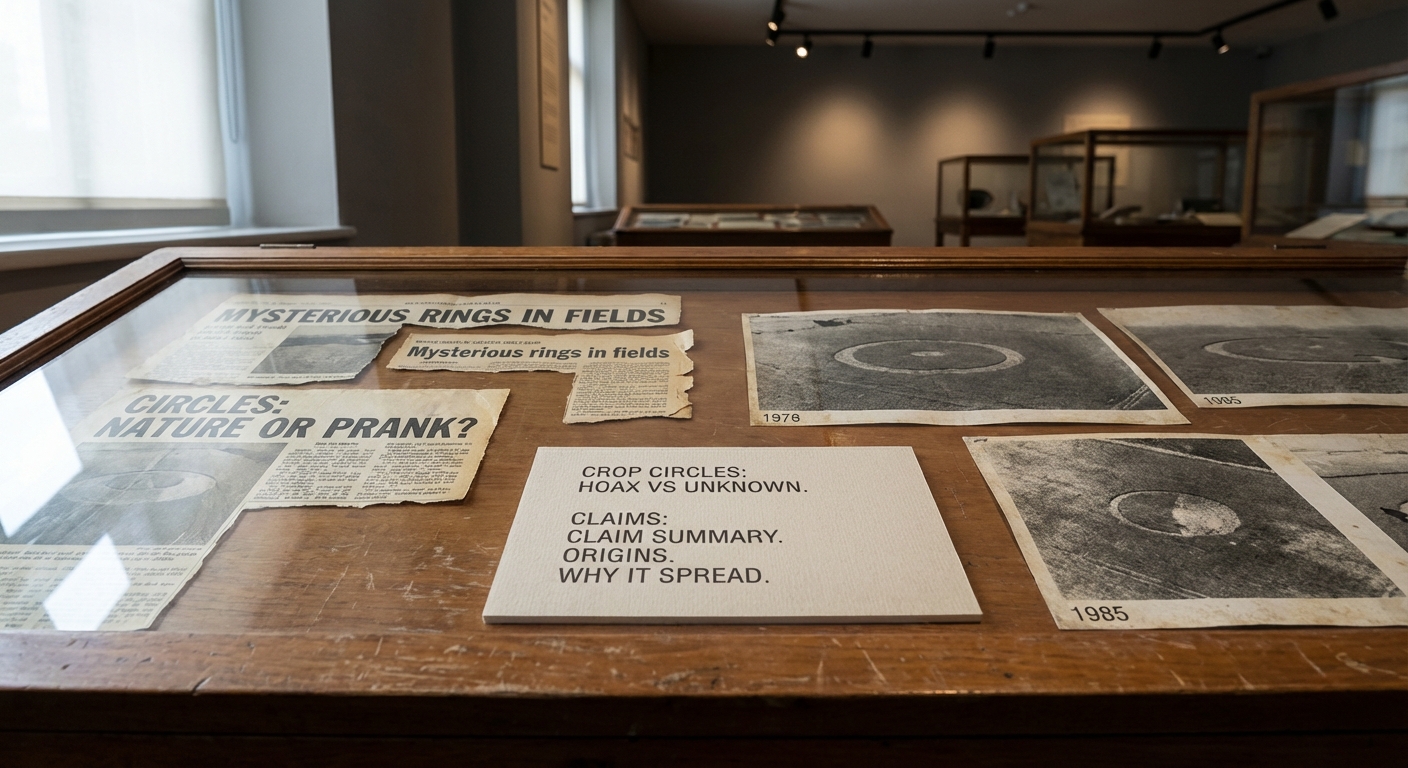
The claim framed as “Crop Circles: Hoax vs Unknown” asserts that many crop formations are deliberate human hoaxes while some remain unexplained or possibly the result of unknown forces. This article treats that formulation as a claim under review, summarizing what is documented in contemporary reporting and research, what is disputed, and where evidence is thin or absent. The phrase crop circles hoax vs unknown will be used throughout as the anchor for the scope of this analysis.
What the claim says
The central claim—summarized as crop circles hoax vs unknown—has two competing propositions often presented together:
- Most or all crop circles are the product of human makers using simple or advanced techniques (the “hoax” side).
- Some crop circles cannot be explained by known human techniques and therefore point to unknown natural mechanisms or nonhuman intelligence (the “unknown” side).
Supporters of the hoax interpretation point to admitted circle-makers, demonstrable methods, and geographic/pattern evidence consistent with human activity. Supporters of the unknown interpretation point to claimed physical anomalies, alleged rapid formation, and the persistence of complex designs despite hoax admissions. Both positions are claims that require evidence; this article analyzes that evidence rather than assuming either conclusion.
Where it came from and why it spread
Modern reports of flattened, circular formations in cereal crops became frequent in southern England in the late 1970s and 1980s; those early patterns were often relatively simple rings and discs. Over the following decade the phenomenon attracted media attention and a subculture of investigators and enthusiasts who documented images and built narratives about meaning and origin. These historical and geographic patterns are documented in reference works and journalistic summaries.
A key moment in the public story came in September 1991, when two British men—Doug Bower and Dave Chorley—publicly said they had made many of the early formations using simple tools (boards, ropes, and stakes) and demonstrated their technique to journalists. Their admission produced extensive coverage and led many commentators to classify at least a large portion of the phenomenon as human-made. However, some researchers and enthusiasts disputed that Bower and Chorley’s work explained every formation, and the debate continued.
Several factors explain why the crop circles hoax vs unknown claim spread widely:
- Media amplification: sensational images and TV coverage in the 1980s–1990s spread interest across countries and into popular culture. Coverage and feature articles treated both mysterious and hoax explanations, extending public fascination.
- Copycat and artistic scenes: once images were published, other creators—ranging from pranksters to performance artists—reproduced and evolved designs, sometimes increasing complexity and visibility. This contributed to the perception of mystery even when human methods were used.
- Technology and attention economy: more recent examples show how marketing and publicity stunts exploit the crop circle motif, prolonging interest and confusion about origin. A 2013 case in California was later acknowledged as a corporate publicity stunt.
What is documented vs what is inferred
Below we divide claims about crop circles into three categories: documented, plausible but unproven/inferred, and contradicted/unsupported. This is an evidence-focused inventory.
Documented (well-supported by contemporary reporting or direct evidence)
- Crop circles (patterns of flattened cereal crops) have been repeatedly photographed and reported since the 1970s; the existence of formations is not in dispute.
- At least some crop circles were created by identifiable human makers: Doug Bower and Dave Chorley publicly admitted making many early circles and demonstrated methods; other individuals and organized teams have also produced formations and sometimes revealed themselves or been observed.
- Patterns and their distribution show social and geographic signals consistent with human activity (concentrations near roads, heritage sites, and populated areas) rather than a random global natural process.
Plausible but unproven (evidence exists but is limited or disputed)
- Some investigations recorded claims of plant-stem anomalies, localized magnetic readings, or thermal irregularities; these reports attracted attention but have not been reproduced reliably by independent teams under controlled conditions. Such observations remain contested and not universally replicated.
- Technical methods (GPS, lasers, or microwave devices) have been proposed to explain how highly complex modern patterns might be made quickly and precisely; these remain hypotheses supported in part by experimenters but do not prove nonhuman origins.
Contradicted or unsupported (claims lacking credible evidence)
- There is no verified, peer-reviewed body of evidence demonstrating that extraterrestrial craft or unknown nonhuman intelligences have created crop circles. Extraordinary claims require extraordinary evidence; to date, that level of documentation is absent.
- Simple appeals to mystery (e.g., “no one could have done it overnight”) are often contradicted by documented human demonstrations of circle-making techniques and by documented cases of intentional publicity hoaxes.
Common misunderstandings
- Misunderstanding: “Bower and Chorley proved all crop circles are hoaxes.” Clarification: Their admission demonstrated that many early patterns were human-made and that simple methods can produce convincing designs, but it does not logically prove that every formation ever recorded was made by them or that no unexplained cases remain. Scholarly and skeptical reviewers note that admitting a large hoaxing campaign changes the evidentiary balance but does not eliminate the need to evaluate each case on its documentation.
- Misunderstanding: “All complex crop circles require advanced technology or nonhuman actors.” Clarification: Skilled human teams with planning, measurement tools (for example, GPS or construction lines), and practice can and have produced very complex designs; modern work by artist collectives shows human capability for sophisticated patterns. Evidence for exotic technology is speculative.
- Misunderstanding: “Physical anomalies (bent nodes, expulsion cavities, magnetism) prove a nonhuman cause.” Clarification: Reports of physical anomalies have been made, but independent, reproducible experiments and peer-reviewed confirmations are lacking; skeptics caution that many such observations are either measurement artifacts or can be produced by known human or natural processes.
Evidence score (and what it means)
- Evidence score: 62/100
- Drivers of the score:
- Strong documentation that crop formations exist and that many were created by human makers (confirmed admissions, demonstrations, and documented artist groups).
- Widespread, credible journalistic coverage and primary-source admissions (1991 confessions) that shifted mainstream interpretation toward human causation.
- Some experimental and theoretical hypotheses (e.g., microwave or GPS-assisted methods) that plausibly explain faster or more intricate production, but these remain partial and not definitive.
- Claims of physical anomalies are reported but lack consistent independent replication in peer-reviewed literature, reducing overall evidentiary weight for unknown causes.
- Ongoing confounding factors—copycat artists, publicity stunts, and selective reporting—complicate assessments of individual formations, keeping the score well below certainty.
Evidence score is not probability:
The score reflects how strong the documentation is, not how likely the claim is to be true.
This article is for informational and analytical purposes and does not constitute legal, medical, investment, or purchasing advice.
What we still don’t know
- Exactly which, if any, documented formations resist plausible human explanation when all contemporary documentation (timestamped photos, independent witnesses, and chain-of-custody data) are available. Many widely discussed cases lack the complete contemporaneous record necessary for conclusive analysis.
- Whether any reported physical anomalies can be reproduced reliably under controlled conditions and published in peer-reviewed journals; existing anomaly reports remain contested and scarce.
- The full extent to which modern technology (GPS, drones, microwave techniques) has been used by human creators to produce complex patterns quickly—and how to differentiate such advanced human techniques from genuinely novel causes, if any.
- How best to standardize field documentation and forensic protocols (timestamped imagery, soil and plant-sample chain-of-custody, independent witnesses) to evaluate future claims rigorously. This is a practical gap rather than evidence of a particular origin.
FAQ
Q: Are crop circles proven to be human hoaxes?
A: Many crop circles are documented as human-made—there are admitted creators, demonstrations, and artist collectives that produce such work. The admission by Doug Bower and Dave Chorley in 1991 is a central documented event that supports the human-hoax explanation for numerous early cases; however, admitting some hoax cases does not by itself prove that every recorded formation is explained. Each formation should be examined using contemporaneous documentation.
Q: Could crop circles be caused by unknown natural phenomena or extraterrestrials?
A: The proposition that unknown natural forces or extraterrestrials created crop circles remains a claim without peer-reviewed, reproducible evidence. Researchers have proposed and sometimes tested alternative mechanisms (e.g., specific meteorological vortices or localized energy effects), but these explanations have not produced a reliable, independently replicated corpus of evidence that would change the broader scientific judgment.
Q: How did the narrative “hoax vs unknown” spread so widely?
A: Media coverage of striking images, coupled with the 1991 admissions and subsequent publicity stunts and artistic productions, amplified public interest. The phenomenon also intersects with UFO culture, art, tourism, and internet-era virality, which together helped the claim spread and persist.
Q: What would count as strong evidence for a genuinely unexplained case?
A: Strong evidence would include contemporaneous, independently verifiable documentation (precise timestamps, multiple independent witnesses, secure physical samples analyzed by accredited labs with open methods, and reproducible anomalies under controlled testing). Absent such documentation, alternative human explanations remain plausible.
Q: Where can I find more rigorous analysis of specific cases?
A: For skeptical, investigative reviews consult sources like Skeptical Inquirer and the work of experienced investigators who publish methods and datasets. For historical summaries and reference overviews, established encyclopedias and major news outlets provide background and contemporary reporting. See the sources cited in this article for examples.

Science explainer who tackles space, engineering, and ‘physics says no’ claims calmly.