
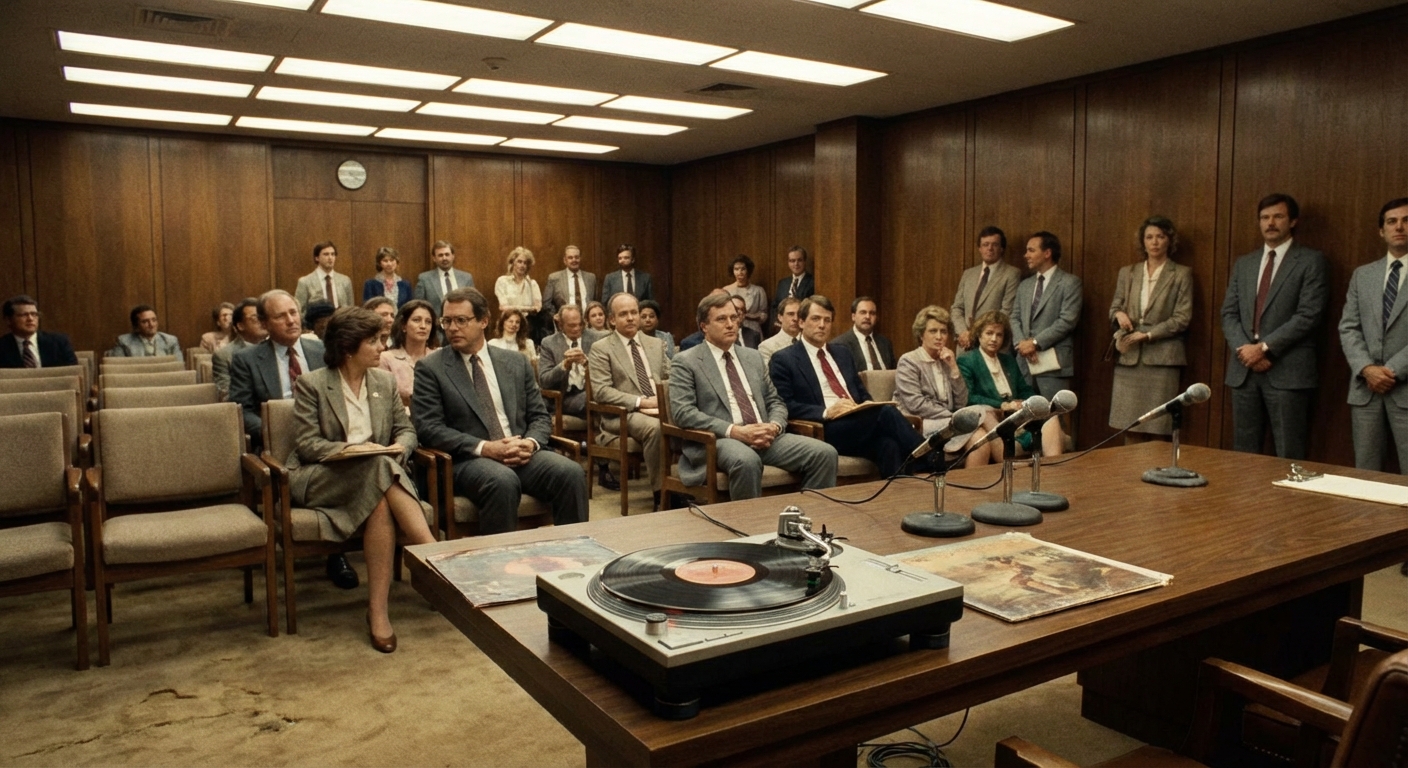
Below are the arguments supporters of the “backmasking” panic cite most often. This article treats the topic strictly as a claim: these are reasons people give for believing backmasked or reversed messages can influence listeners, not proof that any such influence exists. Each argument includes the type of source that typically promotes it and a simple verification test readers can use.
The strongest arguments people cite
-
Alleged explicit backward messages in famous songs (example often cited: Led Zeppelin’s “Stairway to Heaven”). Source type: televised Christian outreach programs, tabloid and legislative hearings in the early 1980s. Verification test: play the original recording backward from a reliable digital copy and compare the phrasing to the claimed wording; ask for studio/engineer testimony or access to masters where possible.
Context and origin: the claim about “Stairway to Heaven” was aired widely after a 1982 broadcast and was played at a California Assembly committee hearing that prompted public attention and legislative proposals.
-
“Paul is dead” / Beatles reverse-phrases — listeners heard phrases like “turn me on, dead man” when playing Beatles tracks backward. Source type: college newspapers, late‑1960s radio shows and DJs publicizing the rumor. Verification test: check contemporary reporting and radio tapes; compare forward and reversed audio and examine whether claims were originally satirical or hoaxed.
Context and origin: the “Paul is dead” rumor spread from college papers and a 1969 radio show that played a reversed slice of “Revolution 9”, which many later described as the early ignition point for reverse-listening phenomena.
-
Legal and legislative action: state bills and hearings (for example, California and Arkansas in the early 1980s) arguing that undeclared backmasked content should carry warnings. Source type: legislative records and contemporary news reports. Verification test: consult the text and legislative history of the bills, committee hearing transcripts, and the final votes or veto messages.
Context and origin: several state-level proposals and hearings were reported in 1982–1983, producing bills and debate (including an Arkansas bill that passed the legislature but was returned by the governor). Documentation of those proceedings and of related federal proposals exists in contemporary reporting and legislative record summaries.
-
Alleged subliminal/backward commands causing behavior (example: the 1990 lawsuit involving Judas Priest where plaintiffs alleged hidden “Do it” commands). Source type: civil lawsuits and local/national press coverage. Verification test: examine the court record, judge’s written decision, and expert testimony from the trial transcript or published summaries.
Context and origin: in a much‑publicized 1990 Nevada trial the judge concluded plaintiffs failed to prove intent and causation even while describing audio phenomena that some listeners reported; the ruling and reporting show the legal standard demanded by courts.
-
Claims that reversed speech reveals unconscious or hidden thought (popularized more recently as “reverse speech” by individual proponents). Source type: books, commercial seminars, and websites promoting a specific method (for example David J. Oates’ reverse‑speech materials). Verification test: look for peer‑reviewed experiments that replicate claims under controlled conditions; check for independent replications published in scholarly journals.
Context and origin: the reverse‑speech theory has been examined by linguists and skeptical researchers; systematic peer‑reviewed support is lacking and critical analyses have concluded the effect is not established in the scientific literature.
-
Audio examples that were intentionally recorded backward by artists (used as evidence that backmasking is real and sometimes suspect). Source type: band interviews, liner notes and admitted studio techniques. Verification test: find band/producer statements, studio logs, or later reissues/liner notes that acknowledge deliberate backmasking.
Context and origin: some bands have openly used backwards recording as an artistic device, and in those cases verification is straightforward: the artist or engineer confirms the technique (for example, admitted backward recordings appear in band interviews and album notes). These admissions differ from claims of secret manipulative messages.
-
Audio‑perception demonstrations by individuals claiming neuroscientific backing (witnesses who testified at hearings or appeared on TV asserting that the brain decodes backward messages). Source type: expert testimony/TV appearances by self‑described researchers. Verification test: check the witness’ credentials and look for peer‑reviewed neuroscience research supporting cross‑language backward decoding or unconscious directive effects.
Context and origin: some witnesses at public hearings and television programs presented themselves as scientific authorities; independent review typically finds those claims lack solid peer‑reviewed neuroscience support.
-
Pattern‑finding / pareidolia demonstrations (people perceive meaningful phrases in noise or reversed audio). Source type: crowd experiments, radio call‑ins and popular demonstrations. Verification test: blind listening tests where listeners are not primed with an expected phrase vs. listeners given the suggested phrase; compare detection rates and false positives.
Context and origin: controlled replications and skeptical analyses indicate expectation and suggestion strongly influence how listeners report backward phrases; listeners told what to hear report more matches than unprimed listeners.
How these arguments change when checked
When the strongest arguments are examined against primary documentation or controlled testing, several consistent patterns appear:
-
Many allegations trace to a small number of high‑visibility moments (1969 radio programs, early 1980s TV broadcasts and state hearings) rather than to contemporaneous studio records or artist admissions. The 1969 “Paul is dead” burst and the 1982/83 legislative hearings are repeatedly cited as origins for large parts of the panic.
-
Court records and major trials that tested causal claims (for example the 1990 Reno trial about Judas Priest) show courts require both proof of intentional embedding and proof of causal effect; reporters and the judge’s written opinion illustrate how difficult those two threshold items are to prove. In that case the judge found plaintiffs failed to meet the burden of proof on intent and causation even while describing the competing expert evidence introduced at trial.
-
Independent linguistic and skeptical reviews find the “reverse speech” hypothesis lacks robust peer‑reviewed support. Controlled experiments replicated by independent researchers find that expectation and suggestion greatly increase reports of meaningful reversals, consistent with auditory pareidolia and top‑down perception effects.
-
Where artists or engineers have deliberately recorded backward phrases, those are easy to verify by direct testimony or session notes; these documented cases are a different category from claims that secret manipulative messages were universally or covertly embedded to control listeners.
-
Legislative and regulatory responses exist in historic record, but they addressed consumer concern and perception rather than establishing a scientific causal mechanism; the legislative history shows policy responses to public fear and lobbying rather than settled scientific findings.
Evidence score (and what it means)
- Evidence score: 28 / 100
- Why this score: most widely cited incidents are well‑documented as social events (radio shows, TV appearances, hearings) but do not provide primary evidence that backmasked content causes behavior.
- Why this score: some artists have admitted deliberate backward recordings, but such admissions do not support the broader claim that secret backward messages are being used to manipulate listeners at scale.
- Why this score: formal tests (court records, skeptical replications) and peer‑reviewed critiques find little empirical support for the claim that reversed audio can reliably implant directives in listeners’ behavior.
- Why this score: subjective perception (pareidolia, suggestion) explains much of the reported experience, and controlled testing shows priming strongly affects what people hear in ambiguous audio.
Evidence score is not probability:
The score reflects how strong the documentation is, not how likely the claim is to be true.
This article is for informational and analytical purposes and does not constitute legal, medical, investment, or purchasing advice.
FAQ
What evidence supports Backmasking panic claims?
Documentary evidence supports that a cultural panic happened — radio call‑ins, TV broadcasts and state hearings in the late 1960s through the 1980s popularized the concern — but the strongest documented items are records of those events, not peer‑reviewed experiments showing behavioral control via backward messages. See contemporary news and legislative records for the public episodes.
Can a hidden backward message actually make someone do something?
No reliable peer‑reviewed evidence shows backward speech or so‑called “reverse speech” can compel behavior. High‑profile legal tests required proof of both intentional embedding and causation; courts and skeptical reviews emphasize that those standards were not met in the major cases.
How can I check a suspected backward message myself?
Start with the simplest verification tests: obtain a high‑quality forward recording (preferably a lossless digital file or original master if available), reverse it using audio software, and listen in a neutral setting. For stronger verification, compare multiple listeners under blind conditions (unprimed vs. primed) and look for independent documentation (studio logs, producer/engineer interviews, or published session notes). If a legal or scientific claim is being made, seek primary documents (court transcripts, peer‑reviewed studies).
Why do people hear words when audio is reversed?
Perception research and skeptical analyses point to top‑down processing and auditory pareidolia: when listeners expect or are primed to hear a phrase, they are much more likely to report it. Independent linguistic critiques and replications show suggestion and selective listening explain many alleged discoveries.
Are there any confirmed cases where bands intentionally backmasked dangerous commands?
Artists have sometimes inserted backward bits for artistic effect or humor, and those admissions are verifiable; but documented intentional backmasking for the purpose of covertly directing behavior has not been substantiated by reliable evidence. Distinguish between admitted artistic backmasking and claims of covert manipulation.

Culture writer: pop-culture conspiracies, internet lore, and how communities form around claims.