
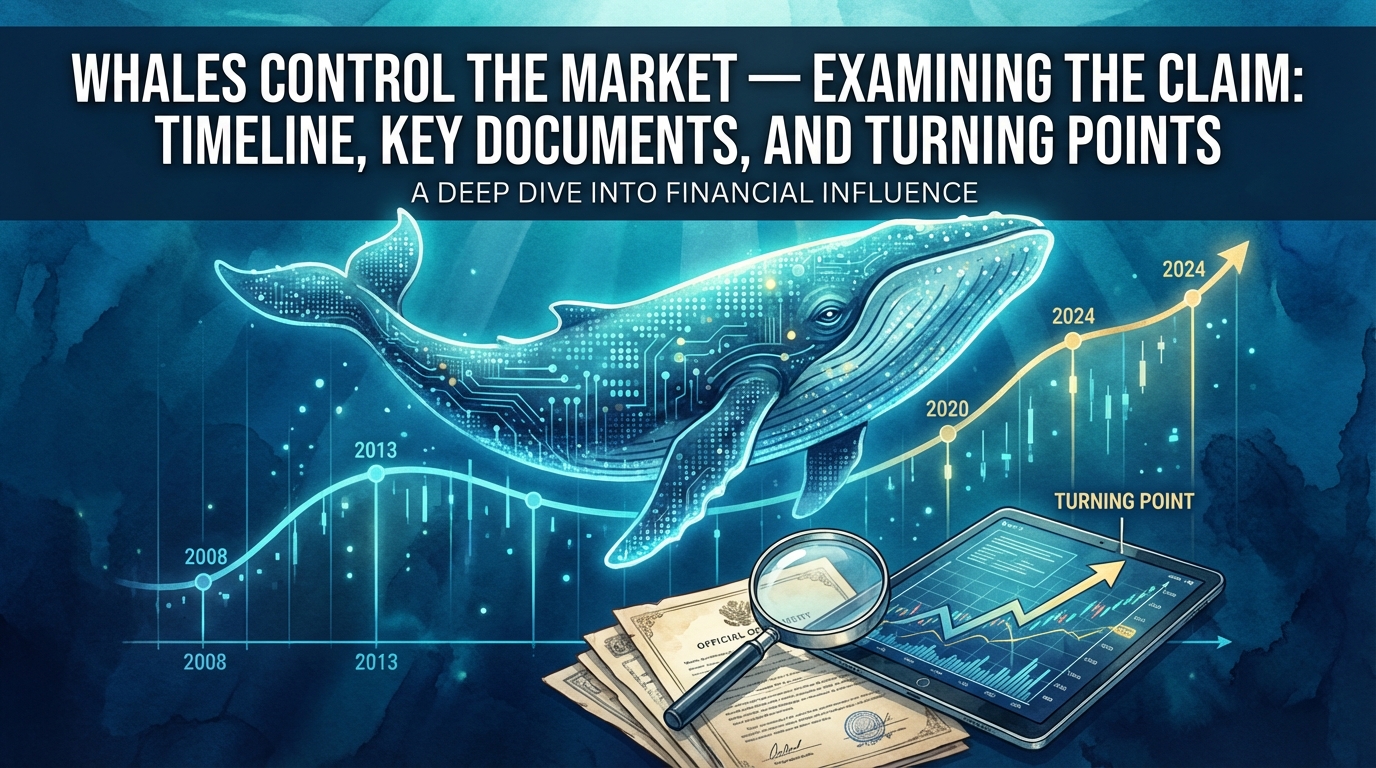
Intro — scope and purpose: This timeline examines the claim “Whales Control the Market” by collating key dates, documented actions, regulatory filings, and academic research. The aim is to separate documented events from inference, identify disputed points, and show which documents and investigations are cited when people assert that whales (large holders or traders) control prices. The phrase Whales Control the Market is treated throughout as a claim under analysis, not an established fact.
Timeline: key dates and turning points — Whales Control the Market
- March–April 2020: MicroStrategy begins public Bitcoin accumulation (documented corporate purchases). MicroStrategy announced a strategic policy to hold Bitcoin and filed Form 8‑K / 10‑Q disclosures showing repeated purchases; these public SEC filings document material acquisitions by a single public company and are frequently cited as evidence that concentrated institutional buying can move markets.
- May 28, 2024: Mt. Gox trustee consolidates coins ahead of rehabilitation distribution (on‑chain movements trigger market attention). The trustee for the bankrupt Mt. Gox exchange moved large blocks of BTC to new addresses in preparation for creditor distributions. Market participants and on‑chain trackers noted price reactions; the trustee’s statements and reporting are primary documents used to show how large on‑chain transfers can influence short‑term price action.
- 2023–2025: Regulatory enforcement highlights wash trading, spoofing and alleged manipulation in crypto markets. Enforcement filings and published complaints (for example SEC actions and press reporting about wash trading and alleged market‑abuse cases) documented techniques such as wash trading and spoofing that can be used by coordinated large actors on less‑regulated platforms; these documents are cited as proof that some large actors have engaged in manipulative behavior.
- May 2024: Binance investigator alleges client manipulation; internal review and press reporting follow. Reporting described an internal Binance investigation that alleged a client engaged in extensive wash trading and manipulation; the company publicly denied permitting market abuse, and internal personnel actions were reported. This sequence is cited by those who say exchanges and large traders can distort price discovery.
- July 4, 2025 (example high‑impact transfer): Very large Satoshi‑era wallet movement and short‑term price reaction. On‑chain trackers and industry analysts reported a multi‑tens‑of‑thousands‑BTC transfer from a long‑dormant address; coverage noted a measurable but limited short‑term price move, and analysts cautioned that single transfers can cause volatility even if they do not determine long‑term market direction. Such events are commonly used as evidence that whales can trigger price moves.
- Ongoing (academic and market‑microstructure research): Studies show large trades have measurable price impact but not necessarily permanent market control. Academic research and market‑microstructure literature document that large or institutional trades can create price pressure and temporary price impact; standard models (e.g., Kyle’s framework) and empirical papers quantify execution costs and impact, which are cited to argue both that large traders influence prices and that limits exist on their ability to ‘control’ markets.
- 2023–2025 (media and analysis): Repeated industry coverage of whale accumulation, on‑chain analytics, and warnings about manipulative tactics. Media and analytics firms (Glassnode, Whale Alert, CoinDesk, Cointelegraph and others) regularly publish data about large wallet activity and discuss techniques (wash trading, spoofing, stop‑loss hunting) that can amplify effects when whales act; these reports are part of the public documentary record people cite when making the claim.
Where the timeline gets disputed
People who assert the claim Whales Control the Market point to individual events above and to concentration metrics (top addresses or institutional holdings) as evidence of broad control. Critics and independent researchers make several counterpoints:
- Scale vs. market depth: while large transfers can cause short‑term volatility, large, liquid markets (e.g., major crypto spot markets, global equities) have depth that limits permanent control by a single actor; analysts have shown specific transfers produced measurable but limited price responses.
- Mixed motives and bookkeeping movements: some large on‑chain movements (custodial consolidation, trustee actions, exchange cold‑wallet transfers) are operational and not necessarily attempts to manipulate price — these are often misunderstood in social media analyses.
- Evidence of manipulation vs. ordinary large trades: regulatory complaints document manipulative patterns (wash trading, spoofing) in specific cases, but these cases do not equate to proof that all large holders coordinate to ‘control’ market direction. The enforcement record shows some manipulative conduct, not universal control.
Evidence score (and what it means)
- Evidence score: 40 / 100
- Drivers:
- Documented: public SEC/8‑K filings and corporate disclosures document concentrated institutional holdings and repeated purchases.
- Documented on‑chain events: trustee consolidations and large wallet transfers are visible and timestamped and have caused measurable short‑term price reactions.
- Regulatory records: enforcement actions and complaints have documented wash trading and other manipulative techniques in discrete cases, showing that market abuse has occurred in some venues.
- Limits and confounding evidence: peer‑reviewed market‑microstructure research shows large trades have quantifiable price impact but also demonstrates limits due to liquidity, counterparty behavior, and market fragmentation.
- Gaps: many social‑media claims conflate correlation with causation and rely on incomplete on‑chain attributions; coordination claims often lack direct documentation (communications, contracts, or admissions).
Evidence score is not probability:
The score reflects how strong the documentation is, not how likely the claim is to be true.
This article is for informational and analytical purposes and does not constitute legal, medical, investment, or purchasing advice.
FAQ
Q: What exactly does the claim “Whales Control the Market” mean?
A: As used in public discussion, the claim typically means that a small number of very large holders or traders (“whales”) can reliably and persistently set prices or direct overall market direction. That stronger interpretation requires evidence of coordination, sustained market‑wide control, or repeated, successful manipulation; the documentary record shows some short‑term influence by large holders and some instances of manipulative tactics, but not comprehensive evidence that whales unilaterally control markets.
Q: Can a single whale make prices move in practice?
A: Yes — large buys or sells can and do move prices in the short term, especially in thinner venues or for less liquid tokens. Media and on‑chain trackers document specific transfers and temporary price responses. However, moving short‑term prices is not the same as exercising durable market control.
Q: Is there documented evidence that whales coordinated to manipulate prices?
A: Regulators and prosecutors have produced complaints and settlements documenting manipulation (wash trading, spoofing) in specific cases and contexts; those documents prove that coordinated manipulation has happened in some markets, but they are not blanket proof that all or most large holders coordinate to control prices. Each allegation requires examination of trading records, communications, and exchange data.
Q: How should I interpret on‑chain whale alerts and analytics?
A: On‑chain alerts show addresses and transfers, which are objective events, but attribution and intent are often unclear. Transfers can be custody moves, wholesale sales, or deliberate market actions. Analysts caution against reading intent from a single transfer without corroborating evidence.
Q: Whales Control the Market — is that proven?
A: No. The documentation shows that whales can influence market prices at times and that manipulation has occurred in documented cases, but it does not prove a sustained, system‑wide control by whales. Public filings, on‑chain records, regulatory complaints, and academic studies together support a nuanced conclusion: large actors matter, sometimes significantly, but evidence for total market control is limited and contested.
What we still don’t know
Key gaps remain: direct evidence of coordination among multiple large holders (contracts, messaging), comprehensive exchange‑level execution records for many crypto venues, and granular attribution for on‑chain wallets to legally identifiable actors. Without those documents, some strong versions of the claim are not provable from public sources.
Short summary
There is documented evidence that large holders and institutional traders can and do move markets in measurable ways, and enforcement records show instances of manipulative conduct. But the stronger claim that “Whales Control the Market” as a general, sustained fact is not fully supported by the public documentary record: evidence shows influence and occasional abuse, not incontrovertible, perpetual control. Where sources conflict or are incomplete, this timeline highlights the documents and studies most often invoked so readers can judge for themselves.

Finance/corporate scandal writer: fraud cases, market manipulation claims, and evidence standards.