
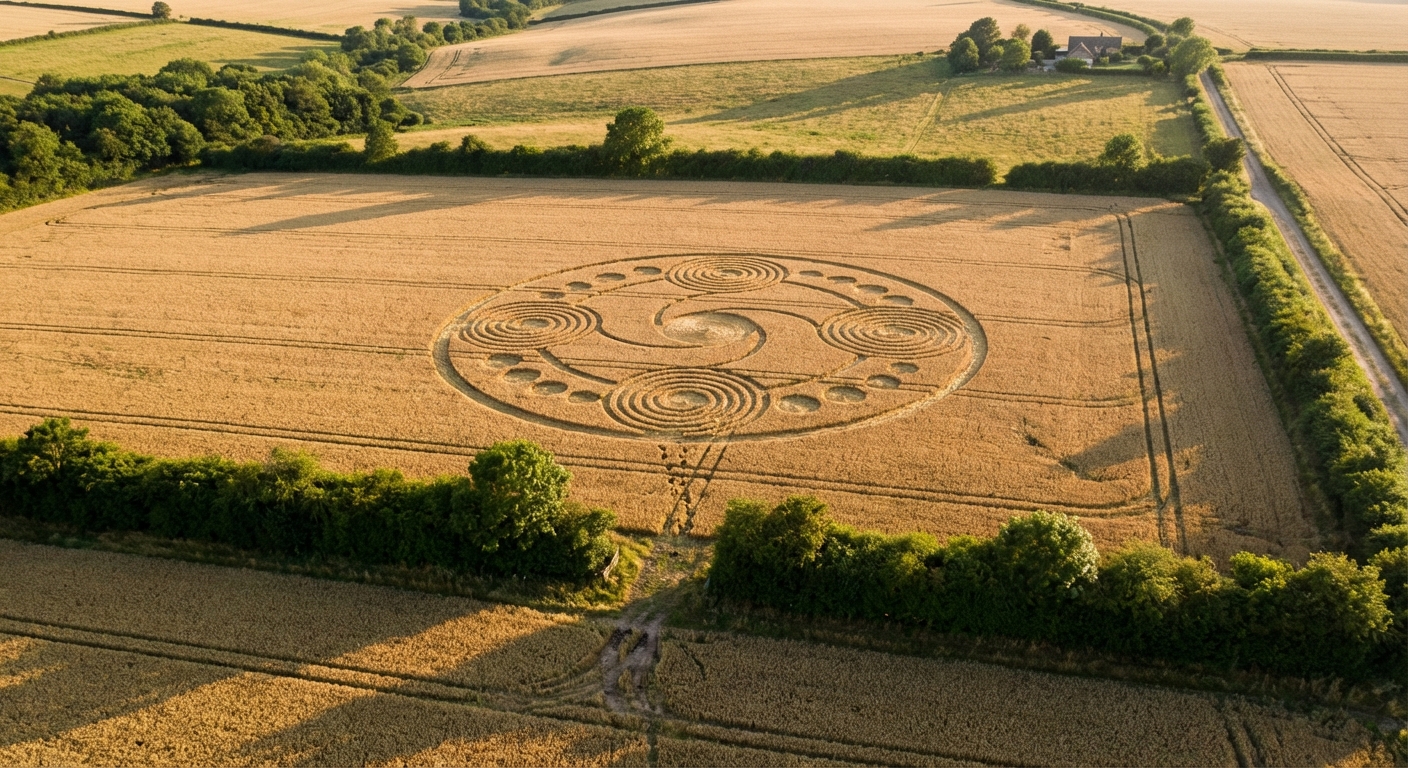
Intro: The items below summarize the main arguments supporters of the claim “Crop Circles: Hoax vs Unknown” typically cite. These are arguments people cite, not proof; each entry identifies the claim, the type of source it comes from, and straightforward ways to test or falsify it. The goal is to separate documented facts from disputed or unproven inferences.
The strongest arguments people cite
-
Claim: Early, high-profile confessions show modern crop circles were started by human hoaxers (therefore many formations are man-made). Source type: contemporaneous journalist interviews and press reports (confessions by Doug Bower and Dave Chorley). Verification test: check primary press coverage, contemporaneous photos, and later demonstrable recreations by the confessors or others.
Documentation & where it comes from: The 1991 media coverage reporting that Doug Bower and Dave Chorley publicly admitted creating many of the English formations is widely archived in press reports and retrospective journalism. These confessions were followed by demonstrations and later reporting about how simple tools can produce round and some complex patterns.
-
Claim: Skilled human teams can and have produced highly complex pictograms; this shows humans can make nearly any observed pattern. Source type: artist/hoaxer admissions, documented demonstrations (Circlemakers and related crews), television/film demonstrations. Verification test: documented daytime/nighttime demonstrations, video/photographs showing construction, and admission or commissioning records.
Documentation & where it comes from: Land-art collectives and self-described circlemakers have published photos, accounts and participated in filmed demonstrations (including a documented daytime demo and multiple commissioned pieces), demonstrating that complex designs can be planned and executed in hours. Circlemakers’ own records and media pieces document these demonstrations.
-
Claim: Laboratory and field plant-anomaly studies show changes in nodes, elongation, or cell structure inside some formations inconsistent with mechanical trampling. Source type: laboratory analyses and small research reports (e.g., W. C. Levengood’s studies). Verification test: independent, double-blind replication of measurements, pre/post-harvest sampling, and controls for trampling, moisture, and heat exposure.
Documentation & where it comes from: Researchers such as W. C. Levengood published analyses reporting anatomical differences in plants taken from inside some formations; those papers and reports are available in specialist journals and reports. However, major critiques in the skeptical literature point to methodological weaknesses (lack of double-blind controls, selection bias, and failure to replicate).
-
Claim: Measured electromagnetic or magnetic anomalies have been reported in some formations, implying a non-human physical cause. Source type: field surveys and researcher claims (for example, work reported by Colin Andrews and others). Verification test: independent instrumentation surveys with blind protocols, pre- and post-formation baseline readings, cross-checks for local geologic/magnetizable objects and instrument error.
Documentation & where it comes from: Field researchers have reported magnetic signatures or anomalous instrument readings in limited surveys; these claims are reported in specialty outlets and in media coverage of researcher statements. Independent replication and explanation that rules out mundane causes has not been established in mainstream science.
-
Claim: Eyewitness reports of lights, orbs, or unusual sounds near formations support a non-human or atmospheric origin. Source type: first-person witness reports and photographic/video stills. Verification test: contemporaneous, multi-sensor recording (video, audio, radar, independent witnesses), geo-timestamped evidence, and follow-up investigation of possible human activity or environmental sources.
Documentation & where it comes from: Multiple witness reports of lights or sounds appear in historical and modern accounts; some media stories have shown photos of lights near fields. Such reports are suggestive but are susceptible to misinterpretation, photographic artifacts, and retrospective embellishment. Independent, tightly documented multi-sensor events linking lights to formation genesis remain absent from mainstream, peer-reviewed records.
-
Claim: Historical references (e.g., the 17th-century “Mowing-Devil” woodcut and other old accounts) imply crop formations predate modern hoaxers. Source type: historical pamphlets, anecdotes, and archival references. Verification test: examine primary historical texts, evaluate whether accounts describe flattened versus cut stems, and consider alternative explanations (folk tales, misinterpretations).
Documentation & where it comes from: Several historical references are frequently cited as precedents for circular crop damage, but many describe cut or burned stalks rather than the flattened, intricately laid stems typical of modern formations; historians caution against treating anecdotal or single-source accounts as direct evidence for identical phenomena.
How these arguments change when checked
1) Confessions and media demonstrations: The 1991 confessions by Bower and Chorley and subsequent press coverage undermined claims that every modern formation required exotic explanations. Those admissions, together with multiple later demonstrations showing how teams produce complex designs, shift the burden: any claim that a particular formation is non-human now requires strong, independently verifiable evidence that the specific formation could not have been produced by known human techniques.
2) Demonstrations of human capability do not automatically disprove every anomalous claim. A documented human-made formation proves people can make that design, but it does not by itself invalidate reports of plant anomalies or anomalous lights in other cases. It does, however, increase the prior plausibility that many or most formations are human-made and raises the evidentiary standard for claiming an unknown origin.
3) Laboratory plant-anomaly studies show mixed results when inspected for methodology. Some proponents point to node elongation, seed-germination differences, or cellular changes as markers of a non-mechanical influence, but independent critiques emphasize lack of double-blind protocols, small sample sizes, and potential confounds (water, heat, trampling technique). Until independent teams replicate the results with rigorous controls, these lab reports remain contested evidence, not conclusive proof.
4) Field-measured electromagnetic or magnetic anomalies are intriguing but unsettled. Small surveys and instrument readings have been reported by proponents; mainstream scientific outlets note that such measurements can be influenced by geology, local metal objects (fences, vehicles), instrument calibration, or sampling bias. Independent, preregistered survey protocols and replication are rare, so these findings remain provisional.
5) Eyewitness reports and historical anecdotes are useful as leads but weak as standalone proof. Human perception and memory are fallible; camera artifacts and retrospective storytelling can amplify ambiguous events. Stronger claims require contemporaneous, multi-instrument records and careful chain-of-custody documentation of samples.
6) Recent legal and policing context changes the practical picture but not the scientific question of origin. Local authorities (for example, Wiltshire Police) emphasize that creating formations without landowner permission is criminal damage and can lead to arrests, which documents that at least some formations are deliberate human acts with legal consequences. That institutional documentation does not by itself address disputed cases where no human authorship is demonstrated.
Evidence score (and what it means)
- Evidence score: 35 / 100
- Drivers of the score:
- Strong, well-documented admissions and repeatable human demonstrations meaningfully document human capability (lowers the bar for a human-origin explanation).
- Several peer-reviewed or formally published small studies (e.g., plant-anatomy reports) exist but have not been independently replicated under double-blind protocols.
- Field-survey claims of magnetic/electromagnetic anomalies and eyewitness lights are intermittently reported but lack consistent, independently verified multi-sensor documentation.
- Primary documentary evidence that would unambiguously require a non-human explanation (e.g., instrumented formation events with video, radar, and blind lab replication) is absent from mainstream scientific literature.
- Local policing and legal records document human-made damage and prosecutions, supporting the position that at least many formations are human-made.
Evidence score is not probability:
The score reflects how strong the documentation is, not how likely the claim is to be true.
This article is for informational and analytical purposes and does not constitute legal, medical, investment, or purchasing advice.
FAQ
Are crop circles hoaxes or unknown phenomena?
Short answer: both claims exist in public debate. The best-documented fact is that many modern formations have been made deliberately by people (confessions, demonstrations, commissioned pieces). Claims that particular formations are of unknown origin rely largely on small-sample field reports or contested lab studies; these have not met the standard of reproducible, independently verified science.
What evidence would convincingly show a crop circle is not human-made?
Convincing evidence would include contemporaneous multi-instrument records (video, audio, radar, independent witnesses), a verified absence of human activity (footprints, tool marks, access evidence), chain-of-custody for samples, and independent replication of any claimed plant or soil anomalies under blinded laboratory conditions. Until that standard is met for a specific formation, claims of unknown origin remain unproven.
Do plant-anomaly studies (like Levengood’s) prove a non-human cause?
Not by themselves. Levengood and others reported anatomical differences in plants from some formations, but critics have pointed out methodological shortcomings (selection bias, lack of double-blind protocols, small samples) and a lack of independent replication. Such studies are a data point worth further, rigorous study — not conclusive proof.
How should a reader evaluate a new, dramatic crop-circle claim they see online?
Ask who collected the evidence and how: Are there contemporaneous multi-angle videos? Were measurements collected blind and with calibrated instruments? Is there chain-of-custody for physical samples? Has independent replication been attempted? Claims relying on anecdotes, single instruments, or unreplicated lab work deserve skepticism pending independent verification.
Can landowners press charges if someone makes a circle on their field?
Yes. Police in areas where crop circles commonly appear have advised landowners that unauthorized creation can be treated as criminal damage; recent local notices emphasize reporting and that crop-circle creation without permission can have legal consequences. This is evidence about human activity and its impacts, not about origins of every formation.

Science explainer who tackles space, engineering, and ‘physics says no’ claims calmly.