
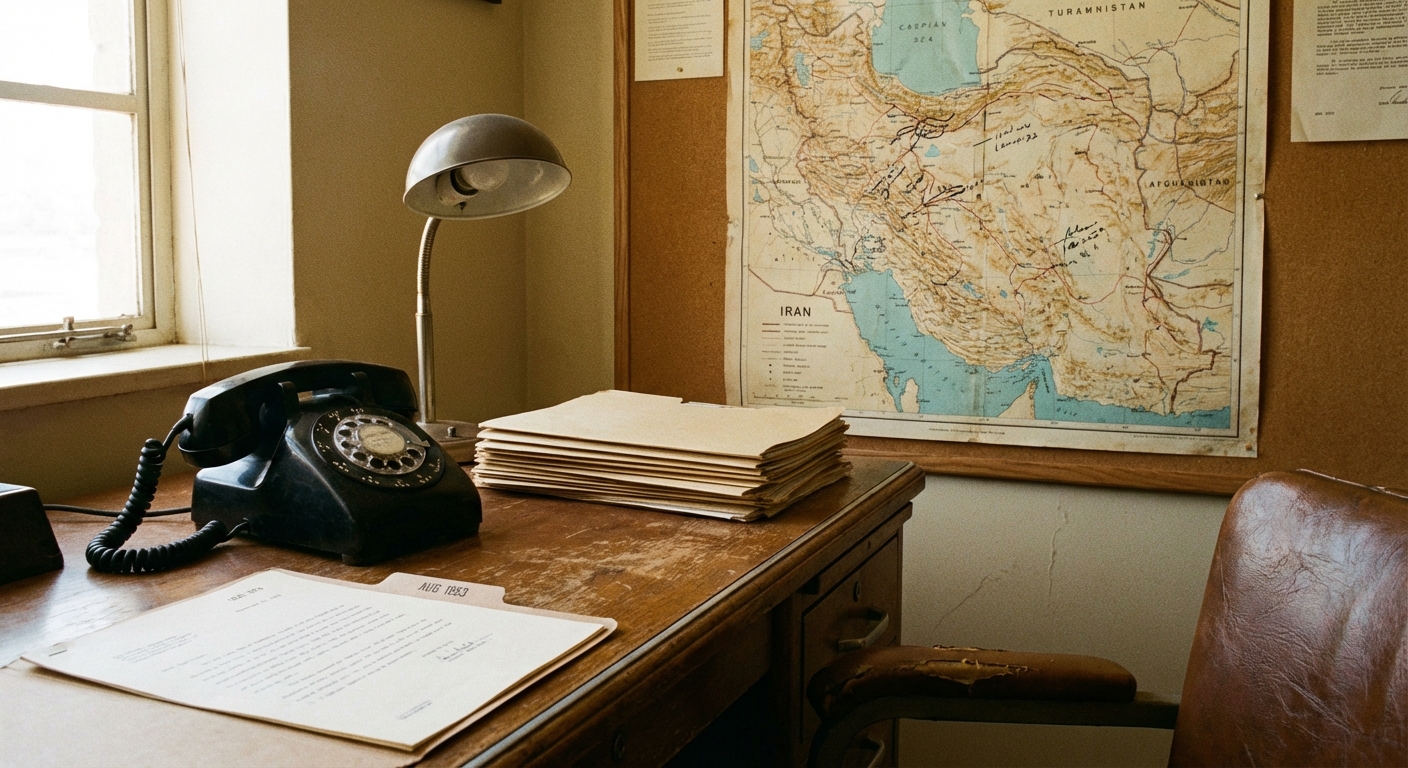
Intro: the items below summarize arguments people cite to support the claim that Operation Ajax (1953 Iran Coup) was orchestrated by Western intelligence; these are arguments people cite, not proof. Each entry notes the type of source invoked and a practical test a reader or researcher can use to verify or contest the argument.
The strongest arguments people cite about Operation Ajax (1953 Iran Coup)
-
Claim: Declassified CIA documents describe a planned covert operation codenamed TPAJAX (Operation Ajax) that sought to remove Prime Minister Mohammad Mosaddegh. Source type: declassified government files and an internal CIA history (often cited from the National Security Archive and FRUS releases). Verification test: read the CIA internal history excerpts and the FRUS volume sections titled “Planning and Implementation of Operation TPAJAX” for the operational description and objectives.
-
Claim: The CIA orchestrated street protests, paid agents, and used propaganda and bribery to influence Iranian political actors — including documentation that paid street-level operatives and used agitators to create unrest. Source type: CIA operational summaries, journalist reconstructions drawing on those documents, and contemporary press accounts. Verification test: check the National Security Archive document collection and contemporary AP/BBC accounts that summarize the declassified materials.
-
Claim: Kermit Roosevelt Jr. and other CIA operatives played direct roles in implementation. Source type: memoirs, contemporary reporting, and later historical reconstructions (books such as Stephen Kinzer’s narrative history). Verification test: compare Roosevelt’s memoirs and contemporary CIA references with secondary histories and publisher materials to isolate first-person claims versus documentary confirmation.
-
Claim: Britain worked in tandem with the U.S. because of oil interests and prior British covert actions; some MI6 planning was known as Operation Boot. Source type: British diplomatic history, contemporary British press, and references in U.S. foreign-policy records. Verification test: consult British archival releases and summaries in FRUS and National Security Archive materials for references to British involvement.
-
Claim: The U.S. State Department’s Foreign Relations series contains operational cables, NSC materials, and documents that tie senior U.S. officials to the decision to proceed. Source type: official government documentary series (FRUS, Office of the Historian). Verification test: read the FRUS Iran 1951–1954 volume (documents 169–308 cover planning and implementation).
-
Claim: Some original CIA operational cables were later destroyed or are missing, creating evidence gaps that complicate reconstruction. Source type: admissions or findings in government historiography and scholarly notes (FRUS preface, Federation of American Scientists summaries). Verification test: review FRUS editorial notes and the FAS summaries that reference missing original cables and the fact that some material was destroyed.
-
Claim: Public acknowledgments by U.S. officials and by the CIA (including later statements and the agency’s own historical summaries or public remarks) tacitly confirm a major U.S. role. Source type: public statements, agency podcasts, presidential speeches, and press coverage. Verification test: locate the CIA’s public historical statements, the 2013 declassification wave reported by major media, and subsequent agency/commentary acknowledgements.
-
Claim: Scholarly reconstructions tie Operation Ajax to long-term political consequences (strengthened Shah, repression, and a role in the 1979 revolution). Source type: academic books and peer-reviewed history. Verification test: consult peer-reviewed history, diplomatic studies, and assessments in major reference works (Britannica, academic monographs).
How these arguments change when checked
When researchers follow the verification tests above, a pattern emerges: many of the broad claims people cite are anchored in primary-source material, but important details are debated, incomplete, or rely on secondary syntheses. Below are common outcomes when each argument is checked against primary and high-quality secondary sources.
-
Declassified U.S. documents clearly show the existence of a CIA covert action codenamed TPAJAX and planning materials describing goals to remove Mosaddegh; these are well documented in FRUS and National Security Archive releases. That establishes documentary evidence for U.S. covert activity. However, how that activity maps onto day-by-day causation in Tehran can still be disputed.
-
Claims about specific techniques (paid mobs, bribery of officials, use of propaganda) have documentary traces and multiple corroborating secondary sources, but some original operational cables or complete operational logs are missing or were destroyed, so the full chain of custody and the scale of some payments are not always fully documented. This gap is explicitly noted in FRUS and related summaries.
-
Attribution of initiative and motive is contested among scholars: some emphasize British oil interests and direct MI6 prompting, others emphasize Cold War anti-communist concerns driving U.S. policymakers. Both motives appear in the documentary record, and historians differ on which was primary. Where sources conflict, we report the conflict rather than choose a single inference.
-
First-person memoirs and narrative histories (e.g., Kermit Roosevelt accounts, Stephen Kinzer’s synthesis) are valuable but must be cross-checked with archival documents; memoirs sometimes overstate personal roles or rely on imperfect memory. Use them as leads that point to archival material rather than as sole proof.
-
Official public acknowledgments (press releases, agency summaries, presidential remarks) confirm high-level U.S. involvement in a covert program aimed at changing Iran’s government, but they rarely provide exhaustive operational detail. Independent archival documentation is the stronger evidentiary anchor where available.
This section has cited government archives, the FRUS documentary series, major journalism, and established historians to show which parts of the claim rest on documentary records and which parts depend on inference or partial records. Where sources conflict, scholars explicitly note disagreement rather than treat every claim as settled.
Evidence score (and what it means)
- Evidence score: 80/100
- Drivers for this score:
- Strong primary-source documentation: FRUS volumes and declassified CIA histories provide direct documentary evidence of U.S. covert planning (raises score).
- Multiple independent secondary accounts (major journalism, academic histories) corroborate the general outlines (raises score).
- Missing or destroyed original CIA operational cables and incomplete British archival access leave gaps on specific operational details and exact causal chains (lowers score).
- Some reliance on memoirs and later reconstructions introduces potential memory bias and narrative shaping (lowers score).
- Clear official acknowledgments by U.S. sources of a CIA-directed covert action bolster the documentary foundation (raises score).
Evidence score is not probability:
The score reflects how strong the documentation is, not how likely the claim is to be true.
This article is for informational and analytical purposes and does not constitute legal, medical, investment, or purchasing advice.
FAQ
Was Operation Ajax (1953 Iran coup) actually engineered by the CIA?
Short answer: the documentary record shows the CIA planned and supported a covert operation codenamed TPAJAX and participated in actions aimed at ousting Prime Minister Mosaddegh; those documents are published in FRUS and in National Security Archive collections. However, exact operational details, some cable-level evidence, and the full sequence of in-country events are incompletely documented because some original operational records are missing or were destroyed. Researchers therefore rely on a mix of official records, contemporaneous reporting, and later memoirs to construct the account.
What are the best primary sources if I want to verify the arguments myself?
Start with the U.S. Department of State’s FRUS volume “Iran, 1951–1954” (documents covering planning and implementation of TPAJAX), then review the National Security Archive’s posted documents and OCR transcriptions of CIA histories and memos. Complement those with contemporary press coverage from major outlets summarized in archives. These are the most direct documentary starting points.
Do historians agree on how much the U.K. influenced the operation?
No — historians generally agree Britain played a significant role in instigating Western concern (largely over oil) and that MI6 had its own operation called Operation Boot, but scholars debate the balance between British prompting and U.S. initiative. Both British and American motives appear in the documentary record; the weight assigned to each motive differs by scholar. Where they disagree, reputable academic sources and government records are cited so readers can review the specific documents.
Why do some details remain disputed or unclear?
Several factors: some original CIA operational cables are missing or were destroyed; British archival access is more limited for some MI6 files; memoirs can be self-serving or fallible; and street-level chaotic events are inherently difficult to attribute precisely in the absence of a complete operational log. Scholars explicitly report these limitations in FRUS prefaces and in methodological notes.
Where can I read a balanced narrative synthesis?
For narrative synthesis grounded in archival research, look to mainstream historical treatments and investigative journalism that cite primary documents — for example, Stephen Kinzer’s All the Shah’s Men for a readable synthesis, and the FRUS/National Security Archive materials for the documentary record underpinning that synthesis. Compare synthesis works to the primary documents to see where authors interpret evidence versus where documents speak directly.

Geopolitics & security writer who keeps things neutral and emphasizes verified records over speculation.