
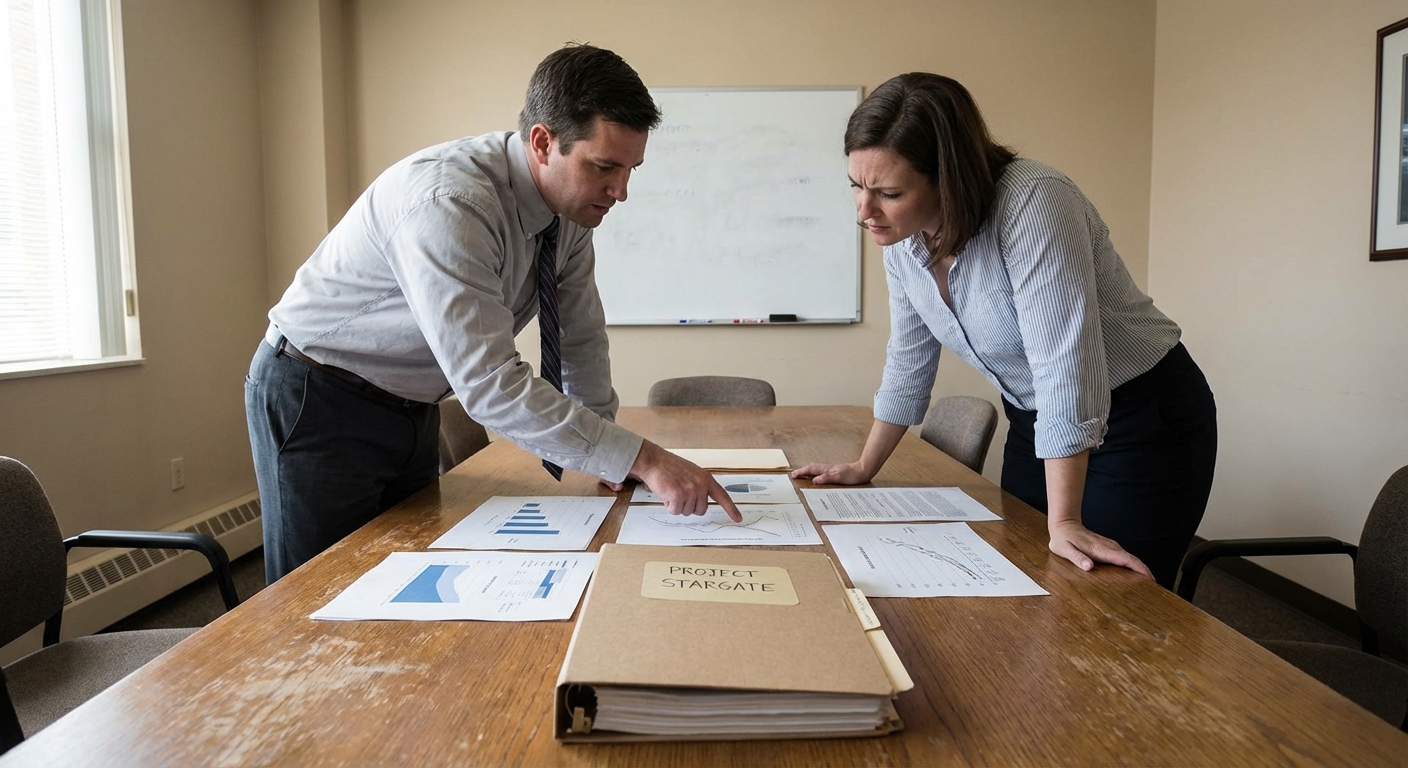
Below are the strongest arguments people cite in support of the claim that Project Stargate (psychic spying) produced useful intelligence. These are presented as arguments supporters use, not as proven fact; each entry lists the claim, the type of source it comes from, and a simple test a reader could apply to evaluate it against the declassified record.
This article treats the subject strictly as a claim and does not assume its truth. Where available, primary government reports and contemporaneous documentation are cited so readers can check the original material themselves.
This article is for informational and analytical purposes and does not constitute legal, medical, investment, or purchasing advice.
The strongest arguments people cite
-
Claim: Project Stargate produced statistically significant laboratory results suggesting remote viewing exists.
Source type: Government-commissioned evaluation of the program’s research literature (American Institutes for Research / AIR, 1995).
Verification test: Check the AIR report’s executive summary and the section summarizing statistical assessments (the AIR report cites differing expert reviews on the same datasets).Notes and sources: The AIR report documents that some laboratory experiments showed statistical effects, and it includes expert reviews that disagree about how to interpret those effects.
-
Claim: Certain remote viewers produced striking “hits” (for example, sketches or descriptions matching classified targets like facilities or equipment).
Source type: Internal program memos, operational tasking reports, and memoirs by program participants (declassified files and later personal accounts).
Verification test: Compare alleged hit examples to the contemporaneous operational tasking files and independent third-party evaluations to rule out post-hoc matching, cueing or selective reporting.Notes and sources: Many session transcripts and sketches are part of the declassified collection (archived by the CIA and mirrored by public archives). The program record preserves session notes that supporters point to as examples. Independent reviewers flagged concerns about possible cues and selective reporting around some high-profile “hits.”
-
Claim: Senior program staff and some members of the intelligence community treated certain remote-viewing results as plausible enough to discuss at high levels (implying operational value).
Source type: Internal correspondence, funding records, and Congressional/appropriations mentions that authorized continued support.
Verification test: Inspect budgetary records, tasking memoranda, and interagency correspondence to see whether results were acted upon or merely discussed.Notes and sources: The program received funding across multiple decades and passed through several sponsorship channels (DIA, Army INSCOM, then CIA review). Congressional attention and intermittent funding indicate institutional interest; however, the official 1995 review concluded no case where remote viewing had produced actionable intelligence.
-
Claim: Independent-looking statistical analyses found effects and support the reality of anomalous cognition (notably by some statisticians associated with program review).
Source type: Expert-statistician assessments included in the AIR evaluation and subsequent academic commentary.
Verification test: Read the full expert appendices and check methodological critiques (e.g., whether multiple comparisons, experimenter bias, or inadequate controls explain the effect sizes).Notes and sources: The AIR report includes competing expert reviews (for example, Jessica Utts argued the statistical evidence was sufficient to show anomalous effects while Ray Hyman cautioned that methodological flaws undermined operational claims). The two reviewers produced conflicting conclusions in the same evaluation.
-
Claim: Declassified archives (thousands of pages) prove the program ran real operations and list concrete operational taskings (e.g., locating weapons, identifying facilities).
Source type: Declassified program archives and document collections mirrored by independent repositories.
Verification test: Consult the official CIA declassified collection and trustworthy mirrors to see the taskings, results, and any subsequent internal assessments about operational value.Notes and sources: The CIA’s declassified Stargate collection and public mirrors (e.g., Black Vault, FAS) contain the raw files often cited by proponents; those files show taskings and session notes but do not, by themselves, prove that any tasking produced validated, actionable intelligence.
-
Claim: Prominent project participants (memoirs and interviews by remote viewers) have testified to operational successes, which supports the claim the program worked.
Source type: Memoirs and later interviews by participants (e.g., Joseph McMoneagle, other former viewers).
Verification test: Cross-check participant claims against the contemporaneous declassified files, and check whether third-party operational records corroborate any claimed successes.Notes and sources: Personal memoirs describe perceived successes; program documents show tasking and positive subjective assessments in some cases, but reviewers warned subjective recollection and selective memory can inflate perceived success.
How these arguments change when checked
Summary: When supporters’ strongest arguments are checked against primary documents and independent expert reviews, the picture becomes mixed and contested rather than straightforwardly confirmatory. The AIR evaluation—commissioned by the CIA—explicitly records both that some controlled experiments produced statistical effects and that the program never produced documented, actionable intelligence for operations. That dual finding is the central source of the tension between proponents and skeptics.
What changes in practice when you apply the verification tests above:
-
Laboratory effects vs operational utility: The AIR report and its expert reviewers distinguish between laboratory statistical anomalies and battlefield/intelligence utility. A statistically significant outcome in a constrained lab task is not the same as producing reliable, timely, and verifiable operational intelligence. The program’s declassified operational files show taskings and session notes, but the AIR review concluded it never furnished usable intelligence that guided operations.
-
Selective ‘hits’ and post-hoc matching: Many of the most-cited “striking” cases rely on retrospective matching of a viewer’s vague description to a target after the fact. Independent reviewers highlighted the risk of cues, selective reporting, and confirmation bias: the declassified record contains examples that are easy to reinterpret as “hits,” but contemporaneous controls and blind replication were often insufficient.
-
Disagreement among experts: The AIR evaluation included competing expert assessments—chiefly Jessica Utts (who found statistical evidence of anomalous effects in lab data) and Ray Hyman (who emphasized methodological problems and the lack of operational usefulness). Because both evaluations are recorded within the same government review, readers can see the precise points of agreement and disagreement. This conflict reduces the force of a single-sided claim that the program ‘proved’ psychic spying.
-
Institutional interest ≠ validated capability: Long-term funding and internal discussion show institutional interest, but the official recommendation after the AIR review was to terminate the program because the documentation did not support continued operational use. So funding history is evidence of interest and experiment, not of proven capability.
Evidence score (and what it means)
Evidence score is not probability:
The score reflects how strong the documentation is, not how likely the claim is to be true.
- Evidence score (0–100): 42
- Driver 1 — Primary documentation exists: Large declassified archives, internal memos, and a formal government evaluation (AIR, 1995) provide high-quality primary sources that can be inspected directly.
- Driver 2 — Mixed expert assessments: The same government review recorded conflicting expert conclusions (notably Utts vs Hyman), which weakens any single interpretive claim.
- Driver 3 — Methodological concerns: Independent critiques and methodological caveats (possible cueing, selective reporting, weak operational controls) lower confidence in the claim that results demonstrate a reliable psychic spying capability.
- Driver 4 — Lack of documented operational success: The AIR report concluded there was no documented case where remote viewing produced actionable intelligence used in decision-making, which reduces the program’s operational credibility.
- Driver 5 — First-hand positive accounts exist but are subjective: Memoirs and participant interviews document perceived successes but require cross-checking against contemporaneous files to exclude bias or hindsight matching.
FAQ
Q: Did Project Stargate (psychic spying) ever produce confirmed intelligence used by US agencies?
A: The formal government evaluation (AIR, 1995) concluded that no remote-viewing report was shown to have provided actionable intelligence that guided US operations. The declassified archive contains taskings and session notes, but the evaluators did not find a documented case of operational success that met standard intelligence validation.
Q: Does the declassified record prove remote viewing works?
A: The declassified record documents experiments and taskings and includes some laboratory experiments with statistically significant outcomes according to certain analyses. However, expert reviewers disagreed about whether those outcomes were due to flaws, bias, or genuine anomalous cognition. The available documentation therefore supports the claim that experiments produced curious statistical results, not the stronger claim that remote viewing is a validated intelligence tool.
Q: Who wrote the most-important official review and what did they conclude?
A: The American Institutes for Research produced a government-commissioned evaluation in 1995. The report records that while some lab results showed statistical effects, reviewers were uncertain whether methodological problems could account for those results; the AIR final recommendation led to program termination because it had not been shown to be useful operationally. The report includes both pro-interpretation and critical expert reviews.
Q: What should someone do if they want to verify a specific “hit” cited by proponents?
A: Locate the exact session transcript or tasking record in the declassified archive, then check (1) whether the target was defined in advance and kept blind to the viewer, (2) whether third-party records corroborate the alleged match, and (3) whether the match survives tests that guard against hindsight matching and cueing. Public mirrors and the CIA FOIA collection provide most of the primary files proponents cite.
Q: What is the best short reading list to understand the disagreement?
A: Read (1) the AIR 1995 evaluation (for the official government summary and the competing expert reviews), (2) critical methodological analyses such as Ray Hyman’s reviews, and (3) primary session files in the declassified archive to see the raw material. These three layers let you compare documentation, interpretation, and raw sessions directly.

Geopolitics & security writer who keeps things neutral and emphasizes verified records over speculation.