
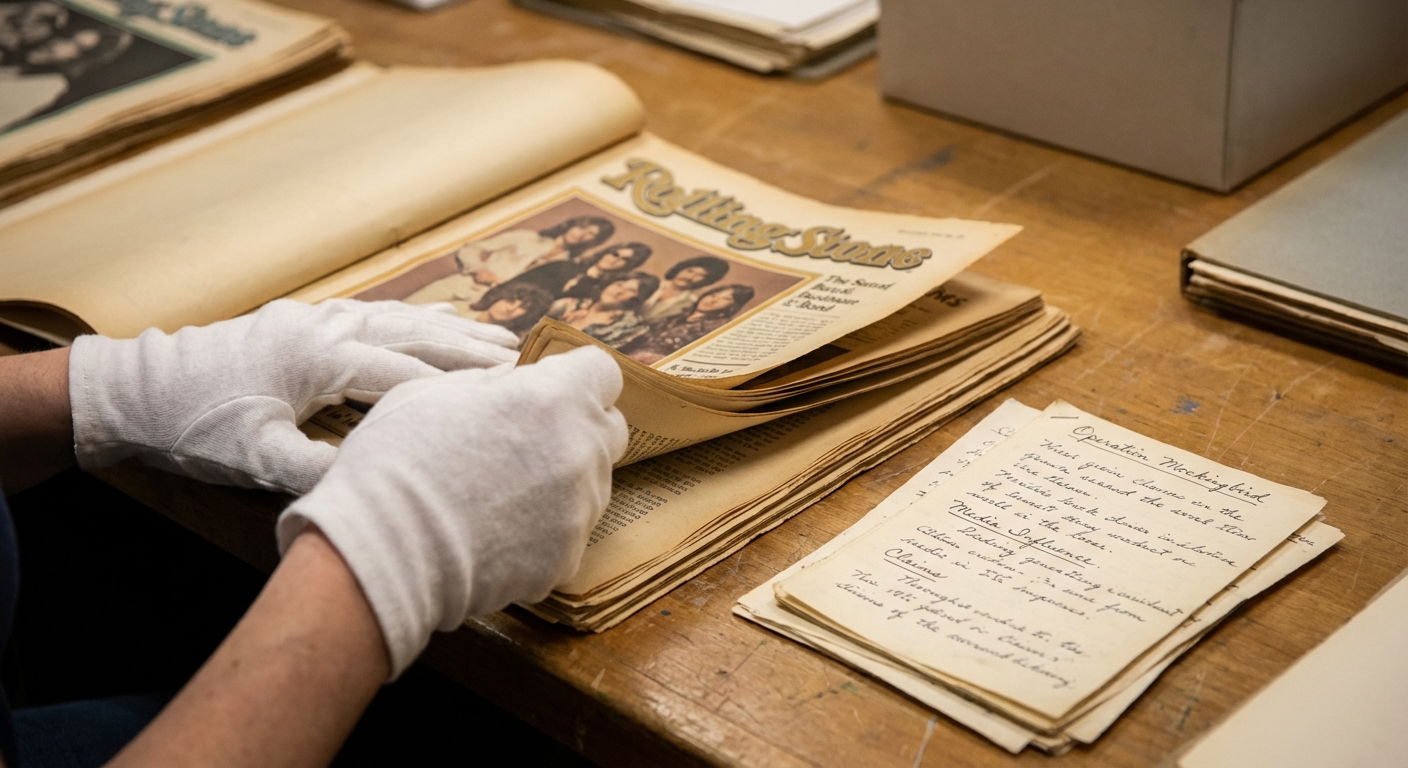
Intro: The items below summarize and analyze the strongest arguments people cite in support of the claim commonly called “Operation Mockingbird” — specifically, allegations that the CIA ran or coordinated broad influence operations inside U.S. and foreign news media. This article treats those as arguments made by supporters of the claim, not as settled facts, and it offers tests and citations you can use to verify or refute each argument. The phrase “Operation Mockingbird media influence claims” is used here as the search-style descriptor for the subject under review.
This article is for informational and analytical purposes and does not constitute legal, medical, investment, or purchasing advice.
The strongest arguments people cite
-
Argument: Congressional investigations in the 1970s found secret CIA ties to journalists and private organizations, which supporters say proves an organized program to influence news coverage.
Source type: U.S. Senate Select Committee (the “Church Committee”) final report and related Congressional materials.
Verification test: Read the committee’s public report sections describing contacts and review the committee’s appendices for descriptions of relationships and recommended policies.Why it matters: The Church Committee documented CIA relationships with non-governmental organizations and reported that journalists had secret contacts with the Agency; the committee’s final report is a primary government source for those findings.
-
Argument: Internal CIA files (the “Family Jewels”) include an entry named “Project MOCKINGBIRD” and reference wiretaps of journalists, which supporters interpret as direct documentary evidence of an operation to surveil and influence reporters.
Source type: Declassified CIA internal memoranda and the Family Jewels compendium (FOIA releases).
Verification test: Inspect the Family Jewels entry text and metadata; compare dates, scope, and the specific activities described in that entry to the broader claims supporters make about a long-running media-control program.Why it matters: The Family Jewels is a primary CIA document listing activities later judged to have “flap potential”; it explicitly names a Project MOCKINGBIRD entry describing wiretaps of two journalists in 1963, which is direct documentation of at least one domestic operation involving journalists. Supporters extrapolate from this to a larger pattern.
-
Argument: Investigative reporting (most prominently Carl Bernstein’s 1977 Rolling Stone piece) claimed the CIA used hundreds of journalists or media contacts to perform assignments or pass information to the Agency.
Source type: Long-form investigative journalism based on interviews and document review.
Verification test: Compare Bernstein’s named examples and sourcing notes to primary records (employment, government memos, internal communications, or institution-level disclosures) and check whether the named journalists or employers acknowledged institutional arrangements.Why it matters: Bernstein’s article is widely cited because it assembled interviews and contemporaneous reporting; it put a high number (“400+”) into wide circulation, but parts of it rest on individual interviews and claims that are difficult to fully corroborate in public archives.
-
Argument: Named CIA officers and vocabulary used inside the Agency (for example, Frank Wisner’s reported reference to a “Mighty Wurlitzer”) imply a deliberate public-relations and influence effort that could include media placement.
Source type: Memoirs, internal oral histories, and secondary histories citing Agency officials.
Verification test: Locate the original quote or memo, confirm context (e.g., whether the term described paid press relations, cultural programs, or a metaphor for influence), and cross-check with contemporaneous operational directives.Why it matters: Quotations attributed to senior CIA figures have been used to describe the Agency’s intent and approach; some are corroborated in multiple secondary sources while other attributions are contested or paraphrased. See reporting and histories that discuss the “Mighty Wurlitzer” as a metaphor for influence operations.
-
Argument: Concrete examples — such as CIA funding of front groups (e.g., National Student Association funding reported by Ramparts) and the use of overseas media relationships — are cited as practical mechanisms the CIA used to shape narratives internationally and domestically.
Source type: Contemporary investigative magazine reporting, subsequent Congressional inquiry findings, and historical studies.
Verification test: Read the original Ramparts reporting and cross-reference with Church Committee findings and later FOIA-released documents about funding channels and front organizations.Why it matters: Documented cases of CIA funding for organizations with media reach are often used to illustrate mechanism-level plausibility for larger influence claims. The Ramparts revelations and Church Committee follow-ups are primary anchors for these examples.
How these arguments change when checked
When each of the items above is tested against original or primary sources, three general patterns emerge:
-
Documented contacts and programs: The CIA’s Family Jewels and the Church Committee report document that the Agency had domestic activities involving journalists, wiretaps, and relationships with private organizations. Those specific facts are documented in primary-source government records. Readers should treat those discrete findings as established documentation rather than unsubstantiated rumor.
-
Extrapolation vs. direct documentation: Supporters often extrapolate from documented incidents (e.g., wiretapping entry, individual journalist relationships) to a claim of a single coherent, long-running program named “Operation Mockingbird” that systematically controlled major U.S. media. That larger, programmatic claim is not uniformly documented in a single authoritative internal Agency directive or blueprint in the public record; much of the extended narrative relies on secondary accounts, memoirs, investigative synthesis, and inference. Some items (e.g., the Family Jewels reference to “Project MOCKINGBIRD”) document specific activities but do not on their face prove the broad organizational narrative some supporters assert.
-
Disputed numbers and generalizations: Figures widely quoted in popular accounts—most notably the claim that the CIA “used more than 400 journalists”—come from investigative journalism that combined interviews and documents, and these figures have been disputed or remain difficult to fully corroborate with public records. Where large numbers are cited, they often reflect interview-based aggregation rather than a single definitive roster in released documents. Readers should therefore treat such head-count claims as claims that require further documentary verification.
-
Institutional policy changes show a response: After the 1970s disclosures, the CIA and U.S. government adopted restrictions on direct relationships with accredited journalists and changed policies on how media contacts were handled. These post-disclosure policy actions are documented and indicate the government treated the issue as serious. However, policy changes do not, by themselves, prove the scale of earlier activity alleged by some advocates of the full “Operation Mockingbird” narrative.
Evidence score (and what it means)
- Evidence score: 50 / 100
- Drivers of the score:
- Primary documentation (Family Jewels, Church Committee reports) establishes discrete Agency activities involving journalists and organizations — a strong documentation base for some specific incidents.
- Investigative journalism (e.g., Carl Bernstein) and memoirs provide persuasive narrative detail but rely in part on interviews and sources not always fully verifiable in public archives.
- There is no single, fully declassified CIA directive or file in the public record that unambiguously documents a comprehensive, long-running program labeled exactly as the popular “Operation Mockingbird” mythos often describes; available documents support some elements but do not fully substantiate broad, centralized control of major domestic media.
- Post-disclosure policy changes and public admissions increase the credibility that problematic contacts occurred; they do not resolve disagreements over scale or structure.
- Some secondary accounts (books and later popular summaries) contain errors or rely on contested sources, which lowers confidence in sweeping claims based on those works alone.
Evidence score is not probability:
The score reflects how strong the documentation is, not how likely the claim is to be true.
FAQ
Q: What exactly are the “Operation Mockingbird media influence claims”?
A: The phrase refers to claims that the CIA ran a coordinated program (commonly called “Operation Mockingbird”) to recruit journalists, place stories, or otherwise control media narratives domestically and abroad. The claim bundle ranges from specific documented activities (wiretaps, individual relationships) to broader assertions of systematic control of major news organizations. Primary government documents confirm some activities but do not uniformly support every extrapolation made by proponents of the broadest versions of the claim.
Q: Did the Church Committee prove that the CIA “controlled” major U.S. newspapers?
A: The Church Committee documented that the CIA maintained relationships with journalists and organizations and that some journalists had secret contacts with the Agency; it did not produce a single declassified internal order showing full institutional control over major newspapers. That report is an authoritative primary source for contacts and abuses, but its findings are not identical to the stronger claim that the Agency controlled editorial content across major newsrooms.
Q: Is the frequently-cited figure of “400 journalists” in any authoritative government document?
A: The “400” figure is most closely associated with Carl Bernstein’s 1977 Rolling Stone article, which drew on interviews and secondary documents; it is not a number that appears as a single, verified roster in the Church Committee volumes or in declassified CIA lists. The figure is influential in public conversation but should be treated as an interview-based claim that requires document-level corroboration for each named case.
Q: How can a reader test specific allegations about named journalists or outlets?
A: Practical verification steps include: searching declassified CIA records (Family Jewels, CREST reading rooms, FOIA releases), checking Congressional reports (Church Committee volumes), looking for contemporaneous internal memos or payroll records when available, reviewing journalist memoirs and employer disclosures, and seeking corroboration from independent archives (university or newspaper special collections). When a named case lacks documentary corroboration, treat it as an unproven allegation rather than an established fact.
Q: Where do modern references to “Operation Mockingbird” come from?
A: The popular label “Operation Mockingbird” was popularized in the late 1970s and beyond by secondary accounts and books (for example, Deborah Davis’s 1979 biography of Katharine Graham used the name in a way that helped popularize it). The Family Jewels document used the label “Project MOCKINGBIRD” for a specific 1963 wiretapping entry, but that single label in a document does not, on its face, validate the broad programmatic narrative often associated with the phrase in popular discourse. Researchers should distinguish the Family Jewels’ Project MOCKINGBIRD entry from later extrapolations that use the same name as shorthand for a much larger alleged effort.
If sources conflict: The available primary documents (Family Jewels, Church Committee) and investigative journalism (Bernstein and others) sometimes point in different directions on scale and structure. That conflict is explicit in the public record: primary documents show specific questionable activities, while later narratives claim broader institutional programs. Where evidence conflicts or is incomplete, this article stops and reports the conflict rather than speculating beyond published records.

Geopolitics & security writer who keeps things neutral and emphasizes verified records over speculation.