
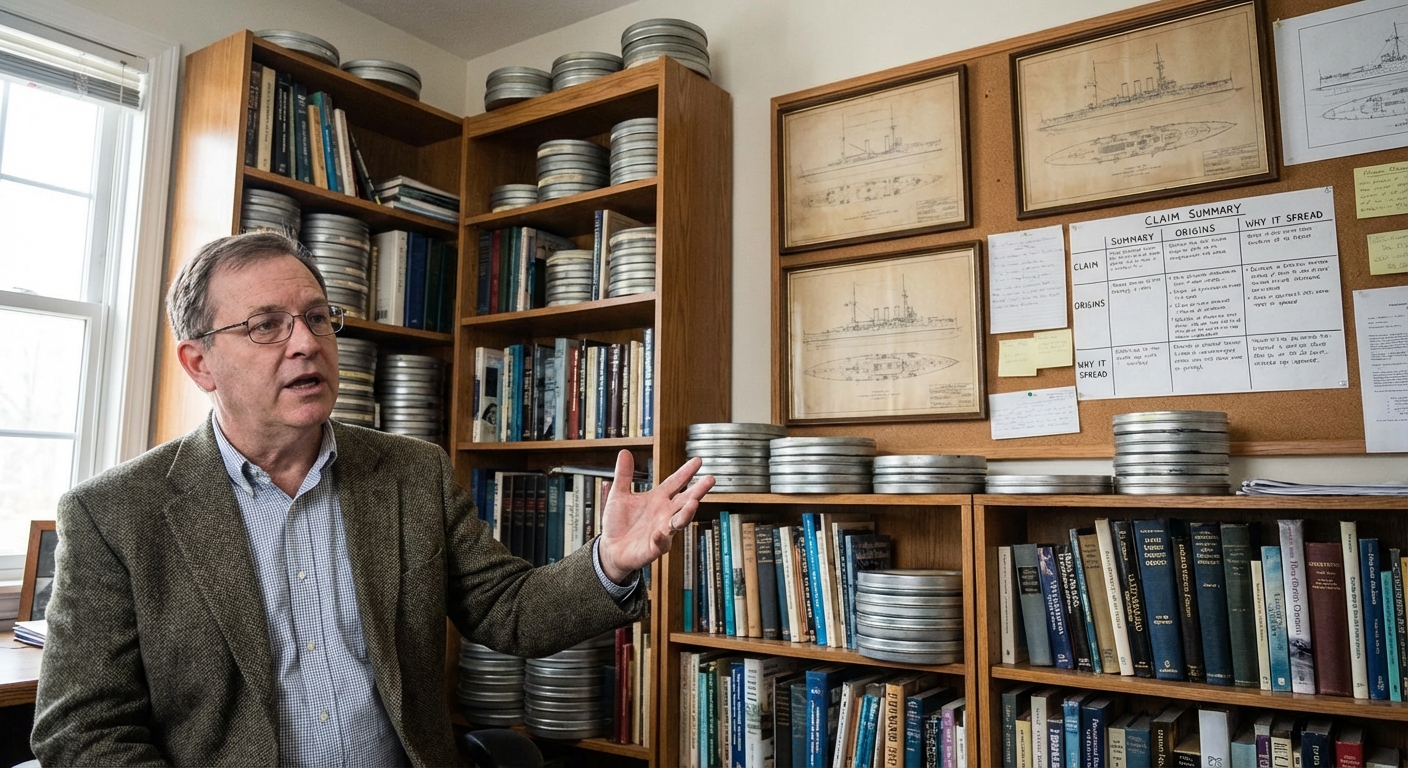
The Philadelphia Experiment claims describe an alleged World War II–era U.S. Navy effort that made a warship invisible and (in some versions) teleported it between ports. This overview treats the Philadelphia Experiment as a claim: it summarizes how the story originated, what documentary records and official responses exist, which parts are supported by evidence, and which parts are inferred or contradicted. The label “Philadelphia Experiment claims” is used throughout as shorthand for the set of allegations tied to the USS Eldridge and related narratives.
What the claim says
The core Philadelphia Experiment claims hold that, around October 1943, U.S. Navy researchers attempted to render a destroyer escort invisible to observers or radar; in dramatic versions the ship briefly vanished from Philadelphia and reappeared in Norfolk, Virginia, then returned, with extreme physiological effects reported among the crew (disorientation, insanity, fusion with the ship’s structure). Variants add time-travel, human experimentation, or a wide-ranging cover-up. These claims circulate in books, articles, and film adaptations and have been a persistent part of UFO and conspiracy subcultures.
Where it came from and why it spread
Origin: The narrative traces to letters and annotations received in the mid-1950s by UFO author Morris K. Jessup from a man using names including “Carlos Miguel Allende” and Carl M. Allen. Allen claimed to be an eyewitness and sent a heavily annotated copy of Jessup’s book to the Office of Naval Research; those annotations and subsequent letters are the seed documents for later retellings. Researchers who investigated the correspondence later identified Carl M. Allen as the likely author of the letters.
Popularization: The story reached wider audiences after the 1979 book by William L. Moore and Charles Berlitz and then film and TV adaptations. These retellings amplified sensational details, sometimes combining different versions of the story and speculative material (for example, connections to alleged unified-field physics or Montauk narratives). The combination of dramatic claims, a few ambiguous primary documents, and mass-media amplification helped the story spread.
Institutional reaction: The Navy and associated historians have repeatedly denied that any invisibility/teleportation experiment occurred. The Office of Naval Research has stated it never conducted investigations that would produce the claimed effects and noted the ONR itself was established after the wartime period cited in some accounts. Veterans who served on USS Eldridge and the ship’s official logs have also been cited in denials or as contradicting key timeline claims. These official positions and documentary records are a major reason mainstream historians treat the tale as a hoax or misinterpretation.
What is documented vs what is inferred
- Documented (stronger support): The existence of the letters/annotations sent to Morris Jessup and their reprinting (the so-called Varo edition) is well-documented in contemporary sources and later research; Carl M. Allen (also known as Carlos Miguel Allende) is a verifiable figure who promoted the story. The USS Eldridge’s service record and deck logs are preserved in naval records and show locations and dates that conflict with some versions of the claim. The Navy has publicly disavowed the extraordinary elements of the story.
- Plausible but unproven / inferred: Routine wartime experiments such as degaussing (reducing a ship’s magnetic signature) and tests of onboard electrical equipment did occur in the era and may have produced unusual visual phenomena (corona discharges, sparks, or St. Elmo’s Fire) that could be misremembered or embellished. Some researchers argue that misinterpreted degaussing or generator tests helped seed the more extraordinary accounts. These inferences bridge documented wartime activities and the later fantastical narrative, but they do not validate the core invisibility/teleportation claims.
- Contradicted or unsupported: Claims that USS Eldridge disappeared from Philadelphia and teleported to Norfolk in October 1943 are contradicted by the ship’s documented movement and deck logs, as well as statements from veterans. Assertions that the Navy performed unified-field physics experiments producing invisibility, teleportation, or time travel have no credible documentary support and conflict with established physics and archival records.
Common misunderstandings
- Confusing routine degaussing or electrical tests with the sensational claims: degaussing had clear wartime purposes (magnetic-mine protection), and electrical generators can create visible discharges; neither implies invisibility or teleportation.
- Treating later sensational retellings as primary evidence: popular books and films often mixed hearsay and speculation without producing supporting primary documents; they cannot substitute for ship logs, action reports, or contemporaneous official records.
- Assuming denial equals cover-up: official denial is not proof of absence by itself, but where archival records (deck logs, action reports) and multiple veterans’ recollections align with the denial, the balance of documentary evidence contradicts the extraordinary claim. Where records are missing or ambiguous, that gap should be noted without assuming conspiracy.
Evidence score (and what it means)
- Evidence score: 18/100
- Drivers of the score:
- 1. Primary seed documents exist (Allende/Allen letters and the annotated Varo edition), which explain why the story originated and spread, but those documents are testimonial and uncorroborated for the most extraordinary claims.
- 2. Official naval records (deck logs, DANFS entries) and veteran statements contradict key timeline and location elements of the claim.
- 3. No credible primary technical documentation or contemporaneous wartime records support experiments producing invisibility, teleportation, or the described physical effects on crew.
- 4. Later books and media amplified unproven elements; those are secondary sources that mixed speculation with dramatization.
- 5. Some plausible alternative explanations (degaussing, generator corona effects, misremembering) fit portions of the story but do not substantiate the extraordinary parts.
Evidence score is not probability:
The score reflects how strong the documentation is, not how likely the claim is to be true.
This article is for informational and analytical purposes and does not constitute legal, medical, investment, or purchasing advice.
What we still don’t know
Several details about how and why versions of the story gained traction remain partly unsettled. Researchers agree the Allende/Jessup correspondence is the proximate origin, but questions remain about the motivations and mental state of the originator, the exact chain by which the annotated Varo edition was circulated, and the role of later authors who may have conflated or embellished separate anecdotes. Archival gaps and the informal nature of eyewitness letters mean some interpretive room remains; however, a lack of contemporaneous technical reports or credible corroborating testimony for invisibility/teleportation is a significant absence. Where sources conflict, the conflicts are reported rather than reconciled here.
FAQ
Q: What evidence supports the Philadelphia Experiment claims?
A: The main primary materials are the letters and annotated copy of Morris K. Jessup’s book sent by Carl M. Allen (also known as Carlos Allende) and later secondary treatments by authors like Moore and Berlitz. These materials document the claim’s existence and early circulation but do not independently verify the extraordinary physical events they describe.
Q: Did the U.S. Navy confirm the Philadelphia Experiment?
A: No. The Office of Naval Research and naval historical sources have stated they have no record of experiments achieving invisibility or teleportation; the ship’s logs and veterans’ accounts do not support the timeline of the most dramatic versions. That institutional response and the archival records are key reasons mainstream historians reject the literal claim.
Q: Could wartime degaussing or generator tests explain the stories?
A: Yes—plausible, routine wartime technical activities such as degaussing (to reduce magnetic signatures) and generator tests can produce visual or sensory phenomena that might be misremembered or exaggerated. Scholars and naval personnel have identified these as likely seeds of the legend, but they do not produce invisibility or teleportation as claimed.
Q: Why did the story keep spreading despite denials?
A: The narrative combined sensational elements (invisibility, teleportation, secret science) with a few ambiguous primary documents and gaps that invite speculation. Media retellings, books, and films amplified dramatic details; social and cognitive factors—such as the appeal of mysteries, confirmation bias, and the tendency to interpret official denial as cover-up—helped the story persist. Researchers who examined both the documents and naval records emphasize that amplification, not new evidence, largely drove the story’s longevity.
Q: What’s the best way to read future claims about the Philadelphia Experiment claims?
A: Treat extraordinary assertions with a hierarchy of evidence: contemporaneous official records, multiple independent eyewitnesses documented near the time of events, and verifiable technical documentation rank highest. Later retellings, single-source eyewitness letters, and dramatic media adaptations require corroboration before being taken as historical fact. Where records conflict, prioritize primary archives and statements from people with direct, documented involvement.

Science explainer who tackles space, engineering, and ‘physics says no’ claims calmly.