
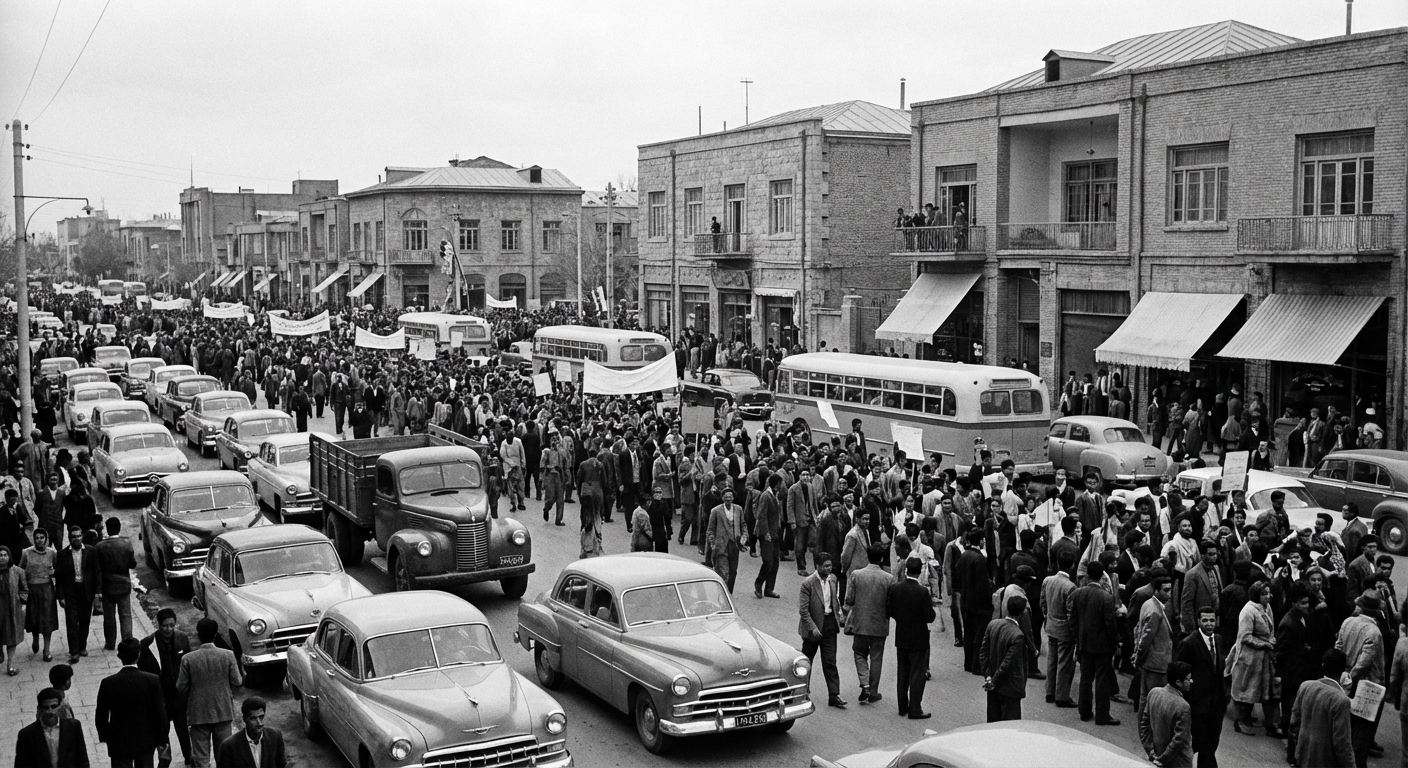
This article examines the claim commonly called “Operation Ajax (1953 Iran Coup)” — namely, that U.S. and British intelligence agencies planned and executed the removal of Iran’s prime minister in August 1953. The piece treats the subject as a claim to be tested: it summarizes the claim, traces where it originated and spread, and reviews what primary documents and reputable histories actually show. Where sources conflict, those disagreements are noted and not resolved beyond what the evidence supports.
What the claim says
The broad claim: that a covert operation (often referred to as “Operation Ajax” or TPAJAX) was a U.S.- and British-directed effort to overthrow Iran’s democratically elected prime minister Mohammad Mosaddegh in August 1953, using propaganda, bribery, organized demonstrations, and cooperation with local military and political figures to remove him from power. Variants of the claim add different emphases — for example, that the CIA “masterminded” the coup single-handedly, that Britain led the plan, or that the operation used large-scale false-flag violence — and those variants have different levels of documentary support.
Where it came from and why it spread
Origins: Contemporary reporting, memoirs of participants, scholarly histories, and later declassified government records all contributed to the claim’s emergence. British and American press reporting and the memoirs of some participants (for example, Kermit Roosevelt Jr.) put aspects of a covert operation on the public record decades ago; later releases of CIA internal histories and Freedom of Information Act material provided direct documentary references to a planned CIA project coded TPAJAX. Prominent books and journalism (e.g., Stephen Kinzer, James Risen, and National Security Archive releases) amplified the narrative and made it widely known to the public.
Why it spread: the 1953 coup touches longstanding public concerns—foreign intervention, control of oil resources, Cold War politics—and it became a touchstone in political discourse inside Iran and internationally. Periodic declassifications (notably a substantial National Security Archive posting and related CIA FOIA releases in the 2000s–2010s) renewed attention and gave journalists and historians fresh material, accelerating the claim’s circulation.
What is documented vs what is inferred
What is documented (strong primary/secondary support):
- That a coup removed Prime Minister Mohammad Mosaddegh and that the decisive events occurred in mid-August 1953 (often dated 19 August, also referred to in Iran as the 28 Mordad 1332 event). This date and outcome are well documented in contemporary reporting and later histories.
- That the United States used the cryptonym TP‑AJAX (TP = Iran in CIA country prefix) in internal planning documents, and that a mid‑1970s CIA internal history states the military coup “was carried out under CIA direction as an act of U.S. foreign policy.” This language appears in declassified CIA material made public or posted by the National Security Archive. Those documents are central to the claim’s documentary basis.
- That Britain pursued parallel initiatives and applied pressure to protect Anglo‑Iranian oil interests; British planning material and scholarly accounts document UK involvement and its motive to regain leverage after Iran nationalized oil. Many historians cite British proposals and communications requesting U.S. cooperation.
What is plausible but inferred (supported by some documents or testimony but not fully proven):
- Precise operational responsibility for every on‑the‑ground action (for example, which faction organized specific street clashes or who paid particular individuals) is sometimes attributed to CIA or MI6 in secondary accounts; some documentary traces show payments and contacts, but full attribution of every act is partially inferred from fragments of records and memoirs. Scholars differ about how central specific CIA officers (notably Kermit Roosevelt Jr.) were to each step.
- The extent to which the coup outcome was the result of long‑range planning versus contingent events and local actors acting of their own accord. Declassified documents show planning and interventions, but some historians argue the final success depended heavily on unplanned dynamics inside Iran. Both interpretations are present in reputable literature.
What is contradicted or unsupported by strong evidence:
- Claims that invent extensive conspiratorial detail with specific attributions (e.g., precise lists of who ordered which killing, or that a single memo proves total control) are not supported by the released documents. Many primary documents are fragmentary or redacted and cannot bear such detailed claims. Where scholarship disagrees, the disagreement is usually about interpretation of partial records rather than discovery of new documentary proof.
Common misunderstandings
- “The CIA admitted everything, so nothing is disputed.” Not true — the CIA materials acknowledge a central role, but historians continue to debate the scale of direct operational control versus the role of Iranian actors and contingency. The documentation strengthens the proposition that the U.S. participated, but it leaves important operational details unresolved.
- “Only the U.S. was involved.” This overlooks sustained UK interest and MI6 activity documented in British sources and discussed in secondary literature; many accounts describe joint motives and cooperation even if exact lead‑roles are contested.
- “Operation Ajax” was an official public program name in 1953. In CIA internal usage the cryptonym TPAJAX appears in documents; the popular label “Operation Ajax” is a later shorthand that entered public discourse via memoirs and histories. That nuance matters when reading primary records.
Evidence score (and what it means)
- Evidence score: 78/100.
- Score drivers:
- – Direct government records (declassified CIA/FOIA materials) explicitly reference TPAJAX and describe CIA-directed covert activity; these are strong primary sources.
- – Independent archival scholarship (National Security Archive) has collated and published contemporaneous cables, planning documents, and memos supporting a coordinated effort.
- – Multiple reputable historians and journalists have corroborated core elements using memoirs, diplomatic records, and archival research, increasing confidence in the central claim.
- – Significant redactions, missing telegrams, destroyed files, and reliance on participant memoirs introduce uncertainties about operational details and exact chains of command. These gaps prevent a higher score.
- – Conflicting interpretations among scholars about the degree of agency exercised by U.S. operatives versus Iranian actors keeps some aspects contested.
Evidence score is not probability:
The score reflects how strong the documentation is, not how likely the claim is to be true.
This article is for informational and analytical purposes and does not constitute legal, medical, investment, or purchasing advice.
What we still don’t know
Key unresolved questions remain because significant records are still redacted, were destroyed, or are fragmentary. Examples include the full accounting of funds and exact recipients for some covert payments, complete internal MI6 files for the period (some remain closed or restricted), and certain first‑hand communications among on‑the‑ground Iranian actors that would clarify timing and initiative. Scholars continue to request fuller releases; until those records are available, some operational details will remain matters of reasoned inference rather than fully documented fact.
FAQ
Q: Does the documentary record prove the U.S. planned and executed the 1953 coup?
A: Declassified CIA materials and archival research show the agency planned and directed covert operations under the cryptonym TPAJAX and that the U.S. took active steps—propaganda, payments, and contacts—to overthrow Mosaddegh. Those primary documents provide strong evidence of U.S. involvement, but they do not fully document every operational detail or assign responsibility for every on‑the‑ground action.
Q: What was Britain’s role?
A: British government and intelligence agencies had both motive and documented activity: Britain sought to protect Anglo‑Iranian oil interests and engaged in planning and pressure that preceded and accompanied U.S. action. Published British files and scholarly accounts document that London pressed Washington to act and that MI6 conducted related operations, though some UK records remain less complete in public archives.
Q: Who was Kermit Roosevelt Jr. and how central was he?
A: Kermit Roosevelt Jr. was a CIA officer who led on‑the‑ground CIA efforts in Tehran according to memoirs and agency histories; he is a central figure in many accounts. Primary CIA histories and participant memoirs place him at the center of much planning and implementation, but historians debate how much credit should be ascribed to any single individual versus broader, contingent local dynamics.
Q: Why do some people dispute the CIA’s centrality in the coup?
A: Some historians argue the coup’s outcome depended heavily on Iranian political actors, street‑level dynamics, and chance events; they caution against over‑reading partisan memoirs or a limited set of documents. The debate is partly methodological: how to weigh fragmentary archives against memoirs and contemporaneous local actions. The disagreement does not deny involvement; rather, it questions the degree and exclusivity of control.
Q: Where can I read the primary documents cited here?
A: Key sources include declassified CIA documents posted via FOIA releases and the CIA reading room, and curated collections published by the National Security Archive. Secondary overviews and scholarly syntheses (e.g., major histories and reputable press investigations) can help interpret those primary records. Links to major document collections are provided in archival publications.

Geopolitics & security writer who keeps things neutral and emphasizes verified records over speculation.