
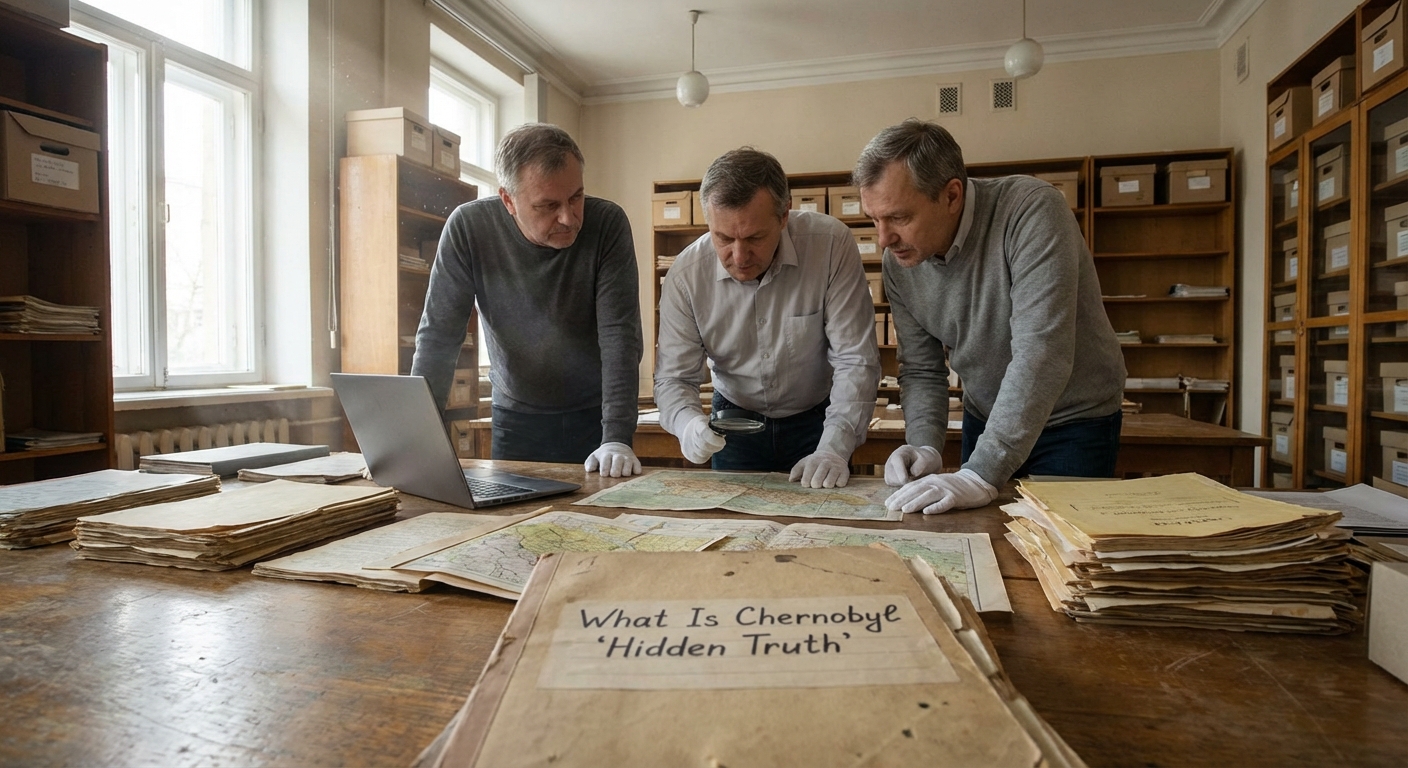
The phrase Chernobyl ‘Hidden Truth’ is used online to label a range of claims that the widely reported history and health findings about the 1986 Chernobyl disaster have been suppressed, deliberately misreported, or systematically understated. This article treats “Chernobyl ‘Hidden Truth'” strictly as a claim: it summarizes what people who use that label allege, traces origins and mechanisms of spread, and separates (a) what authoritative reports document, (b) what is plausible but not proven, and (c) what is contradicted or unsupported by available evidence.
What the claim says
Supporters of the Chernobyl ‘Hidden Truth’ narrative make several overlapping assertions. Common versions include: that official authorities (Soviet then post-Soviet and international bodies) have undercounted deaths and long-term health harm; that damaging environmental and genetic effects were concealed; and that powerful actors (governments, industry, international organizations) suppressed or distorted data to minimize perceived risk. Proponents often present dramatic figures — sometimes tens or hundreds of thousands of deaths — or invoke sensational stories of deformities and ongoing secret contamination. These statements are promoted in videos, podcasts, and conspiratorial websites that use the label “hidden truth” to signal suppressed information.
Chernobyl ‘Hidden Truth’ — where it came from and why it spread
Three historical and media factors help explain the origin and spread of the claim.
- Soviet-era secrecy and early confusion: In April–May 1986 the Soviet government did not immediately publish full technical details and there was limited independent reporting inside the closed Soviet system. That early opacity created a persistent narrative that information had been hidden, which conspiracy framings later amplified. Contemporary declassified documents and historical reviews show official message control and conflicting reporting in the immediate aftermath.
- Complex science and contested extrapolations: Radiation epidemiology involves dose estimates, latency, and statistical projection; different models and assumptions can produce widely different long-term death estimates. International reviews (for example by UNSCEAR, WHO, and the IAEA-led Chernobyl Forum) have produced lower long-term mortality projections for the most exposed groups than some activist or alarmist extrapolations — but they also note uncertainty and mental-health and social impacts. Disagreement over modeling and which populations to include has been a fertile ground for competing narratives.
- Modern social-media amplification and branding: Since the 2010s, many creators and channels package conspiracy-themed content using phrases like “Hidden Truth.” These productions and reposting networks (video platforms, alternative-hosting sites, podcasts) magnify claims that fit existing distrust narratives. Examples of modern channels using “Hidden Truth” branding exist across Rumble, podcast directories, and video-hosting platforms, showing how the label functions as attention-grabbing framing rather than an established scholarly term.
What is documented vs what is inferred
Below we separate well-documented findings from inferences or disputed interpretations.
Documented / verified (stronger evidence)
- The reactor explosion and fire occurred on 26 April 1986 at Reactor Unit 4, releasing substantial radioactive material over large parts of Europe; the basic timeline and mechanics are well-documented by technical investigations.
- Immediate casualties and acute radiation syndrome among first responders are recorded and reasonably well-documented: dozens of workers and emergency staff suffered ARS and several dozen died within months; epidemiological registries exist for many liquidators and evacuees.
- International assessments (the Chernobyl Forum including IAEA, WHO, UN partners, and national authorities) estimated that among the most exposed groups there could be a few thousand eventual radiation-related deaths, and they highlighted an especially elevated incidence of childhood thyroid cancers in affected areas. These reports also emphasize large psychosocial and economic harms.
Plausible but unproven (inference or contested)
- Large-scale projections that extend low-dose risk models across millions of Europeans to produce very high death counts depend heavily on model choice (e.g., linear no-threshold assumptions, population inclusion criteria) and are statistical projections rather than directly observed mortality. Such extrapolations are methodologically plausible but remain disputed; some NGOs and researchers report higher estimates while UN/IAEA/WHO consensus reports give lower numbers.
- Claims that authorities deliberately and continuously suppressed all data about environmental contamination and human harm after 1986 are not supported by the record that shows international investigations, published registries, and open scientific debate — though early Soviet opacity contributed to distrust. The claim of continuous, systematic concealment beyond the early post-accident period requires evidence beyond generalized mistrust.
Contradicted or unsupported
- Assertions of immediate or short-term fatalities numbering in the tens or hundreds of thousands (as if comparable to large-scale wartime mass casualties) are contradicted by contemporaneous medical records, international reviews, and post-accident registries. Peer-reviewed and international syntheses do not support those extreme immediate-death figures.
- Widespread claims about dramatic, visible “mutations” or monstrous deformities directly caused by Chernobyl at levels portrayed in popular sensational accounts lack corroboration from the medical literature; while some health effects (notably thyroid cancer in those exposed as children) increased and many social harms followed, dramatic mutation stories are anecdotal and unsupported at population scale.
Common misunderstandings
- Model projections vs observed deaths: Some reports give statistical projections of potential future cancer deaths in exposed cohorts; those projections are often misconstrued online as observed, already-occurred fatalities. Always check whether a cited number is an observed count or a modeled estimate.
- Local vs continental effects: High exposures were concentrated close to the plant and among first responders; many other areas received low trace fallout. Extrapolating localized high risks across all of Europe inflates apparent effect size.
- Secrecy does not equal permanent concealment: Initial Soviet information control and propaganda created mistrust. But the existence of later international studies, data sharing, and public registries shows that the situation is not one of perpetual global cover-up — though gaps and uncertainties in long-term surveillance remain.
Evidence score (and what it means)
- Evidence score: 45 / 100
- Drivers that lower the score: early information gaps and political propaganda created room for competing narratives; long-term low-dose effects are difficult to detect epidemiologically, producing model-driven differences; many online sources are unvetted and amplify unverified claims.
- Drivers that raise the score: substantial official documentation exists (incident reports, registries of liquidators and evacuees, IAEA/WHO/UN forum assessments, peer-reviewed studies of thyroid cancer increases), and many assertions in the “hidden truth” framing contradict those documented records.
- Evidence quality: mixed — strong documentary evidence on immediate events and some health outcomes; weaker, model-dependent evidence for broad, population-level mortality claims.
Evidence score is not probability:
The score reflects how strong the documentation is, not how likely the claim is to be true.
This article is for informational and analytical purposes and does not constitute legal, medical, investment, or purchasing advice.
What we still don’t know
- Exact long-term attributable mortality for low-dose, geographically dispersed exposures remains uncertain because projecting small increased risks across large populations depends on model choice and assumptions. High-quality, long-term cohort studies continue to refine estimates.
- The full psychosocial and socioeconomic legacy — how relocation, stigma, and disrupted healthcare influenced health outcomes indirectly — is documented as substantial but is complex to quantify and disentangle from direct radiation effects.
- Where credible archival material remains inaccessible or untranslated, specific local questions (for example particular workplace records from 1986) may still be resolvable only through archival research. In short: some details can be clarified further, but large claims require correspondingly strong new evidence.
FAQ
Q: What does “Chernobyl ‘Hidden Truth'” mean — is it an official term?
A: No. “Chernobyl ‘Hidden Truth'” is a media/conspiracy framing used by some creators and commentators to suggest suppressed facts. It is not an established academic or governmental label; scholarly and international reports use terms like “Chernobyl accident,” “Chernobyl Forum” or UNSCEAR analyses.
Q: Does authoritative science support the claim that tens of thousands died immediately from Chernobyl?
A: No. Contemporaneous medical records and later international assessments document dozens of immediate deaths from the explosion and ARS and a limited number of additional deaths among first responders; models projecting much higher immediate fatalities are not supported by the primary medical record. Long-term modeled excess deaths are a separate, contested issue.
Q: Why do different reports give very different numbers for long-term deaths?
A: Differences arise from methodology: which populations are included, how low-dose risk is modeled (e.g., linear no-threshold vs other dose-response assumptions), and whether projections are statistical estimates or observed counts. These methodological choices create wide ranges and public confusion.
Q: Is the “Chernobyl ‘Hidden Truth'” claim simply a product of modern misinformation platforms?
A: Modern social-media and alternative-hosting platforms amplify framings that promise suppressed knowledge. While some skepticism toward institutional reports is healthy, many “hidden truth” productions mix valid criticisms of early secrecy with speculative or exaggerated assertions that go beyond available evidence. Checking original reports (IAEA, WHO, UNSCEAR, peer-reviewed studies) helps evaluate specific claims.
Q: Where can readers find primary source material to check these claims themselves?
A: Helpful primary sources include IAEA and INSAG accident reviews, WHO and UNSCEAR health assessments, and the Chernobyl Forum reports — these documents present the consensus analyses and data registries used by many researchers. For historical context about early messaging, declassified diplomatic documents and contemporaneous press archives are useful.

Science explainer who tackles space, engineering, and ‘physics says no’ claims calmly.