
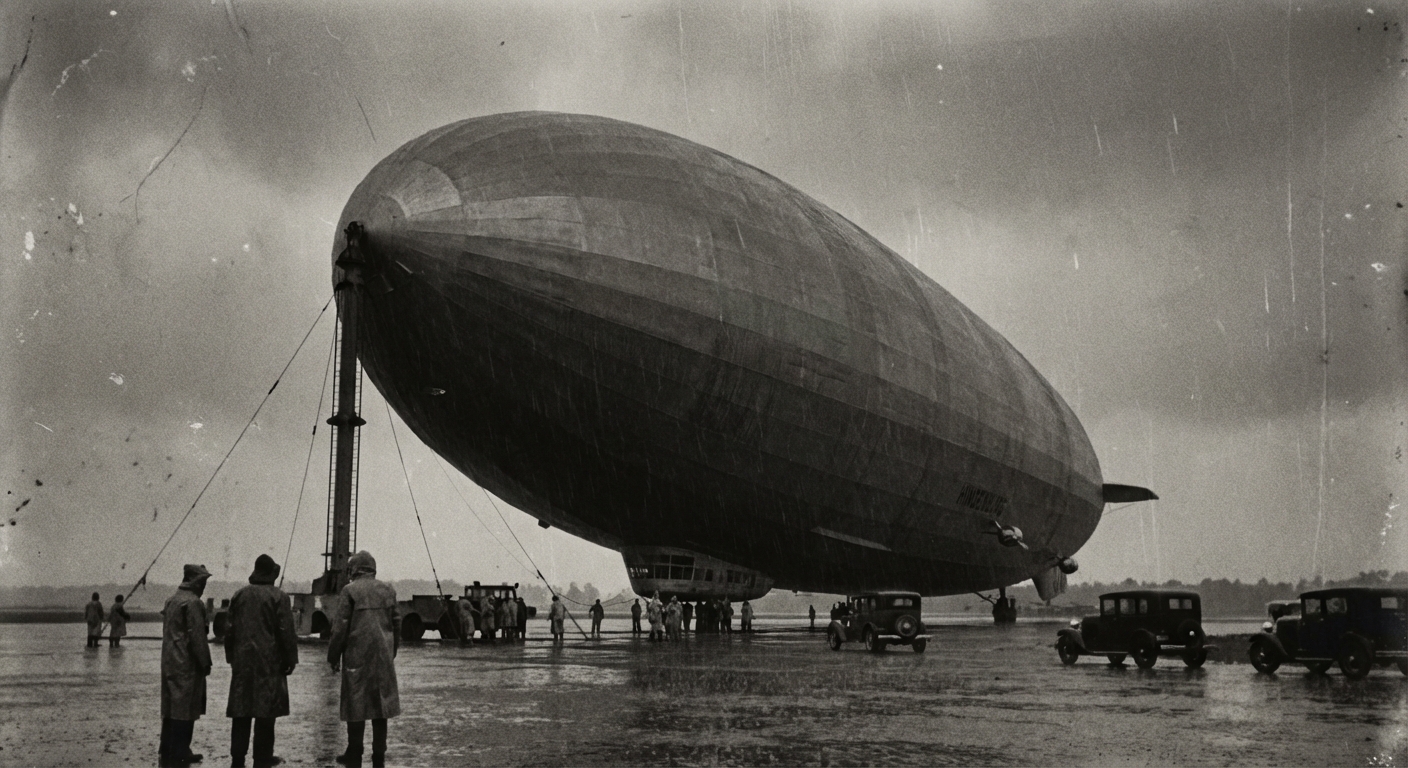
This article treats the assertion known as the “Hindenburg sabotage” claim as a claim — a contested explanation offered for the May 6, 1937 Hindenburg disaster — and examines what contemporary and later investigations actually documented, what remains inference or conjecture, and why the sabotage idea persisted in public discussion. Primary sources, later forensic work, and mainstream reporting are cited where available.
What the claim says
The Hindenburg sabotage claim proposes that the LZ-129 Hindenburg was deliberately set on fire (by an internal device, an incendiary placed on the hull, a shot, or other malicious action) rather than igniting accidentally through a leak and an electrical spark. Versions vary: some allege a planted bomb or incendiary device; others suggest an individual crew member or ground agent intentionally caused ignition. The claim is a historical hypothesis, not an established fact, and different versions carry different implied perpetrators and motives.
Where it came from and why it spread
Immediately after the crash, sabotage was one of several hypotheses raised publicly. High-profile figures associated with the Zeppelin program and some eyewitnesses initially mentioned the possibility of deliberate action, and early news coverage reported threats and speculation. Over time, books, films, and popular retellings amplified sabotage scenarios, while later authors proposed specific suspects and mechanisms. These threads kept the sabotage idea alive in popular culture well after official inquiries had reported their findings.
What is documented vs what is inferred
Documented (official investigations and widely supported findings):
- The U.S. Department of Commerce inquiry (1937–1938) concluded the fire began when a combustible mixture of hydrogen and air ignited near the aft gas cells; the report examined sabotage scenarios and found no conclusive evidence that sabotage produced the disaster.
- Both the U.S. and German contemporaneous inquiries treated the most plausible immediate mechanism as hydrogen leaking and being ignited by an electrical discharge or similar spark. The U.S. report discusses possible structural failure, leakage, and electrostatic ignition as leading explanations.
- Primary physical evidence from the wreckage was limited because much of the fabric and internal structure was consumed; investigators relied heavily on eyewitness testimony, film, photographs, and surviving fragments.
Inferred or disputed:
- Specific, credible physical traces directly demonstrating a planted explosive device or timed incendiary are absent from the official record; claims that such a device existed are therefore inferential or based on secondary accounts rather than a primary forensic chain-of-evidence.
- Theories that the fabric coating alone (the so-called “incendiary paint/dope” or thermite-like mixture) initiated and then powered the rapid spread of the fire have been proposed and tested by later researchers, but remain contested: some experimental work and commentators say the coating could have contributed, while other analyses and reconstructions argue hydrogen was the dominant fuel and that the coating alone could not explain the observed speed of destruction. Modern reconstructions (including televised experiments) generally conclude both hydrogen and coating may have played roles but that deliberate sabotage is not supported by available forensic evidence.
Common misunderstandings
- “No one considered sabotage” — False: sabotage was investigated and discussed at the time; it was considered by officials and by public figures connected to the airship community, but investigators reported no conclusive evidence for it.
- “The dope was rocket fuel and therefore the fire must have been sabotage” — Mischaracterizes the chemistry. Coatings contained aluminum powder and occasional iron-oxide pigments, but their measured compositions and application make a sustained thermite-style reaction unlikely without special conditions; proponents of the incendiary-paint idea (notably Addison Bain) reopened debate in the 1990s, but that hypothesis is disputed in peer critique and experimental replications.
- “Modern studies have proven sabotage” — Incorrect: recent analyses (including the 2021 NOVA investigation and laboratory reconstructions) have produced stronger mechanistic explanations for electrostatic ignition and hydrogen involvement, not proof of sabotage; where sources disagree, they conflict and do not converge on a sabotage verdict.
This article is for informational and analytical purposes and does not constitute legal, medical, investment, or purchasing advice.
Evidence score (and what it means)
- Evidence score: 28 / 100
- Drivers: contemporaneous official investigations found no conclusive evidence of sabotage but could not test all hypotheses because much of the physical evidence was destroyed.
- Drivers: later experimental and forensic work (including 21st‑century reconstructions) strengthens accidental-ignition explanations (electrostatic + hydrogen) while still leaving some uncertainty about rapid flame propagation.
- Drivers: specific claims of a planted device or definitive physical traces are unsupported in primary-source records; many sabotage narratives rely on inference, secondary claims, or disputed readings of partial evidence.
- Drivers: the incendiary-paint hypothesis introduced later experimental debate but has not produced consensus among materials scientists and accident investigators.
Evidence score is not probability:
The score reflects how strong the documentation is, not how likely the claim is to be true.
What we still don’t know
Key gaps remain. There is no unambiguous forensic trace proving a deliberate device or incendiary action, but also no complete physical reconstruction that reproduces every detail of eyewitness testimony and film under the exact 1937 conditions. Questions that remain include:
- Exactly where and how hydrogen first mixed with air in an ignitable ratio—and whether small structural damage, valve behavior, or handling during the rushed mooring contributed to that leak.
- Whether the fabric coating materially changed the timing or speed of flame spread in ways not fully captured by model experiments. Some tests show the coating could contribute; others argue it could not account for the observed rapid destruction alone.
- Why early eyewitnesses and some officials suspected sabotage—specifically which observations fueled that belief and whether any of those observations can now be reinterpreted in light of modern footage and experiments.
FAQ
Was sabotage ever proven in official investigations?
No. The U.S. Department of Commerce inquiry examined sabotage hypotheses (external and internal) and found no conclusive evidence that sabotage produced the disaster; the official reports favored ignition of leaked hydrogen by a spark as the most plausible mechanism given available evidence.
What is the strongest evidence cited by people who claim the Hindenburg was sabotaged?
Supporters of sabotage point to early suspicions, reported threats, some witness statements, and later secondary claims (books and anecdotal accounts) that identify possible saboteurs or suspicious substances. Those items are largely circumstantial or secondhand and have not produced a verifiable forensic chain proving deliberate ignition.
How do modern analyses affect the Hindenburg sabotage claim?
Modern footage and laboratory reconstructions (such as the investigations featured in NOVA) have strengthened accidental-ignition explanations — notably electrostatic discharge igniting leaked hydrogen — while not producing evidence of a deliberate device. These studies reduce the evidential weight of sabotage claims but do not supply absolute proof that sabotage did not occur; rather, they shift the balance of documented support toward accidental causes.
Could the fabric “dope” have caused or accelerated the fire?
The incendiary-paint/dope hypothesis argues the doped coating could ignite and accelerate fire spread. It has stimulated laboratory tests and debate: some experiments and commentators find it could have contributed to flame propagation, while others and peer reviewers point out compositional and application limits that make a thermite-like self-sustaining reaction unlikely. Consensus is lacking; the coating may have played a contributory role but is not established as definitive proof of sabotage.
Where can I read the original official investigation?
The U.S. Department of Commerce (Air Commerce Bulletin, 1937–1938) report on the Hindenburg accident is available in archival reproductions and is summarized by specialist sources that host the original text and selections; those primary transcripts remain the clearest record of the official findings and the questions investigators considered.

Science explainer who tackles space, engineering, and ‘physics says no’ claims calmly.