
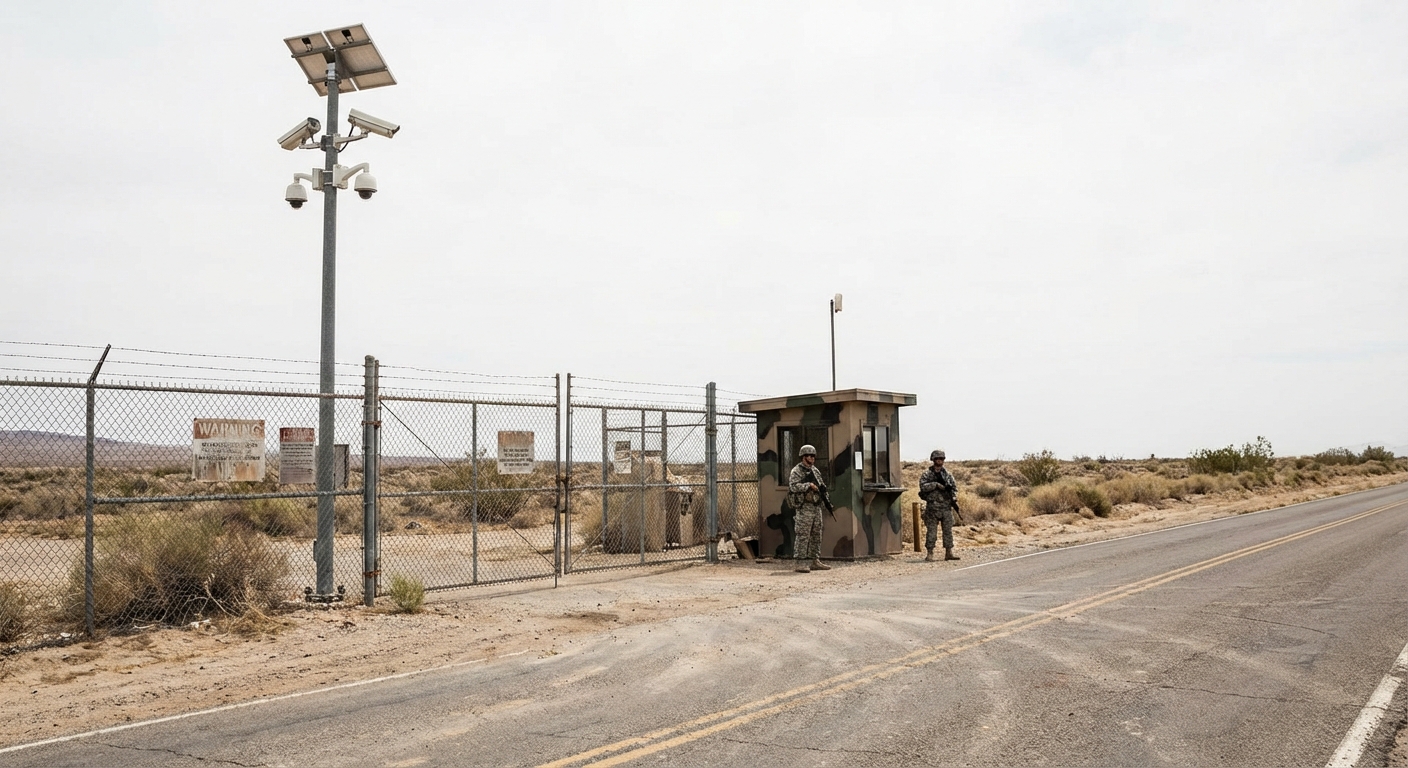
The claim that “Area 51” is the site of a government alien cover-up asserts that U.S. authorities store, study, or reverse-engineer extraterrestrial spacecraft and biological remains at the Groom Lake facility often called Area 51. This article treats that assertion as a claim and examines what is documented about the site, where the alien-cover-up story originated, how it spread, and what evidence supports or contradicts it.
What the claim says
The central claim — hereafter called the “Area 51 alien cover-up” claim — is that the U.S. government has recovered extraterrestrial vehicles and possibly corpses and keeps them at or near the Groom Lake test facility (commonly called Area 51) for study and reverse engineering. Variants assert multiple recovered craft, dedicated subterranean hangars, or a program of long-term concealment from the public and Congress. Proponents point to secrecy around the site, occasional reports from self‑identified insiders, and popular culture references as supporting context.
Where it came from and why it spread
Several documented threads contributed to the rise and persistence of the Area 51 alien-cover-up claim:
- Cold War secrecy and declassified testing programs: Government documents later declassified and reporting by investigative archives show Groom Lake was used to develop and test highly classified spy aircraft (U-2, A-12/Oxcart and later classified programs). The site’s secrecy and unusual flight activity fed public speculation.
- High-profile witness claims in the late 1980s: Public notoriety increased after a 1989 television interview in which an individual later identified as Bob Lazar said he had worked at a facility he called “S-4” near Groom Lake and described recovered non‑human craft and exotic propulsion concepts. That interview, and subsequent media appearances, brought the specific narrative of reverse-engineered alien vehicles into public view. Some local reporting and later investigations unearthed inconsistencies in Lazar’s résumé and employment claims.
- Internet culture and viral memes: Social media and meme culture amplified interest. A 2019 Facebook event, “Storm Area 51,” illustrated how jokes, viral posting, and mainstream news coverage can rapidly spread belief and attention around the idea that something secret and unusual is hidden at the site—even when the originators framed the event as satire.
- Pop culture and documentary media: Films, TV shows, podcasts, and documentaries have repeatedly referenced or showcased the alien-cover-up theme, increasing exposure and cross-pollinating claims between entertainment and purported eyewitness testimony.
What is documented vs what is inferred
Documented facts (what strong, primary sources or reputable reporting directly confirm):
- The U.S. government has long operated a highly classified testing range at Groom Lake (commonly known as Area 51) and used it for aircraft testing and development (U-2, Oxcart/A-12, and other black projects). This is supported by declassified CIA histories and reporting from major outlets.
- The site’s existence and location were formally acknowledged through declassified documents and public records releases beginning in the 1990s and more visibly in the 2013 restoration and release of CIA history material. Those documents describe the facility’s role in Cold War aerial reconnaissance programs.
- Publicized claims by specific individuals (for example, Bob Lazar’s 1989 interviews and later statements) are documented in contemporary broadcast records, transcripts, and subsequent interviews. Those claims are part of the public record.
Inferred or plausible but unproven elements (what supporters typically conclude from the documented facts):
- That recovered craft at Groom Lake are extraterrestrial in origin. While secrecy and advanced aircraft testing are documented, direct, verifiable evidence that any recovered vehicles are non‑human has not been produced in declassified records or reputable independent reporting.
- That the government intentionally hid proof of extraterrestrial life in a cover-up that spans decades and multiple branches of government. The documents show classified programs and withheld operational detail, but they do not provide verifiable proof of extraterrestrial materials; many gaps are attributable to national-security classification rather than to evidence of aliens.
Contradicted or unsupportable elements (claims not corroborated by reliable evidence):
- Claims of physical alien corpses or authenticated extraterrestrial artifacts at Groom Lake lack verified chain-of-custody evidence, peer-reviewed examination, or official admission by credible agencies. No primary government document has been released that validates such objects exist there.
- Many specific technical claims made by self-identified insiders (for example, precise descriptions of non‑terrestrial material properties tied to explicitly extraterrestrial chemistry) have not been independently verified by available academic, forensic, or government publications. Where claimants identify employers or institutions, those institutions have sometimes disputed the claimant’s affiliations or records.
Common misunderstandings
Several misunderstandings keep the Area 51 alien-cover-up claim alive; separating them helps clarify what follows from evidence and what is speculation:
- Secrecy ≠ proof of aliens. Governments classify programs for many reasons (national security, technology protection, personnel safety). The acknowledged history of classified aircraft testing explains much of the secrecy around Groom Lake.
- Acknowledgement of the site is not an admission of extraterrestrial activity. Declassified CIA histories and other records place Area 51 on maps and describe aircraft testing; they do not confirm alien recovery programs.
- Personal testimony is not the same as independent, corroborated evidence. High-profile witness statements (like those by Bob Lazar) are part of the public record, but investigative reporting and records checks have raised doubts about aspects of those accounts. That does not by itself prove or disprove every element of the witness’s statements.
- Viral memes and satire can be misread as organized disclosure efforts. The “Storm Area 51” social-media event is an example of how joke content can be widely misinterpreted and attract serious attention.
This article is for informational and analytical purposes and does not constitute legal, medical, investment, or purchasing advice.
Evidence score (and what it means)
- Evidence score: 22 / 100
- Drivers: strong primary documentation that Groom Lake (Area 51) exists and was used for classified aircraft testing (supports secrecy context).
- Drivers: multiple public, time-stamped media interviews and claims (e.g., Bob Lazar) document that alien-related allegations were made, but these claims lack independent forensic verification.
- Drivers: no declassified government document or vetted scientific publication publicly confirms recovery of extraterrestrial vehicles or biological remains; therefore direct evidentiary support for the alien component is absent.
- Drivers: the claim’s spread is heavily driven by memetics, pop culture, and a small number of high-profile but disputed testimonies—factors that increase visibility but do not increase evidentiary weight.
- Drivers: classification and national-security secrecy mean many records remain withheld; absence of public evidence does not prove or disprove the underlying truth, only that public documentation is weak or lacking.
Evidence score is not probability:
The score reflects how strong the documentation is, not how likely the claim is to be true.
What we still don’t know
Because much activity at Groom Lake has been classified, several lines of uncertainty remain open and deserve careful distinction from assertions made without corroboration:
- What classified programs (past and present) have involved foreign or captured technology that is not publicly described? Declassified histories reveal aircraft testing, but not every project has been declassified; the contents of still-classified files are unknown to the public.
- Whether any evidence exists in classified records that would directly substantiate extraterrestrial origin claims. No publicly released primary document has met that standard so far. If such records exist in classified vaults, they are not accessible for independent review at present.
- For specific eyewitness claims (e.g., named individuals describing recovery and reverse engineering), which details can be independently corroborated (employment records, physical evidence, third-party confirmations) and which remain single-source testimony. Some employment or academic records attributed to claimants have been challenged in investigative reporting.
FAQ
Q: What does “Area 51 alien cover-up” mean?
A: It refers to the claim that the U.S. government intentionally concealed recovered extraterrestrial spacecraft or bodies at Groom Lake/Area 51. The phrase bundles together secrecy about classified testing and the specific allegation of extraterrestrial material. Declassified history confirms the former (classified aircraft testing) but does not confirm the latter.
Q: Is there any official government admission that Area 51 held alien craft?
A: No. Officially released U.S. government materials and declassified histories acknowledge the facility and describe aircraft testing programs; they do not include authenticated admissions of extraterrestrial craft or remains. The government’s acknowledgements relate to classified aviation projects rather than confirmed alien recoveries.
Q: Where did the most influential alien-related claims about Area 51 start?
A: A highly influential strand traces to public interviews beginning in 1989 (notably an interview by journalist George Knapp with a source later identified as Bob Lazar) who described working at a nearby site called “S‑4” and claimed involvement in reverse-engineering non‑human craft. That testimony produced intense media attention and debate but contains elements that investigative reporting has questioned.
Q: Why did “Storm Area 51” matter for public belief?
A: The 2019 viral social-media event illustrated how internet humor and memes can amplify fringe claims into mainstream attention. Though largely a satirical event, it brought renewed media focus on Area 51 and the alien-cover-up narrative, demonstrating how viral culture can shape public perception independent of new factual evidence.
Q: How should a reader evaluate future claims about Area 51 and aliens?
A: Look for verifiable primary documentation (dated, authenticated records, forensic evidence, peer-reviewed analysis), corroboration from independent sources, and consistency with known timelines. Distinguish classified secrecy (which explains limited transparency) from verifiable claims of extraterrestrial recovery (which require independent, documented proof). If official sources release new declassified documents, re-evaluate claims against those records.

Geopolitics & security writer who keeps things neutral and emphasizes verified records over speculation.